

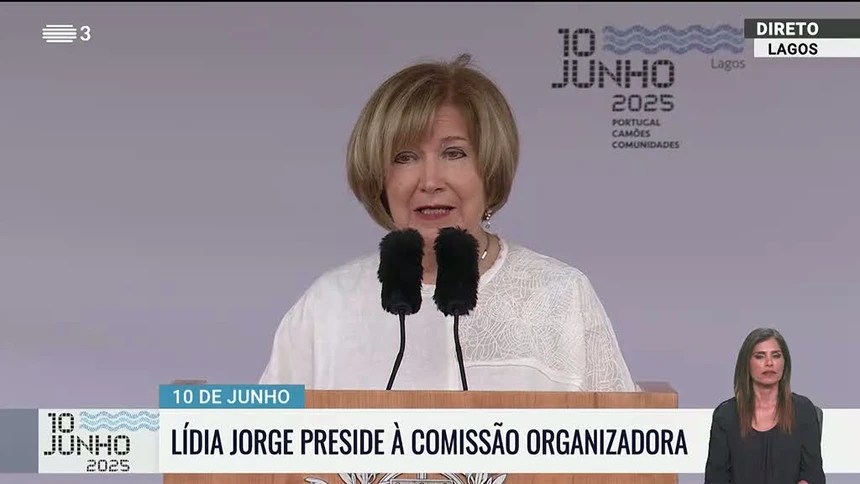
In her speech, the writer spoke of a “new era that is happening on a global scale” and warned against madmen in power and the fury of revisionists.
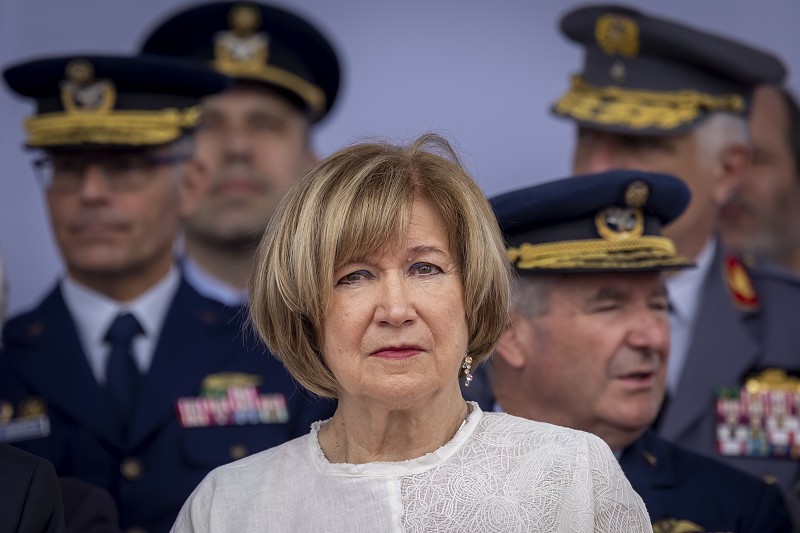
The writer Lídia Jorge, invited by the President of the Republic, Marcelo Rebelo de Sousa, to chair the organizing committee for the June 10 celebrations, focused her speech on the life and work of Camões.
“Camões was born and never died,” said the writer, recalling the phrase said about Beethoven, “one day Camões was born and never died,” and “the way he has been represented over the last 500 years proves it.”
According to the president of the Organizing Committee for June 10, 2025, “Camões, like us, experienced a time of transition and witnessed the end of a cycle.”
“The Lusiads express courageous truths directed at the powers that praise them,” said Lídia Jorge.
In her speech, the writer also spoke of a “new era that is happening on a global scale.”
“The insane power allied with technological triumphalism means that every day, every morning, when we go to meet the evening news, we feel how the round Earth is disputed by various competing necks, as if it were once again a trinket. And citizens are just an audience watching shows on pocket screens. For some reason, citizens today have regressed to the subtle designation of followers. And their idols are ghosts,“ he warned.
”It is against this and for this reason that it is worthwhile for Portugal and Portuguese communities to use the name of a poet as their patron,” he stressed.
For Lídia Jorge, “Lagos, the city of the infant’s dreams, of which Sagres is a metaphor, promotes awareness of what we are capable of doing to each other.”
“It is said that in the 17th century, 10% of the Portuguese population was of African origin. That population had not invaded us. The Portuguese had dragged them here. And we mixed. This means that no one here has pure blood. The fallacy of single ancestry has no basis in reality,“ she pointed out.
”Each of us is a sum. We have the blood of the native and the migrant, the European and the African, the white and the black and all other human colors. We are descendants of the slave and the master who enslaved him,” she warned.
But for Lídia Jorge, awareness of this anthropological adventure “may mitigate the revisionist fury that assails us from the extremes today, a little bit everywhere.”
“Now that we realize that we are at the end of a cycle, and that another is taking shape, and the existential unknown about the near future, still unknown, challenges us every morning when we wake up without knowing what the next day will be like, the question is this: When the institutional, scientific, ethical, and political foundations and the pillars of the relationship between man and machine are called into question, entering a new paradigm, what place will we occupy as human beings? What will it mean to be human?“ she asked.
Concluding her speech, the president of the June 10 Organizing Committee stated that ”we, the Portuguese, are not rich, we are poor and unjust, but even so we overthrew a very long dictatorship, ended the oppression we had imposed on various peoples, established new alliances with them, created a community of Portuguese-speaking countries, and were able to establish democracy and join a union of free and prosperous countries that desire peace.”
“That being the case, we certainly do not yet have the answers, but in the face of the unknowns that assail us, we know that we have the strength. I read Camões, who never died, and I am moved by his fate, because if I have anything in common with him, who was a genius and I am not, it is the certainty that I share his idea that a human being is a being of resistance and combat.
We just need to determine the right cause,” she concluded. Lídia Jorge, a novelist and short story writer, was born on June 18, 1946, in Boliqueime, a municipality in the Algarve.
The author of books such as “A Costa dos Murmúrios” and “O Vento Assobiando nas Gruas,” she has received several awards for her novel, “Misericórdia.” Marcelo Rebelo de Sousa appointed her State Councilor in 2021, at the beginning of his second and final term.
From Rádio Renascença
Translated to English as a community outreach program from the Portuguese Beyond Borders Institute (PBBI) and the Modern and Classical Languages and Literatures Department (MCLL) as part of Bruma Publication and ADMA (Azores-Diaspora Media Alliance) at California State University, Fresno, PBBI thanks Luso Financial for sponsoring NOVIDADES.

 Novidades - The Islands and the Diaspora