

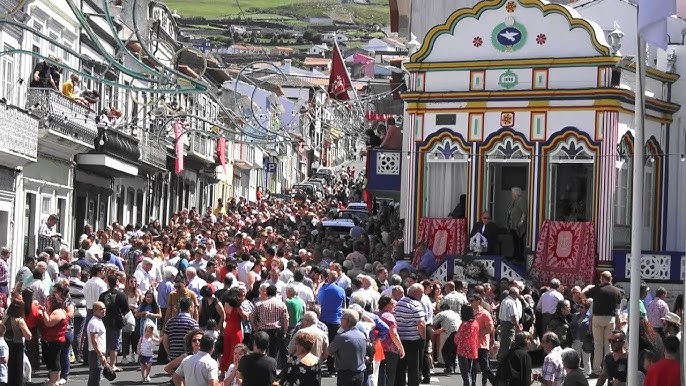
Since many festas are still being held in California throughout the next few weeks, Novidades (the islands and the diaspora) brings you this story from Igrehha Açores, a news service of the Angra diocese in the Azores, regarding the festas in various parts of the Azores.

Holy Spirit: the tradition that unites all Azoreans
From the first Sunday of Easter until Trinity Sunday, there is not an Azorean who does not celebrate the divine, whether in the Azores or elsewhere in the world. The week between Pentecost and Trinity Sunday is, par excellence, the most important in the archipelago. It is the week of the two weddings and Azores Day.
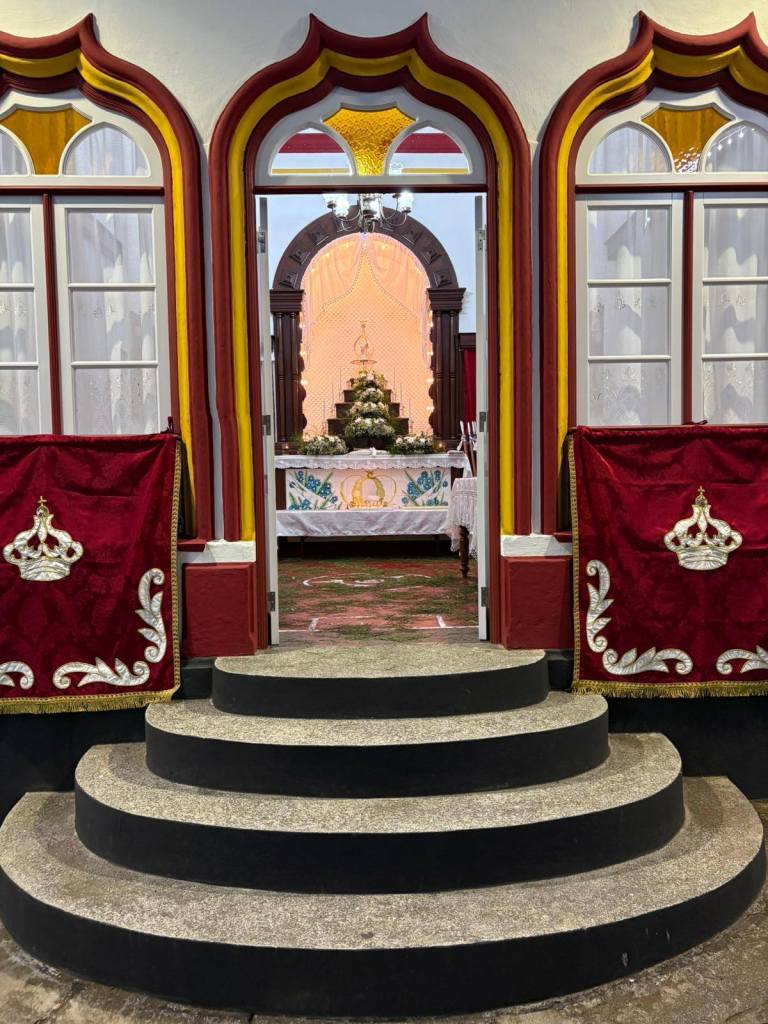
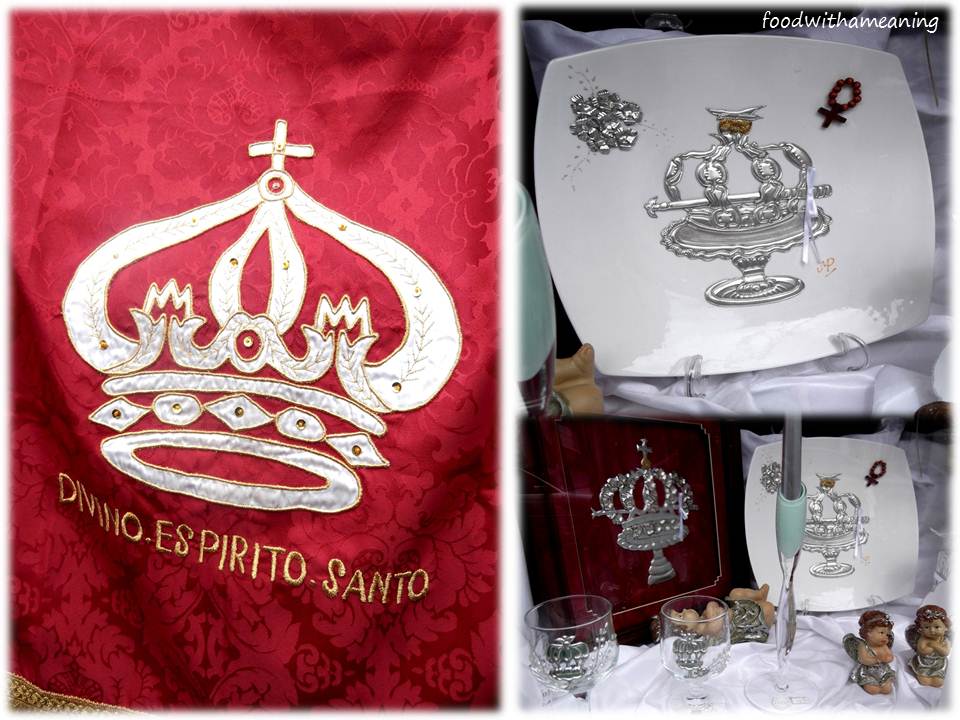
“A crown, a flag, and much devotion to the Holy Spirit, because nothing is denied to Him.” This phrase encapsulates what the cult and celebration of the Holy Spirit mean to all Azoreans, regardless of their geographical location, social status, or even faith. No parish celebrates it. This is particularly true this weekend, when all the islands, especially those in the central group, are decked out in festive attire to honor the Third Person of the Holy Trinity.
Between Pentecost weekend and Trinity weekend, more than a hundred empires and bodos are scattered across the nine islands, which will take to the streets with coronations, bodos, and ceremonies.
Everywhere you go, there is a festive atmosphere: the streets are decorated with lights and flags, the committees and their helpers prepare the tables for dinner, and at nightfall, people walk towards the empire.
No place in the Azores celebrates the Divino these days. The Holy Spirit festivities are part of the soul of the Azoreans.
In the Empire of Sharing or Love, as many refer to it, men and women are invited to live in a utopia of solidarity, realizing the dream of a free, fraternal, and happy society.
Azores Day
Azores Day, known as “Pombinha Monday,” will be celebrated in the municipality of Calheta, on São Jorge. The formal ceremony will take place at 10:30 a.m. and will be attended by the president of the Azores Legislative Assembly, Ana Luís; the president of the Azores Regional Government, Vasco Cordeiro; and the Representative of the Republic for the Azores, Pedro Catarino.
Among the 29 distinguished personalities and entities at the ceremony will be the Casa de Saúde de São Rafael, on Terceira Island, and the Casa de Saúde de São Miguel, both managed by the Brothers of St. John of God, as well as the Santa Casa da Misericórdia das Velas de São Jorge.
Holy Spirit Monday was chosen to celebrate Region Day, which this year falls on June 10, next Monday, a regional holiday.
The days of the Bodo
The Bodo, on Terceira Island, and the Impérios, on Pico Island, set the pace for Pentecost Sunday.
On Terceira Island, the festivities have a “very unique” energy and are experienced mainly in the Ramo Grande area, where the economy remains predominantly agricultural. The empires of Vila Nova and Lajes, for example, are well known for the number of people involved.
The ability to integrate into an agrarian culture explains why it remains so alive in the Azores: the value placed on the land that produces the wheat and corn used to make bread, wine, and meat, aspects in which the gifts of the Holy Spirit are embodied.
The main peculiarity of this cult in the archipelago is that it is popular and develops in the form of an empire, with a strong prophetic and political charge, without any pretension of imitating roles or removing powers.
Around the Empires, the festivities of the Holy Spirit take place over several days, imbued with a charitable ideal and consisting of a series of religious and secular ceremonies: the “coronation” of the Child Emperor, the parade of processions, and the feast of bread and meat.
During each week of the festivities, the insignia of the Divine are venerated in the Emperor’s house, and the rosary is prayed at night before the crown and the flag. On Friday, the oxen are decorated and the “procession of the calf” takes place. Afterwards, the animals needed for the bodo are sacrificed, which the Emperor will offer to the guests on Sunday. The meat is cut up for soup, stew, and the dinner roast, and for the pensions to be distributed to the poor of the parish. On Saturday, alms are distributed, consisting of meat, bread, and wine, blessed by the priest.

On Sunday morning, the first procession takes place, led by the flag of the Holy Spirit. In the “coronation” ceremony, inside the church, the priest takes the scepter, gives it to the crowned person to kiss and then hands it back to him, and then does the same with the crown, placing it on his head; he sprinkles the Emperor with holy water, incenses him, and the “Veni Creator Espiritus” is sung. After the coronation, the Crown and the Flag are carried in procession to the Empire, from where they leave at night for another house.
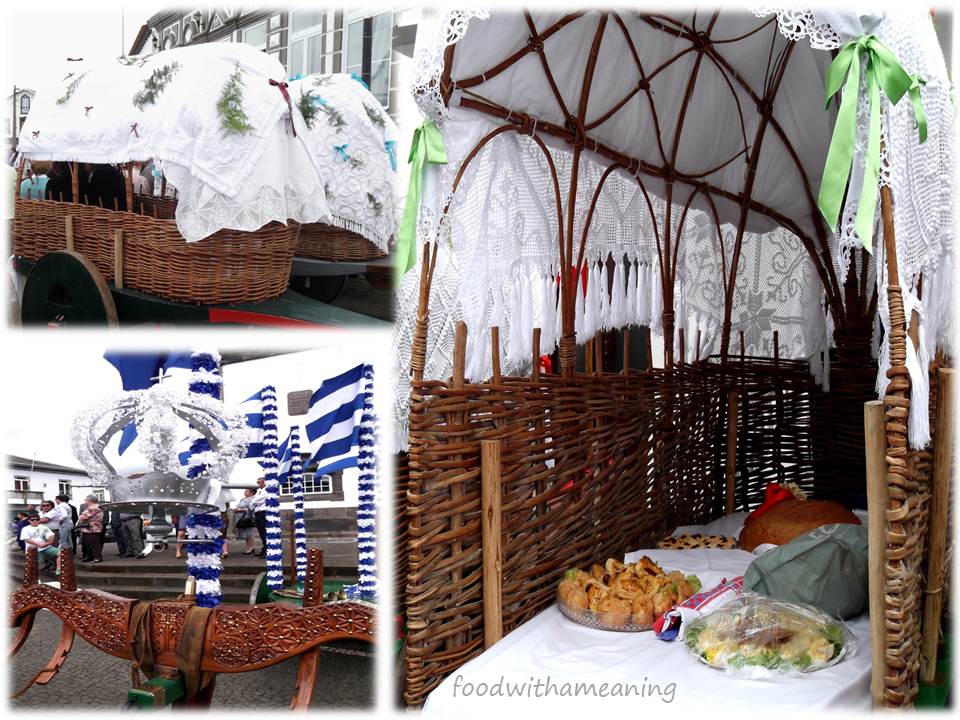
It is also on Sunday that the bodo or “function” takes place, to which everyone is invited, rich and poor, locals and outsiders. The menu for the “function” consists of Holy Spirit soup, beef, bread, stored in the Empires or pantries, by the “massa sovada” or “rosquilhas” (Pico), and wine. The brothers chosen to perform the Bodo are called Mordomos.
The Holy Spirit festivities begin on the Sunday immediately after Easter, with the high point on the islands above being Pentecost Sunday and Trinity Sunday.
On Terceira Island, the Empírios continue throughout the summer until the Império de São Carlos in September.
On Terceira Island, the cult of the Holy Spirit has been documented since 1492, when the Empire was already in place and the bodo was distributed on Pentecost at the door of a chapel belonging to the Holy Spirit Hospital.
The festival consisted of the Mass of the Holy Spirit, the “coronation,” and the bodo. If any brother of the brotherhood “took the empire” without having the means to develop it, he would be helped by the other members of the brotherhood.
When the Holy Houses of Mercy were established on Terceira Island, first in Angra in 1495 and then in Praia in 1498, they were set up in the Empires of the Holy Spirit, eventually becoming responsible for organizing the bodos on Pentecost, a fact that did not affect the creation of brotherhoods in all the parishes of these two municipalities.
The Holy Spirit festivities in the Azores have a common traditional structure but vary considerably between the various islands of the archipelago, and within the same island, between the multiple Parishes.
The cycle of festivities is, however, common. This Sunday and next Sunday are the bodos, and at the end of next Sunday’s bodo, the “fortunes” are drawn to find out which brothers will keep the domingas, seven in total, for the following year. Whoever draws the first “dominga” will keep the Holy Spirit at home for the whole year, meaning that the flag and crown will remain in that brother’s house, in a place of honor, for a year.
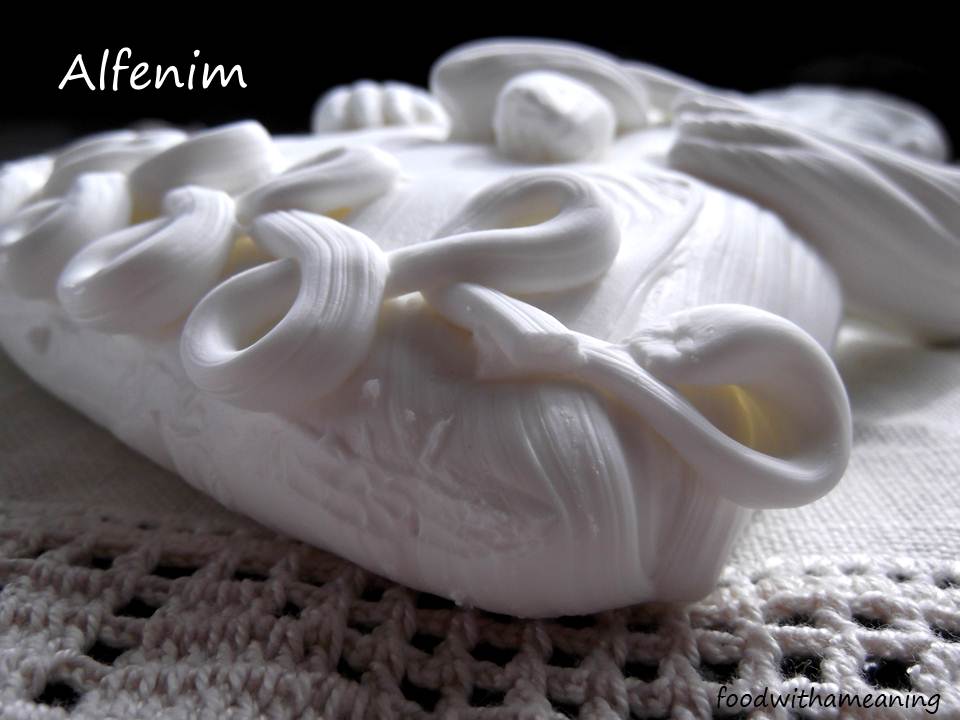
Alfenim
On Terceira Island, for these two weeks, hundreds of kilograms of sugar are transformed into dolls to be offered to the Empires of the Holy Spirit.
The alfenim delivered to the Empires of the Holy Spirit is then auctioned off, and the money goes towards the festivities, where, in addition to entertainment and religious ceremonies, bread, meat, and wine are distributed.
Alfenim (a word derived from the Arabic “al-fenid,” meaning “white”) is made solely from sugar, water, and vinegar; however, if it is overcooked, it transforms into a candy-like substance. Shaping it into realistic images requires a technique that is not within everyone’s reach. The mixture takes about 20 to 25 minutes to cook, and when it reaches the right consistency, it is poured into a buttered bowl, which is placed inside another bowl filled with cold water to cool the dough.
This is a traditional recipe from the islands of Terceira and Graciosa, typically made at this time of year but also available throughout the year in some pastry shops on the island of Terceira.
In the past, the techniques were kept secret, and myths were even invented because the sale of alfenim was a significant source of income for families. However, today there are only half a dozen artisans left on Terceira.
The most common image of alfenim is the white dove, which symbolizes the Holy Spirit. Still, the promises are often associated with health problems, so in times of distress, pieces of body parts such as feet, legs, hands, arms, breasts, throats, and heads are ordered. The most frequent requests are for full-length girls’ and boys’ items, which are suitable for various ailments and other types of “promessas”- promises to the Holy Spirit.
In the past, alfenim was only made for the Holy Spirit festivities or as gifts for weddings and baptisms. Still, today, now included in the list of certified regional products, it is also highly sought after by tourists.
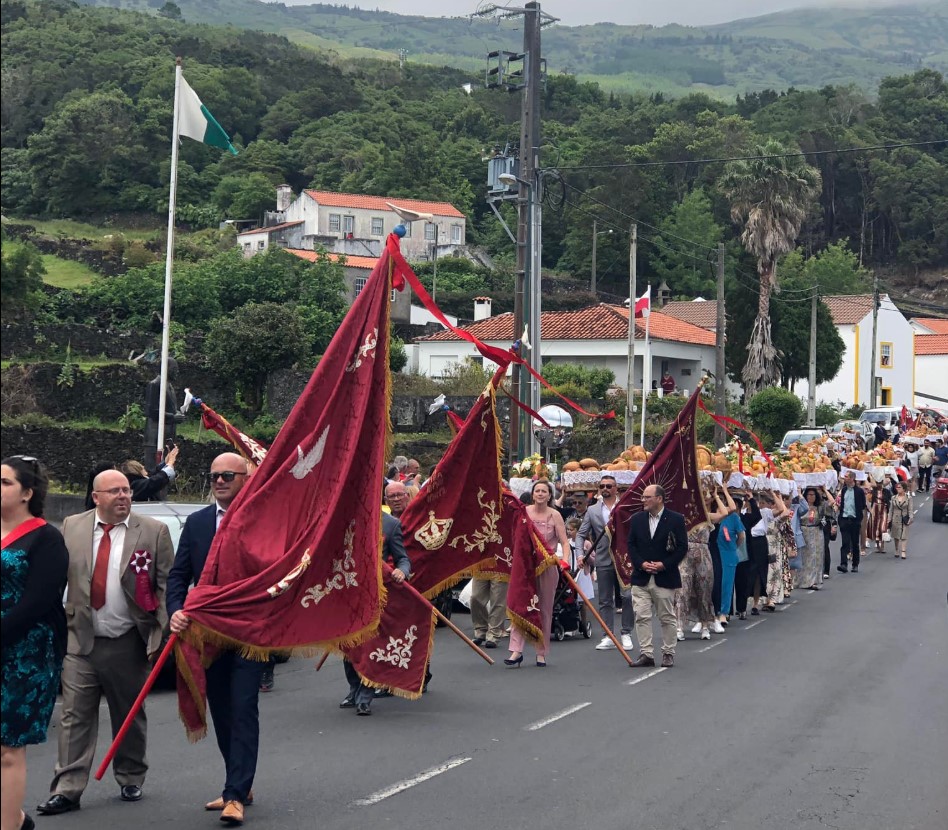
Pico Island: The uniqueness of the Silveira Festa
The Holy Spirit festival begins this Saturday on Pico with the traditional Silveira Empire, in the municipality of Lajes, one of the most characteristic of the mountain island, due to its “uniqueness” in preserving Saturday as the big day of the festival and the presence of revelers.
The vow that gave rise to this Empire dates back to 1720, on a Saturday, when, after a severe seismic crisis, the mystery of Silveira was created. Three years later, the Empire was erected, which today is one of the oldest on Pico Island in the chronology of the island’s settlement. Every year, this Empire organizes its festival, attracting many outsiders.
Another unique feature of this Empire is its soups, to which the entire population is invited to participate, singing and praising the Holy Spirit, according to the researcher, who emphasizes the “importance of the traditional songs of Silveira.” The procession leaves the steward’s house, accompanied by various insignia (banners and crowns), and is joined by revelers and the philharmonic band, heading for the parish church where Holy Mass and the coronation are celebrated.
This is followed by a lunch of Holy Spirit soups, where the brothers of the brotherhoods sit at the same table with their families and all those who are invited to the “function” or “crown expense,” as it is called in some parishes on the mountain island. Everyone is invited.
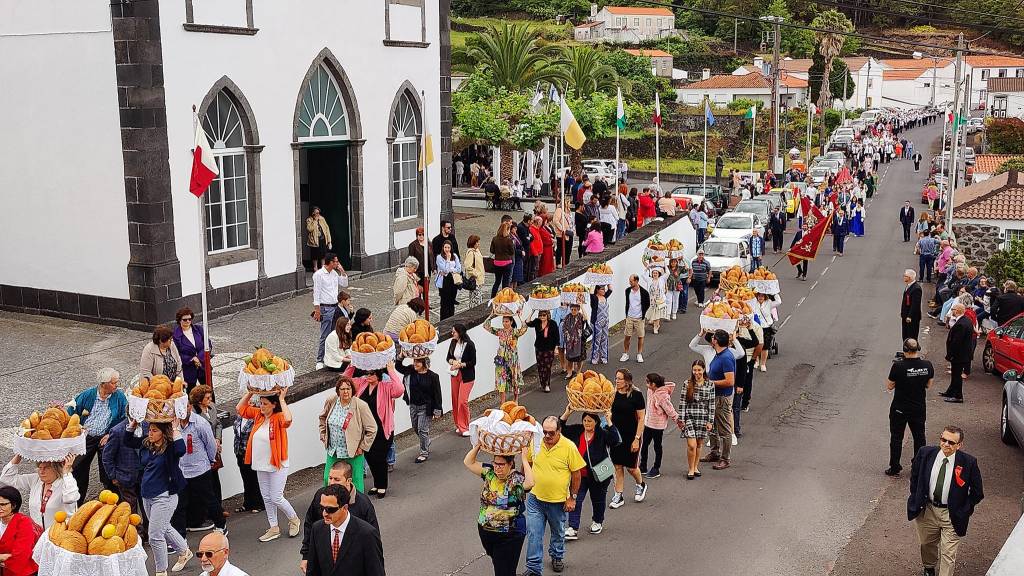
In the middle of the afternoon, a procession takes place to collect the rosquilhas or vésperas, which the women carry on their heads in baskets decorated with artistic tablecloths embroidered with island motifs and seasonal flowers. These delicacies are then distributed to everyone at the festival, which only ends with a fireworks display that signals that everyone has been given a rosquilha or a loaf of bread.
One of the unique features of this island, similar to Faial and São Jorge (the so-called triangle islands), are the rectangular banners rolled up on a pole with an embroidered “fleur-de-lis” at each corner, an explicit reference to the first settlers of these islands, the Flemish who came from Flanders.
In total, there are 45 Impérios in Pico, as many as there are brotherhoods on the island.
During this year’s festivities, more than 20,000 meals will be served, with the majority being offered on Pentecost weekend.
This enormous number of meals, considering the island’s population is less than 15,000, is equivalent to more than 10 tons of meat and over 20,000 loaves of bread, according to information obtained by the Azores Church website from the various empínios on the island.
The processions and festivities are enlivened by the island’s 13 philharmonic bands and groups of revelers.
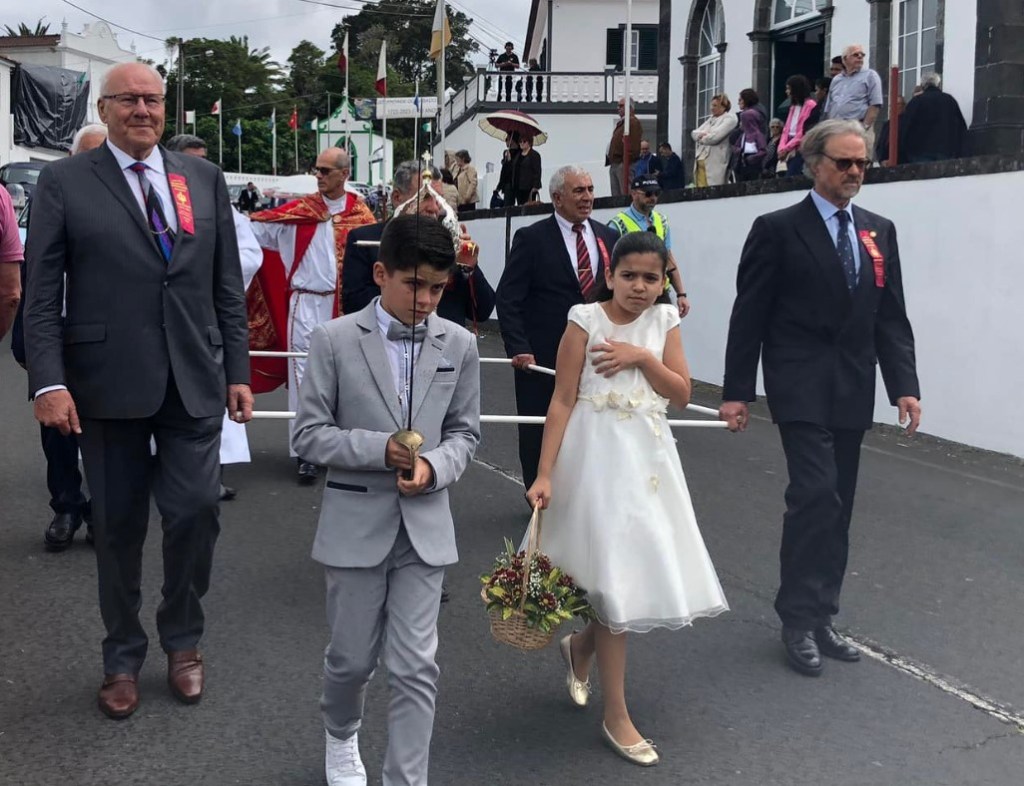
In addition to the traditional Holy Spirit sopas, these 45 celebrations will feature boiled and roasted meat, sweet bread, and rice pudding.
At each festival, rosquilhas, vésperas, or bread are distributed to all those who pass through the parish.
It should be noted that rosquilhas – “relics” – and bread are offered in the empires on the south side of the island (from Madalena to Calheta de Nesquim) and véspera cakes in the empires on the north side of the island (from Bandeiras to Calheta de Nesquim). The parish of Calheta de Nesquim is the only one that offers rosquilhas and vésperas cakes.
The largest empire on the island (and probably in the Azores) is that of Holy Spirit Tuesday in Vila da Madalena, where around 5,000 rosquilhas are distributed, many of them shared with outsiders who flock to the mountain island from Faial and São Jorge.
In addition to these 45 brotherhoods, which hold their celebrations on these days, six others hold their festivities at other times of the year, with coronations, soups, and the distribution of rosquilhas.
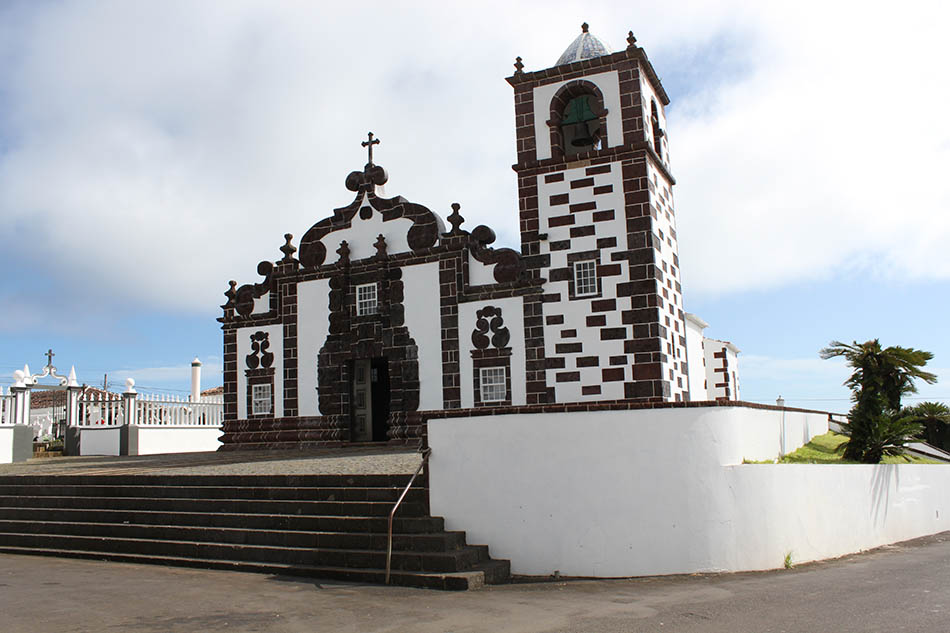
The Parish of Santo Espírito
In Santa Maria, these empires are typically small sheds behind churches, reserved for storing items related to the festival and for cooking the so-called “soups,” which are distributed free of charge to anyone who attends.
While it is usually the brotherhoods that organize the empires, selecting a steward for this purpose, in Santa Maria, it is common for the empires to be used as payments for promises made by volunteer stewards.
Thus, the festivals can follow one another and even be repeated in the same villages, with the volunteer steward paying for the “soups” – beef (preferably old), homemade wheat bread (hard), cabbage, onion, lard, mint, dill, salt – preferably accompanied by wine. Everyone eats, without exception.
The parish of Santo Espírito is one of the most characteristic and picturesque on the island.

 Novidades - The Islands and the Diaspora