


Devin Nunes, a member of the Trump administration with Portuguese roots in the Azores, argued on Monday in Lisbon that Portugal should have a “specific role” in NATO, which includes “warships.”
The current head of the US President’s Intelligence Advisory Board recalled having worked with the Portuguese government for “many, many years, trying to encourage them not only to increase their budget for NATO, but to do so in a specific way that reflected their geographical location.”
“All the reasons why Portugal was in a great position to explore the world 500 years ago are still in place today for it to have a specific role within NATO,” added the former congressman. Regarding warships, quoted by Agência LUSA, Devin Nunes said they should be deployed at the entrance to the Mediterranean Sea and along the African coast. Nunes was speaking at a conference on “The current geopolitical challenges for Europe and the United States,” promoted by the television channel Now. He expressed optimism about the future of NATO. “I think we are starting to see NATO countries investing more money and taking seriously what they are good at, what they are going to specialize in,” he said.
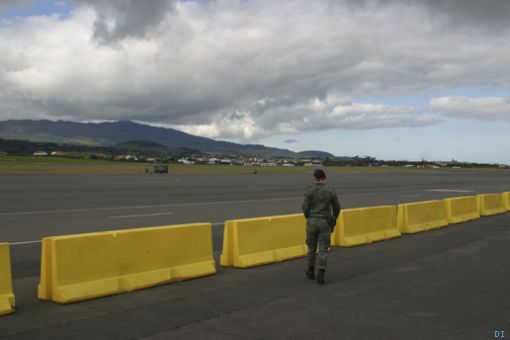
DI reported yesterday on statements by the former Chief of Staff of the Armed Forces, António Silva Ribeiro, who argues that increased Portuguese investment in defense should significantly involve the Azores, particularly the island of Terceira.
“The privileged area where, from an infrastructure point of view, we must make an effort is in the Azores. It is here that, in my strategic view, I think it is essential to put more resources,” he said.
In an interview with RTP/Açores, on the program “Conversas com Ciência” (Conversations with Science), hosted by journalist Armando Mendes, the admiral said that “without a doubt, the proximity between the Lajes Air Base and the port of Praia da Vitória makes this location an essential strategic base for controlling the Atlantic.”
Silva Ribeiro maintained that the Navy should “reinforce its presence in the port of Praia da Vitória with submarines and one or two frigates.”
At the Lajes Base, he emphasized that it is “essential to increase resources to have greater capacity for surveillance at sea,” which involves the presence of P-3 aircraft and long-range drones.
Another measure would be to reinforce the Army with a more “robust” presence.
“I see all this happening within 10 years. We have to do this planning. As defense budgets are increased, there will be more resources to put in place. Apart from long-range drones and radar, frigates, submarines, and P-3 aircraft already exist. They are on the mainland and can operate here, provided the Armed Forces have the resources to do so,” he continued.
The NATO summit, which takes place on the 24th and 25th of this month in The Hague, has as one of its central points the proposal to increase defense spending.
Member states may allocate 5% of their Gross Domestic Product (GDP) to defense, 3.5% to direct military spending, and 1.5% to security and infrastructure-related investments.
In Diário Insular-José Lourenço, director
Translated to English as a community outreach program from the Portuguese Beyond Borders Institute (PBBI) and the Modern and Classical Languages and Literatures Department (MCLL) as part of Bruma Publication and ADMA (Azores-Diaspora Media Alliance) at California State University, Fresno, PBBI thanks Luso Financial for sponsoring NOVIDADES.

 Novidades - The Islands and the Diaspora