

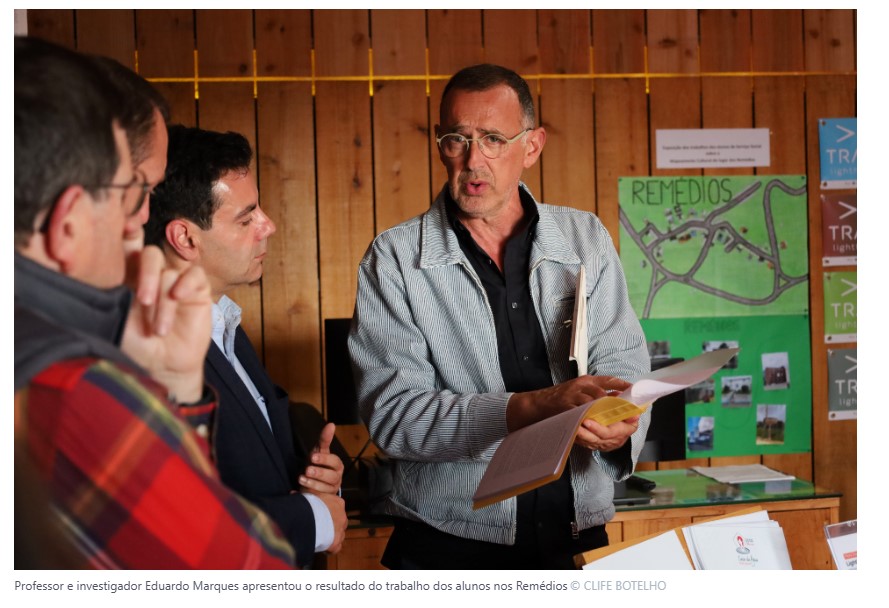
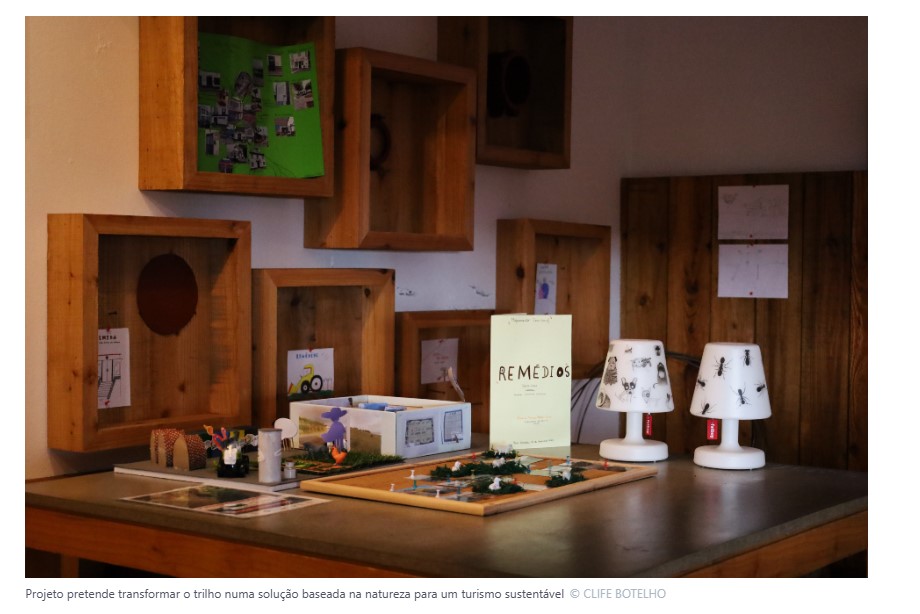
It is called “Trans-Lighthouses, Beyond Green: Lighthouses of nature-based transformative solutions for inclusive communities.” It is a European-wide research project led in the Azores by the University of the Azores in partnership with other local entities and with a single location under study: Remédios da Lagoa, more specifically, everything that includes and surrounds the Janela do Inferno trail, located in that part of Lagoa, which attracts hundreds of tourists every day during the high season. “The idea is that our trail, the Lagoa trail, is not just a trail, we want it to be a different, diverse, unique trail in the Azores region and that it can be a solution to other complex social problems,” Eduardo Marques, professor and social work specialist at the University of the Azores (UAc), began by explaining to Diário da Lagoa (DL). The conversation with DL took place in Remédios at the first participatory assembly of the project on May 17, the day an exhibition was also inaugurated featuring testimonials, photographs, drawings, and graphics created by UAc social work students. Thirty-five students walked around Remédios talking to residents, using a methodology known as a “walkthrough.”
“The idea is to have several beacons to illuminate governance and new public policies in Europe, to have lights that show us the way, that enlighten us so that we can develop another economy and other policies based on participation, on collaborative governance between the various parties that we find in a territory, namely public organizations. It could be the government, local authorities, companies, the university, and then the entire social sector,” explains Eduardo Marques.
José Raul Medeiros, one of the best-known residents of Remédios, if not the best known, enjoyed seeing himself in the drawing that the Social Work students made of him and his wife, which is on display at Casa da Água in Remédios. “I liked it, but even if I wasn’t there, I would still be just as happy with what is happening,” he tells DL. However, José Raul Medeiros admits that many residents of Remédios have never walked the Janela do Inferno trail and are therefore unfamiliar with it. Eduardo Marques shares the same idea. “Most, or a large number of people, have their backs turned to the trail, have never been there, despite living here in the vicinity,” says the teacher. Even so, he is sought after by hundreds of people, and this has an impact on the surrounding area.
Combating unemployment using nature
Eduardo Marques explains the main objectives of this pioneering project in the Azores. “The idea is to understand how an asset, an important resource, the ‘Water Route – Janela do Inferno’, can leverage a process of a more positive relationship with the trail so that the community can also benefit from this relationship with the trail,” he explains. He adds that the aim is to “transform the trail into a nature-based solution for sustainable tourism. We can draw inspiration from nature and how it works to solve complex social problems.” He gives examples: “How can we solve unemployment problems? How can we draw inspiration base ourselves on nature to solve problems of employment versus unemployment, how can we improve health—we have solutions that have been implemented in Japan since the 1960s, which are nature therapy parks that reduce stress and blood pressure—so we can use nature to heal ourselves, to be integrated into health systems, we can integrate nature as a dimension of art and culture.”
For the mayor of Lagoa, Frederico Sousa, “it is up to us, the people of Remédios, the parish council, and the municipal council, to take advantage of this assessment,” that is, of the entire “Trans-Lighthouses” project. The project, which comprises several phases, has received contributions from the Remédios community and aims to enhance the lives of those residing there, always in line with harmonious development that respects the surrounding environment.

The Lagoa local authority, the Santa Cruz parish council, CEFAL (Lagoa Center for Environmental Education and Training), and OVGA (Azores Volcanological and Geothermal Observatory) are some of the local partners in this European project. For the president of the Santa Cruz parish council, Sérgio Costa, “everything that is recorded and archived is very important, not only for now but also for those who come after us,” and he is available to do “whatever is necessary.”
“We believe that only through collaboration and inter-institutional cooperation can we develop the territories in a sustainable and more harmonious way, always with the involvement of the local population,” says Eduardo Marques, who is responsible for the project.
At the first participatory assembly held in Remédios, the population was invited to share business ideas, suggestions, and proposals for the redevelopment of spaces, as well as to discover the trail on a joint walk scheduled to take place in August.
Remédios will be “perhaps the first community to have a locally-based participatory budget,” says Eduardo Marques, which will be between €5,000 and €10,000.
In Diário da Lagoa, Sara Sousa Oliveira, executive director, and Clife Botelho, director.
Translated to English as a community outreach program from the Portuguese Beyond Borders Institute (PBBI) and the Modern and Classical Languages and Literatures Department (MCLL) as part of Bruma Publication and ADMA (Azores-Diaspora Media Alliance) at California State University, Fresno, PBBI thanks Luso Financial for sponsoring NOVIDADES.

 Novidades - The Islands and the Diaspora