

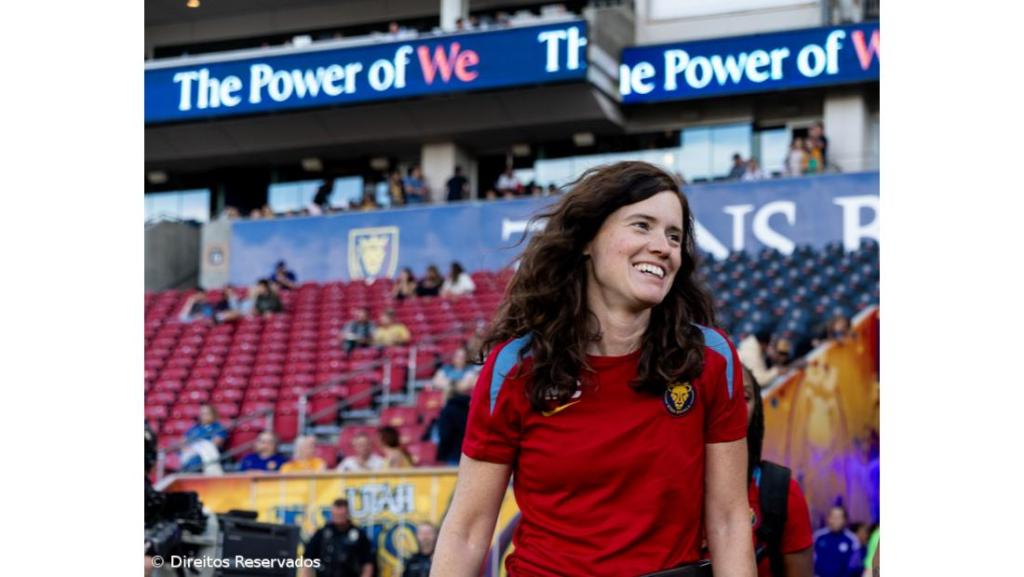
Mariana Cabral, with a degree in journalism, had always been passionate about soccer until she decided that coaching would be her path. Following a successful career in soccer in Portugal, Mariana this year took on a new challenge that led her to the US and the Utah Royals, an experience she describes as “exceptional, much better than I could have imagined.”
Mariana Cabral had a very happy and enriching childhood. Her family always encouraged her to “do whatever she wanted, both in sports and in other areas.
I have very happy memories of my school life at Colégio São Francisco Xavier, Escola Roberto Ivens, and Liceu Antero de Quental, where I had exceptional teachers,“ she tells us, emphasizing that ”education, both at home and at school, opens the doors to the world.”
She doesn’t know exactly when her love of sports began, “but I know there are several photos of me from an early age with a soccer ball, probably encouraged by my father, who often went to play with his friends at Vitória Clube do Pico da Pedra, and I always followed him with my ball to kick around.”
Mariana Cabral chose to study journalism in Lisbon.
She tells us that “I wanted to know more than I knew and learn to be independent outside the family context of an island that ends up being small when you are young and have lots of ideas for your life.” Her choice of journalism was because “I always grew up very connected to words: obviously my father was a journalist and I always saw him preparing his programs at home,” but her mother was also a big influence “because she was an English teacher and encouraged me to read a lot from a very young age, as did my aunt Paulinha, with whom I loved going to book fairs in Ponta Delgada,“ adding that ”during the holidays I also saw my aunt Beatriz reading religiously every night, usually detective novels, and I’ve had that bug ever since.”
She humorously recounts her father’s reaction when she told him she wanted to study journalism: “My father immediately told me to change my mind, saying it was not only an extremely difficult profession, but also poorly paid.” She also laughs as she tells us that “today I have a profession that is also tough, but at least it pays much better.” “Obviously, when I stopped being a journalist and became a full-time coach—because I was already doing it part-time — my parents were reticent, because I already had a steady job at the Expresso newspaper, where I had been working for a decade, but fortunately my family has always supported me in everything and I am very grateful for that comfort,“ emphasizing that ”we only have one life to live and we should enjoy what we do.”
In the field of journalism, Mariana Cabral did an internship at the newspaper A Bola. But “I ended up realizing that it wasn’t really the kind of news I liked to write. I realized that I liked having time to write more off-the-wall stories or to do interviews, something I was able to do at Expresso.” So, when she finished college, “I had an internship at Expresso magazine and when the internship ended, I ended up being hired, initially for the multimedia section, but later in sports, which was my preference.”
When asked about the reasons that led her to leave journalism and pursue a career in soccer, Mariana Cabral begins by saying that “I really enjoyed all my years as a journalist, during which I interviewed some of the biggest names in men’s and women’s soccer (for example, Ruben Amorim, José Mourinho, Sarina Wiegman, etc.) and had the opportunity to cover major tournaments, such as Euro 2016, which Portugal won.” She recalls that she spent over a month in France and “it was an unforgettable experience, for which I ended up receiving an award from the Association of Sports Journalists,” which made her feel very honored, “not so much for the award itself but because I received it alongside two great Azoreans: my father and Pauleta,” she said with good humor. But, “football has always been my great passion, and in this case I stayed in football, but just in different roles. It was something that happened naturally because I’ve always had a keen interest in training and the tactical side of the game, and that’s what led me to become a coach.” Her biggest influence in football was Helena Costa, who “is currently the sporting director of Estoril Praia’s men’s football team.
(…) She encouraged me to take the coaching course and has always been a mentor to me, and continues to be so today, as well as a great friend.“ Being a soccer coach is not easy because ”it is still not a very common profession for a woman in Portugal, so there were always a lot of sexist comments and behavior, even if sometimes unintentional.
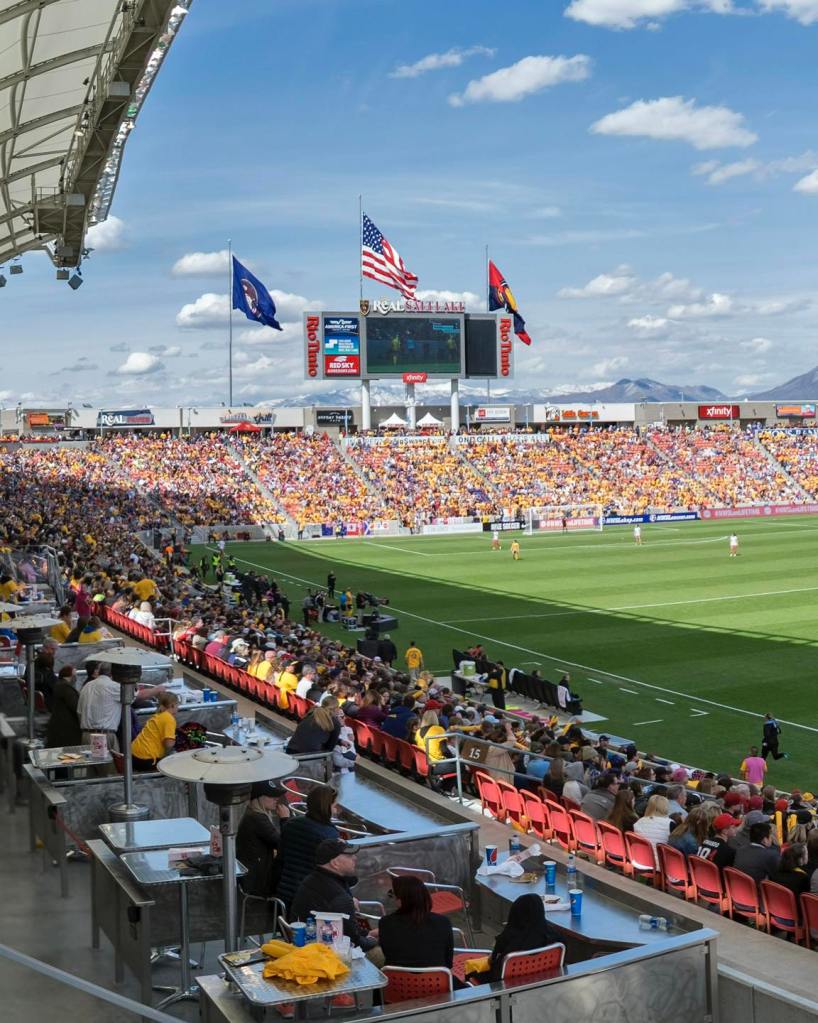
(…) It’s a job that requires high performance because we always need to be ready to deal with multidisciplinary issues; we’re a kind of people manager (…)“, she says. And of course, stepping onto the pitch ”is the best place in the world, so I always go out there with a smile, even if I sometimes come off with a frown (laughs). And I always go in with the awareness that for me to be a professional soccer coach, there were many people before me who had to fight hard for women’s soccer to grow and be respected, so it’s part of me to honor those people and continue that fight.”
As a coach, Mariana Cabral started in the girls’ training schools of 1º Dezembro, in Sintra. She was at the boys’ training schools of Benfica. She worked with the Estoril Praia women’s under-17 team “until I joined Sporting as coach of the under-19 team and technical coordinator for all training.” At Sporting, “I ended up moving up to the B team, which was the national champion of the senior second division with only under-21 players, and that’s when I was invited to join the A team.”
She emphasizes that the best moments are “seeing our team play well, because that’s what gives me the most pleasure in soccer, as well as seeing the players happy, particularly the young ones I’ve followed through the training process and who then go on to become professionals, play for national teams, and join big European clubs.” (…) The worst moment was losing in the Champions League qualifiers last season against Real Madrid, because “I felt we could have gone further if the conditions had been different at the time” (…).

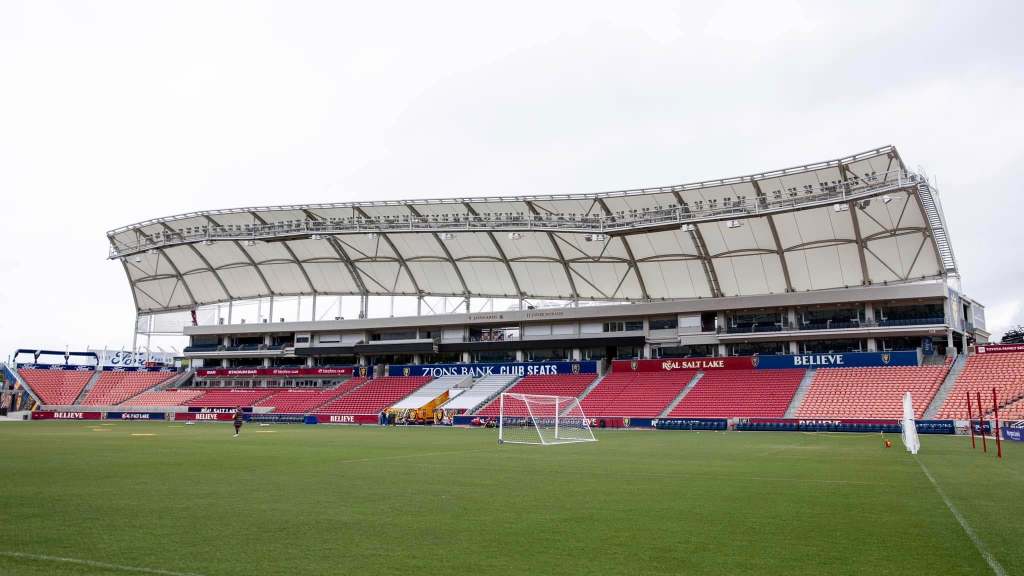
She is currently in the US as assistant coach at Utah Royals, an “exceptional” experience, “much better than I could have imagined, not only in sporting terms but particularly in social terms, because the cultural experience is totally different,” she said, recalling that “when I left Sporting, I felt I was losing my passion for what I was doing, because I didn’t share the club’s goals and values for women’s soccer, and I just wanted to enjoy the game again.“ She had offers from several clubs in very different countries, but ultimately chose the US. She admits she had some reservations ”after the election of the new American president, but I ended up accepting the invitation anyway, because I felt that the club really wanted me to come (…)”.
She misses her parents and “all my family, of course, particularly my grandmother, who now has to learn how to use WhatsApp, which isn’t easy, but she’s getting there,” she said with a laugh, emphasizing that “when I miss them, I always remember her, who is an incredible woman. When she was young, the only thing she wanted was to study, but her mother wouldn’t let her. (…) I know that today I do many of the things she would have liked to do and couldn’t (…)”.
On her journey, which has not always been easy, with joys and some disappointments, Mariana Cabral is a woman who is “fulfilled today, because much of what I have done I probably couldn’t have imagined a year, two or three years ago, let alone 10 years ago, but I feel that there is still a lot to achieve,” such as “returning to São Miguel and enjoying life in the countryside. And, who knows, maybe I’ll be able to open a soccer school on the island, because going back to coaching youth is a goal I have, because there we’re not just focused on performance, but on training human beings for the future.”
Susete Rodrigues is a journalist for Açoriano Oriental, and Paula Gouveia is the director

Translated to English as a community outreach program from the Portuguese Beyond Borders Institute (PBBI) and the Modern and Classical Languages and Literatures Department (MCLL) as part of Bruma Publication and ADMA (Azores-Diaspora Media Alliance) at California State University, Fresno, PBBI thanks Luso Financial for sponsoring NOVIDADES.
 Novidades - The Islands and the Diaspora