

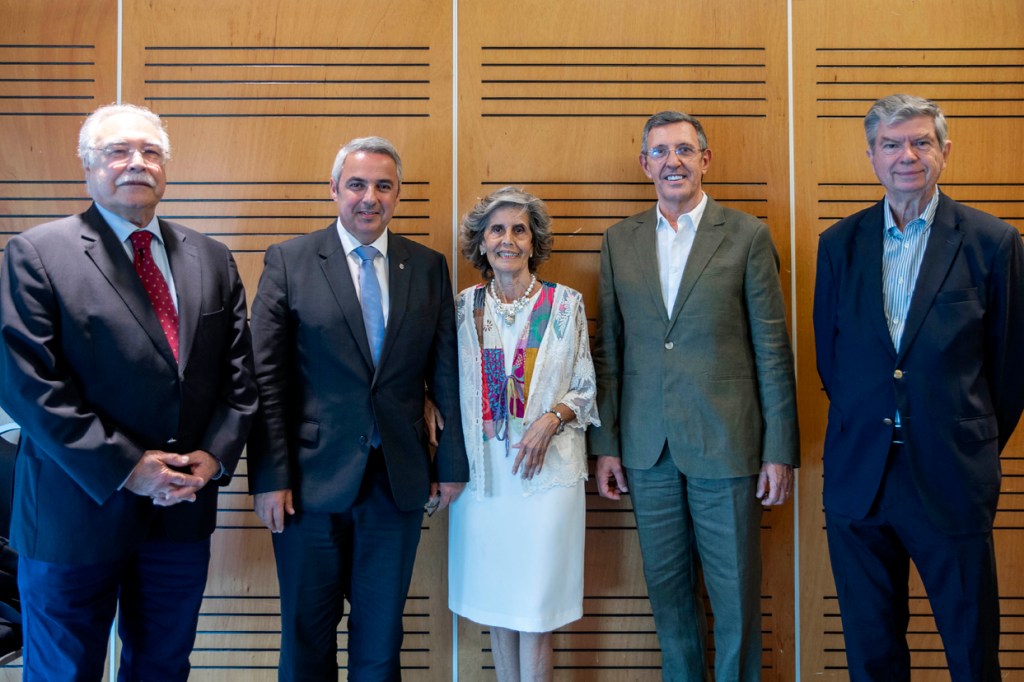
The Mayor of Ponta Delgada, Pedro Nascimento Cabral, stated this week during the “Pensar Ponta Delgada” debate that “open dialogue and plural participation are essential to carry out the will of the citizens.”
“Firstly, I would like to praise this commendable initiative promoted by the São Miguel Seniors Association, led by Dr. Leonor Anahory, which has established itself as a dynamic agent in promoting critical thinking and dialogue. This is a clear example of how civil society can contribute, in a serious and committed manner, to the discussion of central issues involving our municipality,” stressed the mayor.
At the round table, moderated by former journalist Teresa Nóbrega, Pedro Nascimento Cabral stated that “every strategically thought-out reflection or suggestion on the development of the municipality is always an asset that we must preserve,” reiterating his “permanent willingness to welcome ideas, listen to opinions, and integrate contributions” into the daily management of the municipality.
Invited to share his views on the current implementation of the Recovery and Resilience Plan (PRR) and the future of housing, the mayor assured that the Municipality of Ponta Delgada “is doing its part.”
“We are already building 70 new homes. That’s €12 million invested to solve a serious problem that has long been identified but has always been neglected. We must not forget that there has been serious underinvestment in housing in the Azores. Between 2009 and 2020, the governments led by the Socialist Party only built 39 homes in São Miguel, which is highly reprehensible for an island that is home to 60% of the Azorean population,” he stressed.
When asked about the relationship between the role of video surveillance, drug use, and homelessness, Pedro Nascimento Cabral clarified that: “Video surveillance cameras are intended to effectively combat the feeling of insecurity that exists among our population, vandalism, and petty crime associated with the consumption of these damn drugs, not to defeat the homeless population, which, as we know, needs humane and fraternal intervention. These are obviously different dimensions and objectives that are at stake here.” “The problem of homelessness requires a different kind of response—one that is more profound, integrated, and truly humane. It is a very complex reality that requires a structured approach based on restoring personal dignity, access to healthcare, and the creation of mechanisms for social reintegration. It is precisely in this sense that we have been developing a network with various entities,” he added.
In addition to the annual support of €650,000 given to private social solidarity institutions in the municipality, Pedro Nascimento Cabral recalled that “Housing First has already taken five people off the streets. We are also preparing a protocol with the São João de Deus Institute and another with Cáritas, which will directly support 15 more people.”
“In this regard, we will also grant three plots of land to the Azores Government for the creation of overnight accommodation, hygiene, and food facilities for the homeless population. These are concrete measures that aim to have a real and lasting impact on people’s lives,” he said.
As for mobility, the mayor stated that the City Council is collaborating with renowned consultants to develop an action plan that addresses the new traffic and parking challenges facing our city.
“We have already completed the specifications that will allow us to move forward with the public tender for the second phase of the underground extension of Avenida Infante Dom Henrique, which will create more than 300 parking spaces, as we have already finished our proposal to redefine the Mini Bus lines, with the aim of expanding the network, facilitating travel, and encouraging the use of public transport, for submission to public tender in 2026, which is currently being analyzed by the parish councils of the municipality,” he added.
The round table also included the President of the Ponta Delgada Chamber of Commerce and Industry, Gualter Couto, the President of the Association of Civil Construction and Public Works Industrialists of the Azores, Alexandra Bragança, psychiatrist João Mendes Coelho, and architect Jorge Kol de Carvalho.
In Correio dos Açores-Natalino Viveiros, director.
Translated to English as a community outreach program from the Portuguese Beyond Borders Institute (PBBI) and the Modern and Classical Languages and Literatures Department (MCLL) as part of Bruma Publication and ADMA (Azores-Diaspora Media Alliance) at California State University, Fresno, PBBI thanks Luso Financial for sponsoring NOVIDADES.

 Novidades - The Islands and the Diaspora