

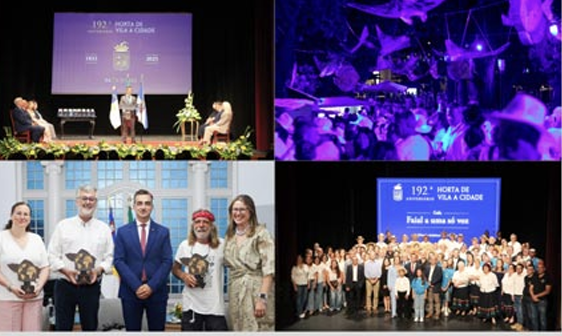
The celebration of the 192nd anniversary of Horta’s elevation to city status took place in the late afternoon of Friday, July 4, at the Faialense Theater, with the usual solemn session that included a tribute to City Council employees, personalities, and institutions that have distinguished themselves for their contribution to the municipality and the community. In an election year, the ceremony was marked by speeches focusing not only on the work done but also on demands that remain unanswered by the Regional Government. In addition to the Mayor of Horta (CMH), Carlos Ferreira, the President of the Municipal Assembly (AM), Teresa Ribeiro, and the President of the Legislative Assembly of the Autonomous Region of the Azores (ALRAA), Luís Garcia, also spoke, echoing the same ideas and demands as the mayor of Faial. In his speech, the mayor praised Horta’s historical journey and its projection in the national and Atlantic context. “An island with history, marked by names of national importance,” he said, referring to António José de Ávila, “the great architect of Horta’s elevation to city status on July 4, 1833,” and Manuel de Arriaga, the first elected President of the Portuguese Republic.

Recalling the words of Pedro da Silveira, Carlos Ferreira reaffirmed that Horta is, in fact, “the largest small city in the world,” with a central role in the history and present of the North Atlantic. From the port of refuge for the caravels of the Age of Discovery in the 15th century to its current status as the capital of international yachting, the city has been a stopping point for North American whaling ships, the headquarters of submarine cable companies, a base for Dutch tugboats, and a stopover for PAN AM clippers. He highlighted the fact that Horta is home to the headquarters of ARLAA, and on the scientific level, he emphasized its role as the “core of the Sea Cluster,” with the University of the Azores, the Department of Oceanography and Fisheries (DOP), and the Okeanos Research Institute, all internationally recognized institutions, noting that this axis will be further strengthened with the MARTEC Technopole and the new Oceanographic Research Vessel. Carlos Ferreira pointed out that Faial’s connection with the sea is also reinforced by the presence of the Azores Sea School and the Horta Naval Club, “whose history and size deserve full recognition.” He also considered that this “sea cluster” is not limited to the institutional dimension. He listed some local protagonists who take Faial to the four corners of the world, namely Peter Café Sport, the Genuíno Restaurant-Museum, and the work of diver Norberto Serpa.
Speaking of the present, he praised the performance of Faial athletes, the impact of the Azores Trail Run, and the community’s participation in Sea Week. In culture, he highlighted the role of philharmonic bands, folk groups, chamarritas, choral groups, and associations, which keep the local identity alive. In the last year of his term, Carlos Ferreira presented a set of investments that, in his view, are fundamental for the development of Faial and which, not long ago, seemed “unattainable.” The MARTEC Technopole, the new Oceanographic Research Vessel, the construction of the Horta City Bypass, the renovation of Block A of the Horta Hospital, along with the acquisition of the first Magnetic Resonance Imaging equipment, and the continuation of the second phase of the Feteira Intergenerational Building, the new Temporary Reception Center of Santa Casa da Misericórdia da Horta are some of the investments currently underway on the island of Faial that contribute to its development. While acknowledging that “much is being done,” he did not spare criticism of the lack of response in key areas such as accessibility. Carlos Ferreira pointed to shortcomings in air transport, arguing that Azores Airlines should strengthen the Lisbon-Horta route and also called for improvements in maritime transport, asking for greater capacity, regularity, and reliability.

He also pointed out the need for investment in the São Lourenço Park, the Port of Horta’s works, the road network, and housing. In what was the last formal session of the current term, he made a point of presenting the work carried out by the municipality, anchored in a humanistic vision of municipal public policies, with priority given to people, education, housing, and social cohesion. With regard to municipal works, the mayor noted the central section of the seafront, the Porto Pim pedestrian promenade, several roads and arteries rehabilitated in the parishes, and investment in the water network. He also reaffirmed the strategy focused on the blue economy, with the new degree in Ocean Sciences, the University Residence under construction, and the future Blue Grant. “There is, in fact, a concerted strategy that places Faial at the heart of the Azores Sea Cluster,” he concluded.
Along the same lines, the President of the AM (Municipal Assembly), Teresa Ribeiro, reinforced the importance of the work in progress and the demands of the people of Faial, shared by all local authorities. Recalling the long history of Horta’s elevation to city status, achieved and promoted by António José de Ávila in 1833, she stressed that, almost two centuries later, “the spirit of affirmation of Horta remains alive.” She also noted that Faial is going through “a phase of profound transformation,” with interventions such as the redevelopment of the waterfront, the MARTEC Technopole, the construction of the University Residence, and ongoing housing projects, which she considered essential to guarantee the right to housing and create conditions for the population to settle. He reaffirmed the urgency of moving forward with the expansion of the airport runway and the restoration of the Port of Horta. This infrastructure remains central to the island’s mobility, economy, and maritime identity. “These are not vain demands,” but “legitimate needs of those who want to live with dignity in their land.”
For his part, the President of ALRAA, Luís Garcia, reinforced the importance of this date as a moment of celebration, but also of renewed commitment to the development of Faial. Saluting the local authorities and the citizens of Faial, he maintained that “the greatness of a city is not measured only by how long it has existed, but above all by what it has done and does with that time,” adding that Horta has proven its ability to “reinvent itself.” Garcia pointed to quality of life as an essential goal for the future of the island. “The tranquility of our daily lives, the beauty of the landscapes that surround us, the closeness of the people, the strength of our identity, and the deep connection to nature and the sea are qualities that make Faial a good place to live, not only for those who were born here but also for those who visit us or choose to settle here.” In this context, he praised the work that has been done by the University of the Azores and local entities linked to the sea and science, recalling the international impact of the research carried out in Faial. Like Carlos Ferreira and Teresa Ribeiro, Luís Garcia pointed out the strategic importance of extending the airport runway, building the University Residence, and investing in knowledge and the blue economy as pillars of development.
By Susana Garcia, director of the newspaper Tribuna das Ilhas-Horta, Azores.
Translated to English as a community outreach program from the Portuguese Beyond Borders Institute (PBBI) and the Modern and Classical Languages and Literatures Department (MCLL) as part of Bruma Publication and ADMA (Azores-Diaspora Media Alliance) at California State University, Fresno, PBBI thanks Luso Financial for sponsoring NOVIDADES.

 Novidades - The Islands and the Diaspora