

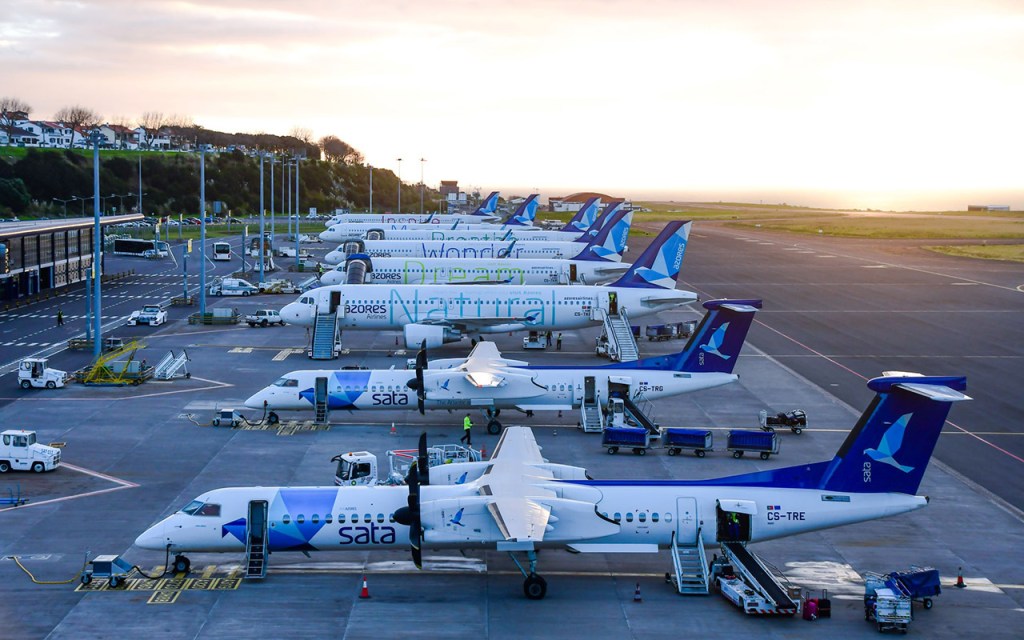
If the seven-day strike at SATA Air Açores does occur, as scheduled, the company will operate more than half of its scheduled flights. Despite the union’s opposition, the Arbitration Court has ruled that a minimum of 194 flights must be operated.
The National Union of Civil Aviation Flight Personnel (SNPVAC) has called a strike at SATA Air Açores from July 18 to 24, demanding higher wages and improved working conditions on board aircraft.
Speaking to Antena 1/Açores, the union’s president, Ricardo Penarróias, stated that he would hold meetings yesterday in São Miguel, including with SATA’s management, as a last-ditch effort to avert the strike.
“No one wants a strike and no one is happy about it. It is something that has to be done to demonstrate our demands. Often, this is the only way companies understand our demands,” he said.
Ricardo Penarróias admitted that there had been a ‘rapprochement’ between the union and the company’s management. “We are 1% apart,” he explained.
Antena 1/Açores reported yesterday evening that the union had considered the meeting with SATA to be positive. However, the decision on whether or not the strike will go ahead will only be known today, after the workers have voted.
Minimum services
In a press release, SATA revealed the flights covered by minimum services. In total, there are 194 flights over seven days: 32 on Friday, 24 on Saturday, 26 on Sunday, 32 on Monday, 26 on Tuesday, 28 on Wednesday, and 26 on Thursday.
“The Arbitration Court has determined that flights must be operated for critical reasons of safety of persons and property, as well as a sufficient number of air connections to allow at least one daily connection to each island, in addition to a set of additional flights to ensure mobility in the Azores archipelago,” the company said.
According to SATA, the decision of the Arbitration Court of the Economic and Social Council of the Azores was influenced not only by the fact that the company “is the only means of transport between some islands of the archipelago,” but also by “the period of immobilization resulting from the strike, which lasts for seven consecutive days and involves a labor component that is essential for the operation of flights.”
Another factor was that the region “is in the middle of the high tourist season” and that there are reservations “for around 4,500 passengers per day, with a potential daily mobility of 5,000 passengers per day,” which could reach 35,000 passengers during the seven days of the strike.
The company also highlights “the public and well-known economic and financial crisis of the employer and the repercussions that such a specific period of seven consecutive days of strike would have.”
The decision was also influenced by “the confirmation that the Q200 aircraft causing discomfort due to the lack of air conditioning is duly certified and operational and has always had this limitation.”
The company stated in a press release that it would continue “to make every effort to minimize the impact of the strike on its customers and partners.”
It added that changes to trips outside the strike period are allowed “without penalties or fare differences” and that voluntary cancellations will be eligible for a refund, regardless of the type of fare and without any penalty.
The SNPVAC president stated that the union would challenge the decreed minimum services in court.
“There are too many flights. It distorts the very concept of minimum service. The Arbitration Court ended up agreeing with the company’s demands, the economic demands, the hotel lobbies,” he criticized.
Treat SATA with respect
The National Union of Civil Aviation Workers (SINTAC) called on politicians to “start treating SATA and its workers with the respect they deserve,” criticizing the paradox of those who think of SATA as “omnipresent and omnipotent” but complain “constantly about its existence.”
“If a SATA flight is canceled, it’s a serious problem; if there is fog and operations are halted for a day, the region comes to a standstill, but in most speeches, politicians argue that SATA can close,” he explained.
“If workers go on strike for better wages and working conditions, there is a heated debate about SATA not being able to stop, as it is an irreplaceable pillar of the region’s economy, and minimum services above what is reasonable to ask for are demanded, but then many politicians continue to argue that SATA can close,” he added.
The union claims that SATA “needs competent politicians who appoint competent managers and stop using SATA for their own political and personal goals.”
“We are living in times when records are being broken in terms of occupancy, tourism, and mobility, and this is being used as a political banner, but then insulting statements are made placing the blame for the company’s poor results on the workers, even though they are the ones who guarantee the success of air operations in the Azores,” he said.
In Diário Insular, José Lourenço-director
Translated to English as a community outreach program from the Portuguese Beyond Borders Institute (PBBI) and the Modern and Classical Languages and Literatures Department (MCLL) as part of Bruma Publication and ADMA (Azores-Diaspora Media Alliance) at California State University, Fresno, PBBI thanks Luso Financial for sponsoring NOVIDADES.

 Novidades - The Islands and the Diaspora