

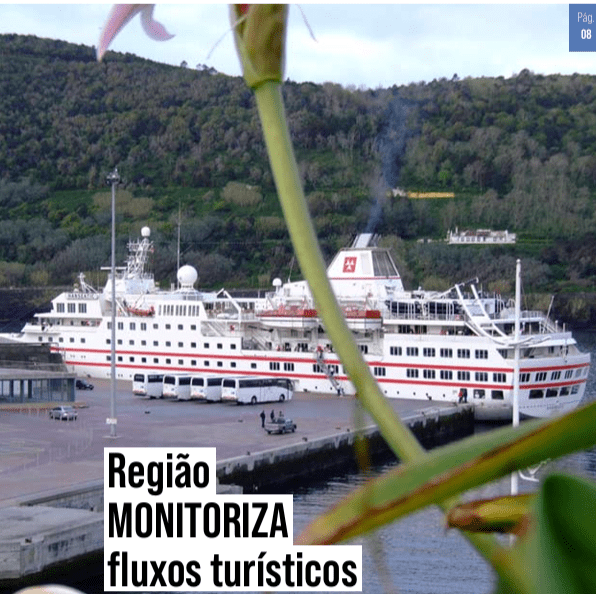
The Azores are set to develop an Integrated Intelligent Tourist Flow Monitoring System, funded by the Recovery and Resilience Plan (PRR), to enhance sustainable tourism management in the region. The Angra do Heroísmo Chamber of Commerce and Industry welcomes the measure but points out that it had already proposed it two years ago.
The new platform will “provide real-time data on tourist profiles, mobility, and visitation patterns on the nine islands.”
According to the Regional Government, this information “will be essential to support data-driven decisions, contributing to more sustainable and balanced tourism.”
“The Azores are at the forefront of the green and digital transition applied to tourism, reinforcing their commitment to the environmental, economic, and social sustainability of the sector,” said the Regional Secretary for Tourism, Mobility, and Infrastructure, Berta Cabral, quoted in a statement.
The creation of the Integrated Intelligent Monitoring System for Tourist Flows in the Azores was awarded to the Ubiwhere/Digiwest Group, following an international public tender, for €598,999 (plus VAT), with a deadline of 70 days.
The project is financed by the Recovery and Resilience Plan, under the Administrative Modernization Incentive System.
According to the Azorean executive, this project “is in line with the strategic objectives of the Azores Tourism Marketing Strategic Plan (PEMTA 2030) and aims to improve and modernize the management of tourist flows in the Azores.”
An idea that is two years old…
When questioned by DI (Diário Insular newspaper), Marcos Couto, the president of the Angra do Heroísmo Chamber of Commerce and Industry, stated that the announcement of the measure came “two years late.”
“Two years ago, when we presented a proposal for the implementation of a sustainability tax, we spoke precisely about this issue,” he pointed out.
The business association argued at the time that by paying the sustainability tax upon entering the region, “tourists would have to register automatically to obtain their sustainability pass.”
“This sustainability pass would automatically allow us to know the tourist’s itinerary, including where they ate, where they slept, etc., through QR codes,” he explained.
According to Marcos Couto, the aim was for the money raised from the €25 tax per tourist to be invested in the Azores’ water management system.
“One of the big issues with tourism is the huge consumption of water, which is five times higher than that of local residents,” he pointed out.
“It is interesting that the president of the Agricultural Federation is now talking about the importance of water storage,” he added.
The president of the business association reiterated that the sustainability tax would not only allow the amount raised to be used for measures to promote sustainability, but also “at the same time monitor tourist flows, origins, and tastes.”
On the other hand, the proposal aimed to create a database with the information collected to help promote tourism in the destination.
“It is a pity that it is taking so long to implement the numerous measures that the chamber of commerce has presented over the years and which would be very useful for the region’s economy,” said Marcos Couto.
“It is good to know that we are three years ahead of the government,” he concluded.
In Diário Insular, José Lourenço-director
Translated to English as a community outreach program from the Portuguese Beyond Borders Institute (PBBI) and the Modern and Classical Languages and Literatures Department (MCLL) as part of Bruma Publication and ADMA (Azores-Diaspora Media Alliance) at California State University, Fresno, PBBI thanks Luso Financial for sponsoring NOVIDADES.

 Novidades - The Islands and the Diaspora