

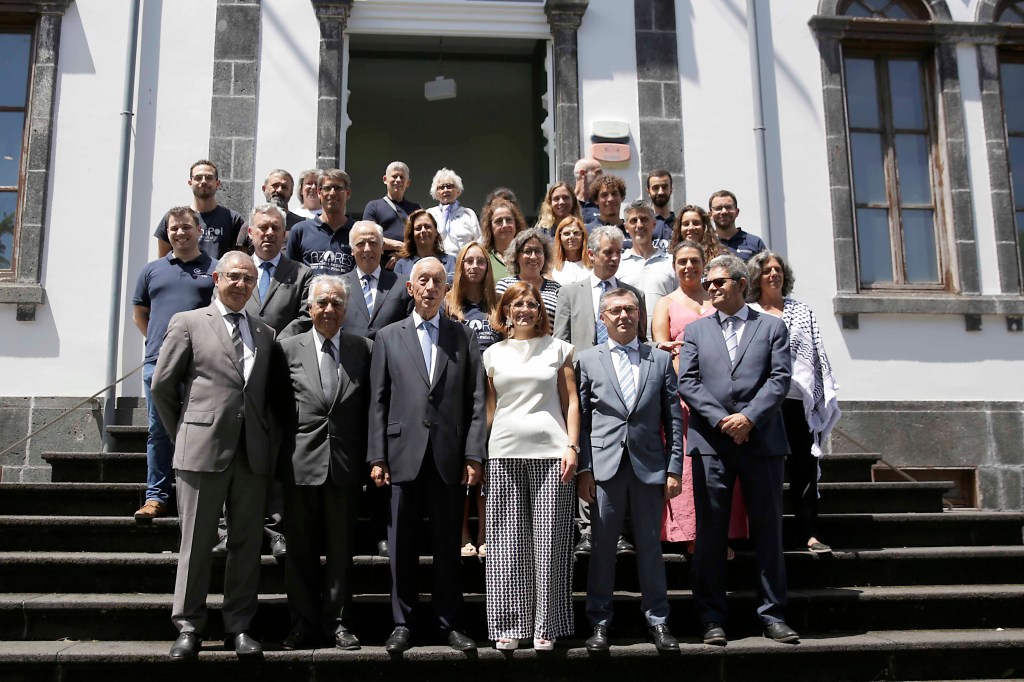
The President of the Regional Government of the Azores, José Manuel Bolieiro, accompanied by the Regional Secretary for the Sea and Fisheries, Mário Rui Pinho, demonstrated this Friday the relevance and geostrategic value of the Azores Sea Cluster, at the Sea School, on the island of Faial.
The initiative, part of the official visit of the President of the Republic, Marcelo Rebelo de Sousa, to the Autonomous Region of the Azores, followed visits to the islands of Terceira and Pico and was a moment to reaffirm the centrality of the sea in the regional development strategy.
During the session, which also featured a lecture by Admiral António Silva Ribeiro, former Chief of Staff of the Armed Forces, on the “Geostrategic Value of the Azores,” José Manuel Bolieiro highlighted the crucial role that the ocean plays in climate balance, oxygen production, and the regulation of life on the planet, warning, However, he warned of growing threats such as pollution, climate change, and overexploitation of marine resources.
“These challenges not only affect biodiversity, but also jeopardize the well-being of communities and global food security,” he warned.
Underlining the Atlantic identity of the Azores, the President of the Regional Government emphasized that the region’s blue natural capital, which represents almost one million square kilometers of Exclusive Economic Zone, places the Azores in a prominent position on the international stage, both in terms of resources and scientific research, and in terms of security, defense, and situational awareness of the Atlantic.
The regional executive leader reiterated the Regional Government’s commitment to affirming the Azores Sea Cluster as a strategic axis for development, linked to the Portuguese Blue Hub Network, and noted that structures such as the Azores Sea School, which already plays a consolidated role in maritime training and safety, will be reinforced with new investments, such as the MARTEC Technopole, a research and business incubation center for the blue economy to be built in the city of Horta, and the new scientific research vessel “Azores Ocean.”
The latter, scheduled for delivery in December 2025, will represent a multidisciplinary research platform with the capacity to operate at depths of up to 5,000 meters, with an investment of over €23 million, via the Recovery and Resilience Plan (PRR), enabling it to attract researchers from all over the world and train new generations of technicians and scientists linked to the sea.
About the MARTEC Technopole, scheduled for completion in June 2026, José Manuel Bolieiro said that this is a flagship project with an investment of over €23.5 million, which will include a blue incubator, an aquaculture center, and the future Azores Marine Park, positioning the region as an international benchmark in marine innovation.
During the presentation, the creation of the Azores Marine Protected Areas Network (RAMPA) was also highlighted, which was approved last October and established more than 287,000 square kilometers of areas with total or high protection.
“The best science requires the protection of at least 30% of the marine environment, and the Azores have taken this lead with courage and responsibility,” he said.
The approved law sets a strict timetable until 2030 for the implementation of effective management of this network, with planning, management strategies, and an adaptive model that integrates the evolution of scientific evidence, ensuring that the new marine park is not limited to formal existence but effectively fulfills its objectives.
The session reinforced the image of the Azores as a territory with a unique maritime vocation, capable of reconciling environmental protection with economic development and scientific innovation, and reaffirmed the Azores Government’s commitment to investing in the region’s blue future.
“We are leading by example and building a legacy of sustainability, knowledge, and prosperity for future generations,” concluded José Manuel Bolieiro.
From Press Release,
Translated to English as a community outreach program from the Portuguese Beyond Borders Institute (PBBI) and the Modern and Classical Languages and Literatures Department (MCLL) as part of Bruma Publication and ADMA (Azores-Diaspora Media Alliance) at California State University, Fresno, PBBI thanks Luso Financial for sponsoring NOVIDADES.

 Novidades - The Islands and the Diaspora