


“Saudade in Procession: The Enduring Light of the Festa de Nossa Senhora dos Milagres in Gustine, California”
There are places on Earth where heaven seems to touch the ground — not with thunder, but with memory, incense, and song. In the late summer warmth of Gustine, California, every year, such a sacred threshold is opened in the name of Nossa Senhora dos Milagres. Her festa is not merely a religious celebration. It is the heartbeat of a people dispersed across oceans and time but still united under one mantle of blue: the mantle of faith, of belonging, and saudade.
For those of us who arrived from the Azores as children — wide-eyed with the strangeness of a new land, and yet with hearts tethered to our ancestral islands— the Gustine Festa in the 1970s, 80s, and 90s was a revelation. Our parents, carrying stories in their silences and prayers in their calloused hands, found in Gustine a shrine not only to Mary, Mother of Miracles, but to their own pasts. They traveled from Tulare, San Jose, Hanford, Sacramento, San Pablo, and beyond — a pilgrimage not measured in miles, but in longing.
I remember vividly how my mom and dad went to the Gustine celebration every single year, beginning in the early 1970s, just a few short years after we arrived in the United States. It was more than a tradition — it was a yearly homecoming of the soul. My father especially cherished those days. After his retirement, he found great joy in attending the festas throughout California, each one a thread tying him to the land he had left behind and to the community he helped build here.
Gustine was his favorite. Nossa Senhora dos Milagres had always been important to us on Terceira, and in California, she took on new meaning — a beacon of comfort and connection in the diaspora. I still recall that this was the last festa he ever attended. It was Gustine, 2002. He didn’t stay until Monday, after the bullfights, as he always had. Instead, he quietly returned to Tulare on Sunday. We knew then something had changed. Just a week later, he was gone. Since then, the Gustine festa has lived in my heart not only as a symbol of faith and culture but also as the place of his final pilgrimage, where prayer and farewell were whispered in silence.
We remember the candlelight processions that glowed like rivers of gold winding through the town. Each flame carried a promise: to remember, to give thanks, to ask, to believe. We recall the cantoria — the poetic duels of wit and verse — where singers echoed the lyrical intelligence of the Azores under the California sky. We witnessed the parades with marching bands and queens, the bulls in the arena reminding us of Terceira and her bravery, and the crowds — oh, the crowds—with faces that looked like our tias, our padrinhos, our neighbors, all gathered in one sacred geography of community.
To speak of the Festa de Nossa Senhora dos Milagres in Gustine is to talk about a cornerstone in the Portuguese-American experience in California. It is not only a Festa, but it has long been among the most radiant of the Festas. In it, the sacred and the social, the spiritual and the cultural, embrace one another with gentleness. Here, memory is not a ghost — it is a hymn. Here, identity is not hidden — it parades humbly and proudly through the streets.
The Gustine Festa has always been more than a celebration; it is a living archive. A place where children learned to carry banners taller than themselves, where elders held rosaries that had crossed the Atlantic, and where we — immigrants, descendants, visitors — knew who we were. The Gustine Festa taught us that Catholicism could be Azorean in accent, that America could be Portuguese in flavor, and that California — this great experiment in diversity — was made richer through our devotion.
And in today’s world, where globalization often means erasure, the Gustine Festa becomes not just a cultural artifact, but a vital act of resistance. It says: We are here. We remember. We belong. In the context of building a truly multicultural state in California, these festas are not mere spectacles of nostalgia; they are vibrant testaments to a plural identity that strengthens the democratic, spiritual, and artistic soul of this state.
Gustine’s streets, adorned each year with banners and flowers, echo with more than hymns — they echo with the enduring dream of community. Events like this nourish the Catholic faith not only as an institution but as a living, breathing part of people’s daily, intergenerational lives. For the Azorean diaspora, Nossa Senhora dos Milagres is not only a figure of divine grace — she is the mother of the emigrant heart, the one who holds our uprootedness and grants it shelter.
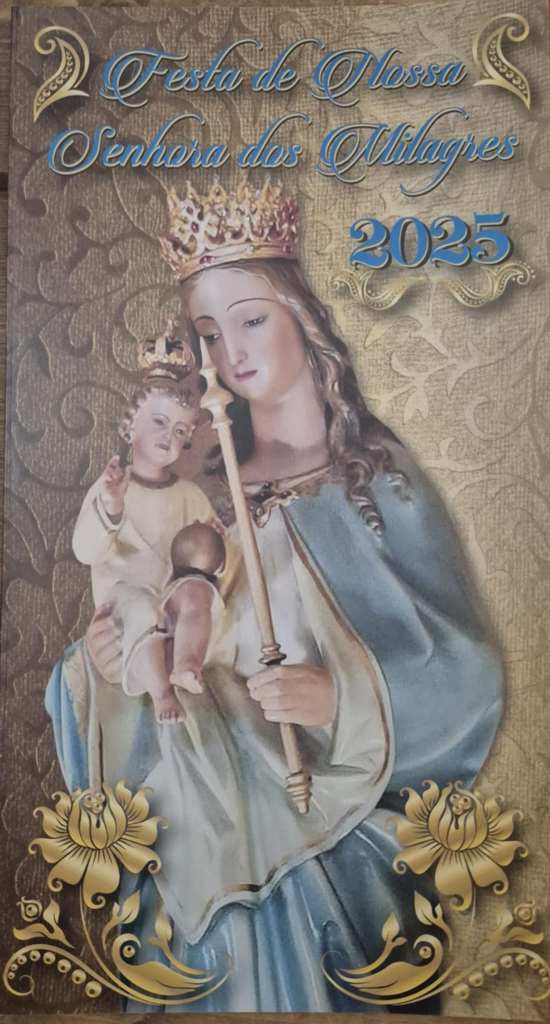
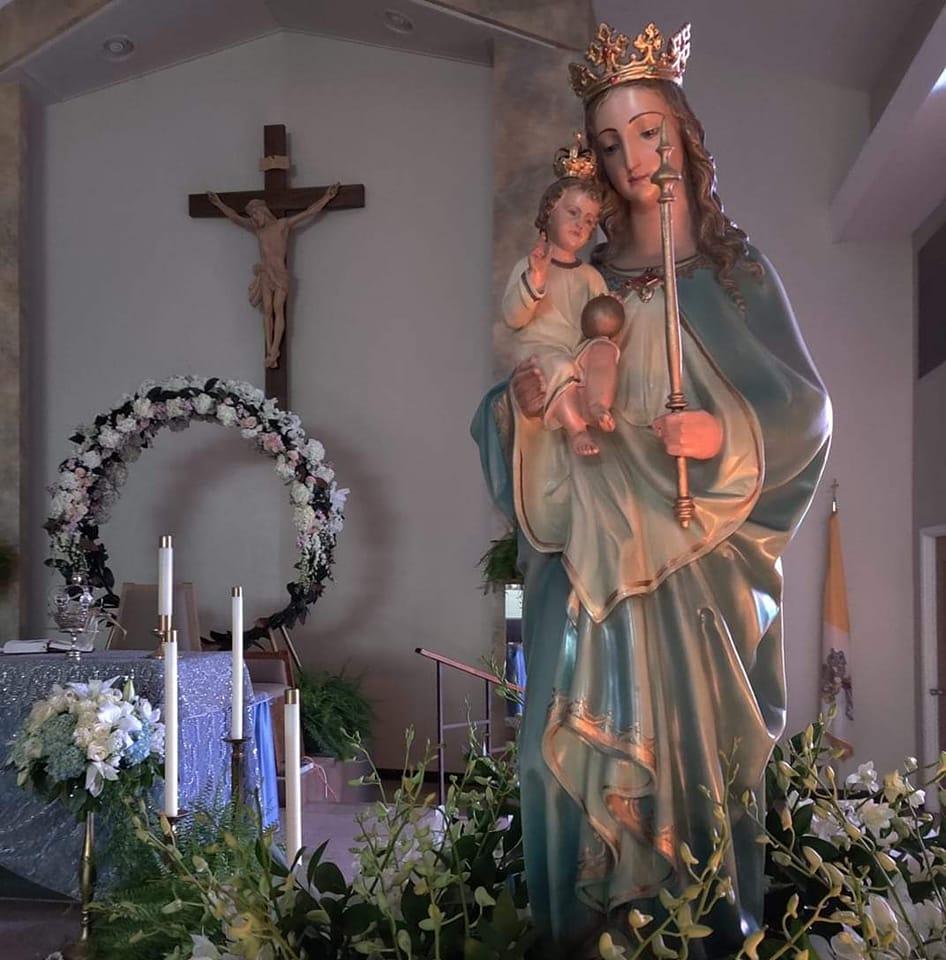
In every festival program, such as the beautiful one prepared this year, there is the trace of that great labor of love. The crowns may shine in procession, but it is the people — their prayers, their stories, their return each year — who make her reign visible. And through her, this small town in California’s Central Valley became a cathedral of memory and hope.
May we continue to walk under her mantle. May the candles be lit anew by generations who may speak more English than Portuguese, but who still kneel with the same faith. May the music play, the bulls run, the prayers rise, and the community embrace itself, again and again.
And may Gustine — this town with a name not so Portuguese but a heart so unmistakably Azorean — forever be a land where miracles are not only asked for but lived.
Because some lights are not meant to fade, they are intended to guide.
Diniz Borges
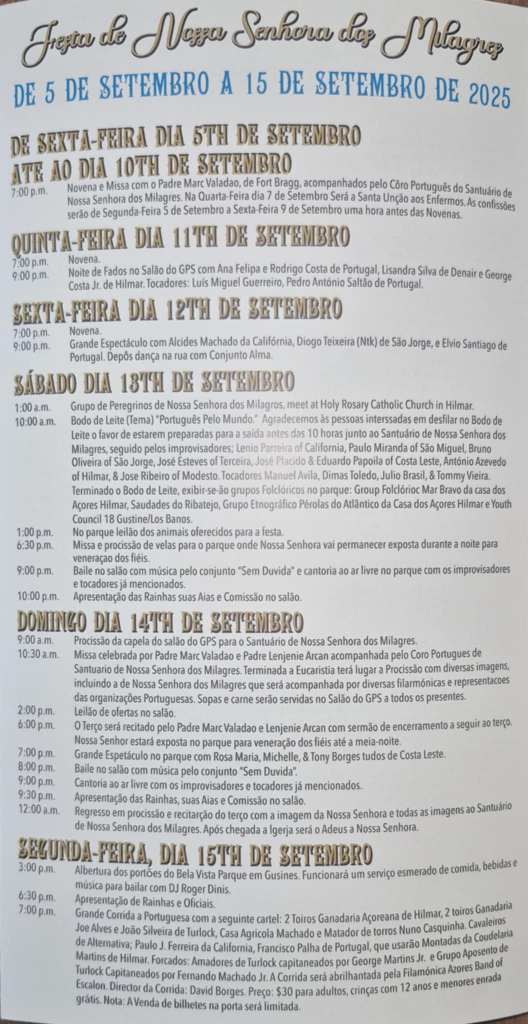
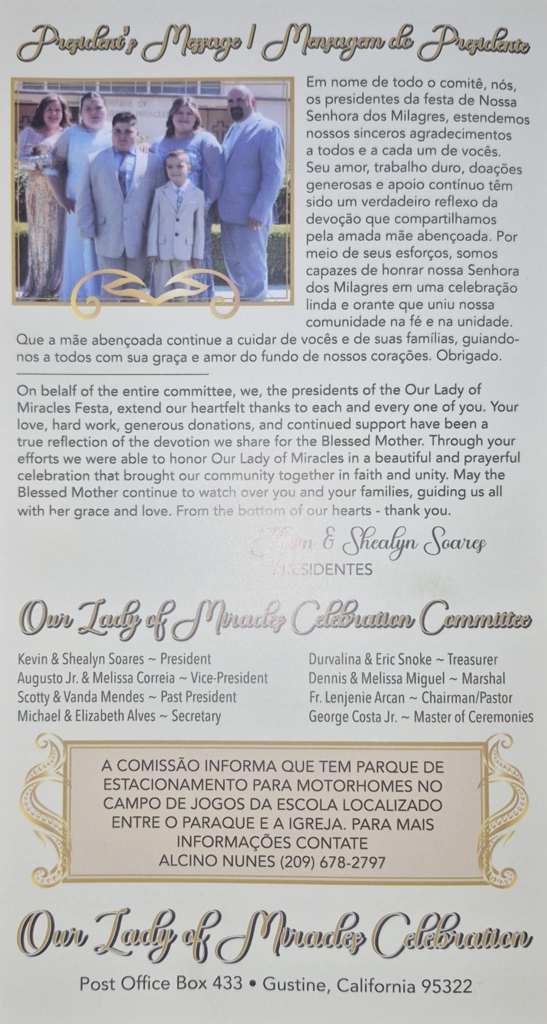
Here is this year’s program…Everyone is invited to attend



 Novidades - The Islands and the Diaspora