

The Azores are preparing to take a new step in their current agricultural system: the introduction of cocoa plantations. The Regional Government plans to set up two experimental fields of Theobroma cacao on the islands of Terceira and São Miguel, to test its adaptation to different climatic and soil conditions. The initiative could ‘open doors’ for agricultural diversification in the archipelago and respond to global market demands. “Experimentation in two different fields may reveal significant differences in plant tolerance, allowing for the selection of strains with greater resilience and productivity in adverse conditions,” explains António Ventura, Regional Secretary for Agriculture and Food.
According to the official, “this approach allows us to compare the performance of the plant under different rainfall and temperature regimes, as well as to identify more resilient agricultural practices.” António Ventura emphasizes that the crop, traditionally grown in humid tropical regions, can be integrated into agroforestry systems that value sustainability, soil conservation, and carbon sequestration. The “introduction of cocoa represents a promising strategy for assessing the crop’s adaptability to different soil and climate conditions, especially in a context of increasing climate change,” adds the regional secretary.
“With the intensification of climate change, including rising temperatures and irregular rainfall,” the agricultural sector is looking for crops that are resistant to climate change and have high commercial value. For António Ventura, “cocoa could represent a viable economic alternative, creating new opportunities for Azorean producers and boosting exports.” “Agricultural diversification with cocoa could contribute to the emergence of new producers and create an economy in the Azores,” says the government official.
António Ventura guarantees that “there is currently a global demand for cocoa,” due to low production in São Tomé and Príncipe, the Ivory Coast, Nigeria, and Ghana. The ‘cocoa crisis’ in traditionally leading countries is driven by a combination of factors, such as adverse climatic conditions for production, pests, and associated diseases, such as moniliasis and swollen shoot. Given the instability of output, “the price of this raw material is reaching record prices on the world market, with increases of 60%,” explains the government official.
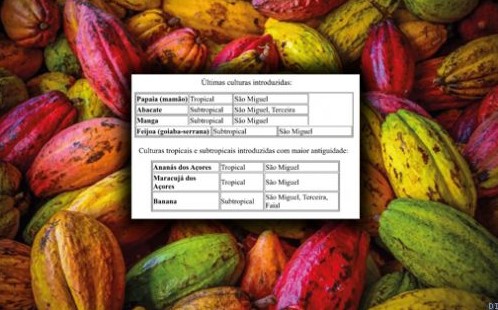
Although the commitment to cocoa is recent, in recent years the Azores have been introducing tropical and subtropical products such as papaya, avocado, mango, and feijoa, which have joined pineapple, passion fruit, and banana, already established symbols of regional production.
In Diário Insular-José Lourenço, director
Translated to English as a community outreach program from the Portuguese Beyond Borders Institute (PBBI) and the Modern and Classical Languages and Literatures Department (MCLL) as part of Bruma Publication and ADMA (Azores-Diaspora Media Alliance) at California State University, Fresno, PBBI thanks Luso Financial for sponsoring NOVIDADE.


 Novidades - The Islands and the Diaspora