

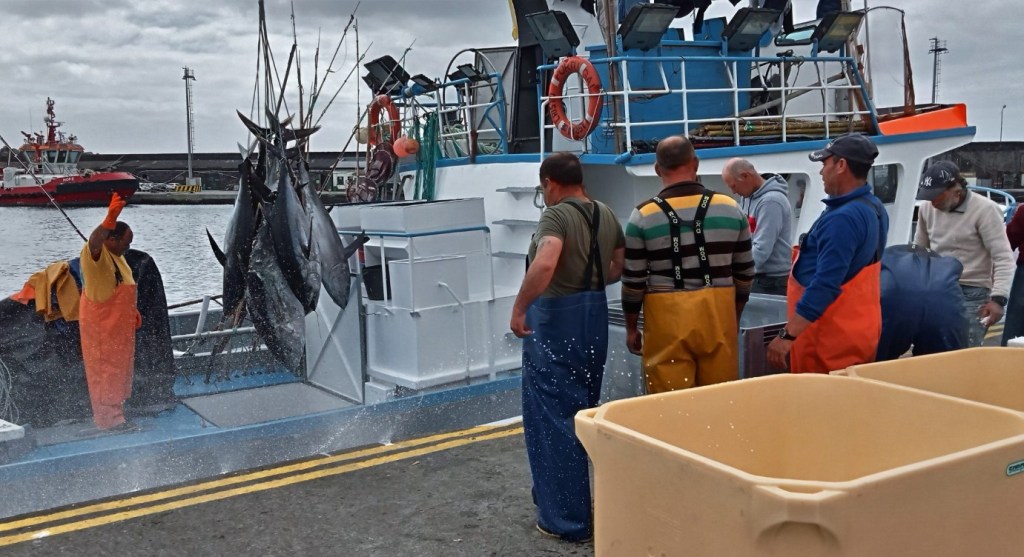
Lotaçor clarified the reasons for the lack of fish storage space in the region’s cold storage warehouses, a situation that has caused concern and constraints among Azorean fishermen.
According to the public company, in a press release, the problem is mainly due to “the abundant harvest, which is expected to be the best in the last 10 years, and which has led to large quantities of tuna having to be stored in warehouses, on the one hand, and on the other hand, to the processing capacity of canneries, which is much lower than the volume of landings that have been recorded in 2025.”
Lotaçor adds that “there is also a significant amount of bigeye tuna stored, not intended for industry, which is awaiting a market to be sold.”
The company emphasizes that alternatives outside the Azores warehouse network are practically non-existent: “Lotaçor has already contracted the rental of 200 tons of frozen storage capacity from two companies in S. Miguel, which are already exhausted. It is not possible to do more than this because there are no private companies offering this type of service.“ Currently, ”the region’s cold storage warehouses, managed by Lotaçor, have a theoretical storage capacity of around 5,500 tons of frozen fish.” However, this capacity was calculated for species such as bonito, while “the other species of tuna, namely yellowfin tuna, bigeye tuna, bluefin tuna, and albacore tuna, take up twice as much space as bonito.”
The Azores Fish Auction Service emphasizes that “there is a significant amount of bigeye tuna stored, which contributes to the depletion of available space even though we have not reached the limits in terms of stored weight.”
The company clarifies that “just as Lotaçor is not the cause of this constraint, it is not, by itself, the solution to it. This is an issue that must be discussed with the entire sector, and we are talking about production, marketing, and industry, under the guidance of the Regional Government department responsible for fisheries, the Regional Secretariat for the Sea and Fisheries.”
Despite this, it is open to collaborating in the search for solutions: “obviously, Lotaçor is available to work together to try to find a way out of the current situation and future situations that is beneficial to all.”
In Correio dos Açores-Natalino Viveiros, director
Translated to English as a community outreach program from the Portuguese Beyond Borders Institute (PBBI) and the Modern and Classical Languages and Literatures Department (MCLL) as part of Bruma Publication and ADMA (Azores-Diaspora Media Alliance) at California State University, Fresno, PBBI thanks Luso Financial for sponsoring NOVIDADES.

 Novidades - The Islands and the Diaspora