


This Sunday, the 31st of August, Vila Franca do Campo in São Miguel Island will, once again, experience a special moment in the traditional festivities in honor of Senhor Bom Jesus da Pedra (the Good Lord of the Stone), a festival recognized by Pope Leo XIII in 1903 and promoted by Santa Casa da Misericórdia, one of the oldest in the diocese of Angra, founded between 1551 and 1552.
For the first time, Father Norberto Brum, a native of this village in São Miguel, the first capital of the island of São Miguel, will be the preacher of the triduum, which began on Wednesday, and of the solemn Mass of the feast, which for decades has deeply marked his spiritual and personal life. “For me, it’s a return to my roots,” says the priest, who has lived this devotion intensely since childhood. The son of a family deeply connected to the parish church of São Miguel Arcanjo and also to the Church of Mercy—his father was a sacristan, his mother was involved in activities, and his godmother, Maria do Carmo Bulhões, was the caretaker of the image—Father Norberto Brum grew up between the parish church, the Church of Mercy, and the fervent atmosphere of the feast.
He recalls in detail his childhood spent accompanying his godmother in the daily care of the image, when olive oil was still used in the lamp. “The first thing we did when we entered the church was to say ‘hello to the boss,’” he says, recalling how physical and spiritual closeness to the Lord of the Stone shaped his faith.
While still young, he took on the task of decorating the church and the statue, introducing jewelry that had previously been stored away. He came to be affectionately nicknamed the “tailor of Senhor da Pedra.” For the priest, who this year marks 25 years of ordination and is therefore celebrating a double jubilee, the connection with the statue has always been “one-on-one.”
“I slept with the Lord of the Stone, literally,” he says, recalling the nights spent in the church guarding the statue and its adornments, a responsibility he took very seriously. “People spent the whole night there in the parish church, and my uncles—one of my uncles worked there—helped to prepare everything, especially to take care of it, as they said.

There was always that concern, and for me, the festival was practically always spent in the church because the procession would end and we would already be putting everything away.“ ”I remember even when the image was on the litter to be prepared and it was without its cover, I would stand next to it and give it a hug and say, ‘tomorrow you will see the pretty girls of the village.’
And the older people would say: ‘Hey, boy, you shouldn’t say that. You’re offending the Lord.’ It wasn’t an offense at all, it was just a great desire to embrace that Lord and make him even more beautiful so that everyone would venerate him,” he adds. He also helped with the lighting and various other aspects of the festival, even receiving his first paycheck for this work when he was a student.
“500 escudos (the old Portuguese monetary unit)… It was a feast. I can say it was my first salary. I had worked hard and they paid me,” he says with some humor. Despite the changes in the village and its people over the last 25 years, the priest always feels welcome when he returns: “People greet me, they celebrate me. It’s so good to return to my roots,” he emphasizes.
“A cult of love and patience”
The image of Senhor da Pedra—Christ seated on a rock, crowned with thorns, with his hands bound—recalling one of the steps of the Passion —has always spoken to him of boundless love.
“He is a peaceful, loving Christ, with a very gentle gaze. A God who does not need jewels or capes, but who needs our love and capacity for devotion,” he explains.
For Father Norberto Brum, the cult shares similarities with other notable Azorean devotions, such as the Lord of Miracles, attracting faithful who turn to him in times of distress and make promises. Without denying the value of this gesture, the priest emphasizes that Jesus “is not an emergency service, he is love.” But what challenges him most is the potential that this cult has for evangelization, which should be more valued, “perhaps even in the creation of a sanctuary,” he says, given the permanent presence of the faithful.
“Sometimes the Church has treasures in its hands and does not develop them. The Lord of the Stone is a precious stone,” he says, arguing that celebrations should be integrated into the calendar and traditional practices of the people, without trying to impose artificial models.
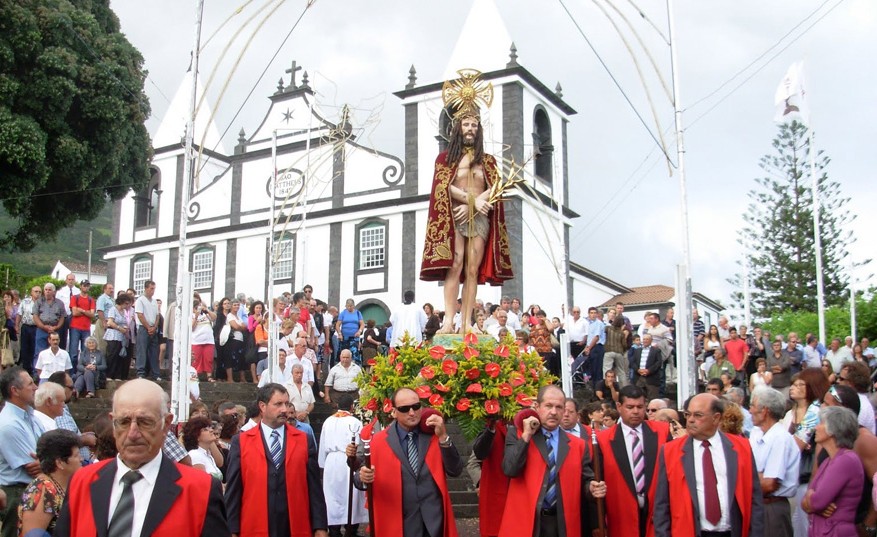
The year 2025, marked by the Jubilee of Hope and the priestly jubilee of Father Norberto Brum, extends the invitation of his classmate, Father José Borges, to preach even more symbolically.
The priest reveals that he has been praying hard to understand what God wants him to say to the faithful. His intention is to use the image of the Lord of the Stone to convey a simple and familiar message: “He did not remain seated on the stone forever. He rose, he conquered the stone of the tomb. The Lord of the Stone is the Lord of the Resurrection, the God with us,” he says.
Drawing on the tender gaze of the image as a source of inspiration, Father Norberto Brum wants to challenge each person to “clean their own stones” and to discover, in the patience and love of Christ, hope for today.
“We are the glory and beauty of God. He who guards and protects us waits for us, always, with his hands tied so as not to flee from our side,“ he says.
And, like him, ”we also have to clean our stones. We have to get up, set out on the road, which is sometimes a cross, but this is also the Lord of the resurrection, the living one, the God with us. That’s right, the Good Lord of the Stone is the Lord God with us, he is the one who is in the world, crowned with thorns because we are his glory, we are his splendor. We are the beauty of God,” he concludes.

With this return, Father Norberto Brum brings back more than just childhood memories. He brings with him a lifetime of faith rooted in his land and his people, and on this day, August 31, he wants to give back to them in words and celebration the love he received there.
“For me, above all, it is a return to my roots. And when I say return to my roots, it is because since I was a little boy, as a native of Vila Franca, I have always participated in this festival,” he says. Father Norberto Brum was the preacher of the triduum at the Church of Mercy. This Sunday’s celebration includes the usual tribute to Senhor Bom Jesus da Pedra with a Mass at 9:30 a.m. and a procession at 6:00 p.m.
This celebration extends beyond municipal boundaries and attracts numerous Christians to Vila Franca, including those from the diaspora. According to tradition, the image of Senhor Bom Jesus da Pedra was found several centuries ago on Praia do Corpo Santo beach in Vila Franca do Campo, inside a wooden box. The inscription on the box read: “To the Misericórdia of Vila Franca.” The population interpreted the find as a divine sign. The image was then taken to the Church of Mercy, also known today as the Church of Senhor Bom Jesus da Pedra.
The festival in honor of Senhor Bom Jesus da Pedra takes place every year on the last Sunday in August and is organized by the Brotherhood of Mercy and the local community. The highlight is the solemn Mass and procession through the village streets, where the image is carried on a richly ornamented litter. The devotion is very penitential and supplicatory in nature, similar to the cult of Senhor Santo Cristo dos Milagres in Ponta Delgada. Many faithful turn to Senhor da Pedra in times of distress, paying promises or bringing offerings.
In Correio dos Açores, Natalino Viveiros, director
Translated to English as a community outreach program from the Portuguese Beyond Borders Institute (PBBI) and the Modern and Classical Languages and Literatures Department (MCLL) as part of Bruma Publication and ADMA (Azores-Diaspora Media Alliance) at California State University, Fresno, PBBI thanks Luso Financial for sponsoring NOVIDADES.

 Novidades - The Islands and the Diaspora