

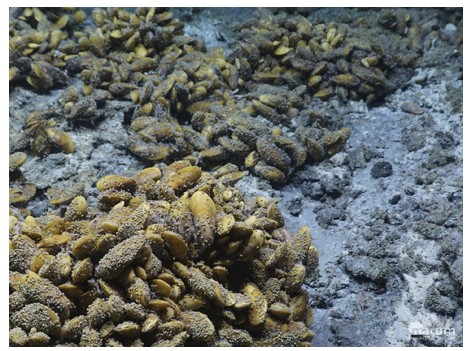
Deep hydrothermal vents, known as true “oases of life” at the bottom of the sea, are home to unique communities of organisms that survive thanks to chemical energy rather than sunlight. How this diversity is maintained in such isolated environments was the focus of a recent study led by Ana Colaço, a researcher at OKEANOS-UAc.
The research analyzed the dispersion of larvae of the mussel Bathymodiolus azoricus, an emblematic species of the Azores hydrothermal vents, using a model that combines ocean currents and the biological characteristics of the larvae. The results showed that, in most situations, the larvae remain in their region of origin, with very limited exchanges between different hydrothermal fields.
The Rainbow hydrothermal field (located on ultramafic formations at a depth of about 2,300 meters on the Mid-Atlantic Ridge and about 370 km southwest of Faial Island) stood out for its isolation, receiving some larvae from Menez Gwen and Lucky Strike (also located southwest of Faial), but showing little connectivity with the others.
This knowledge is fundamental for the management and conservation of these unique ecosystems, especially in the face of natural threats or human activities.
In Correio dos Açores, Natalino Viveiros, director
Translated into English as a community outreach program by the Portuguese Beyond Borders Institute (PBBI) and the Modern and Classical Languages and Literatures Department (MCLL), in collaboration with Bruma Publication and ADMA (Azores-Diaspora Media Alliance) at California State University, Fresno. PBBI thanks Luso Financial for sponsoring NOVIDADES.

 Novidades - The Islands and the Diaspora