


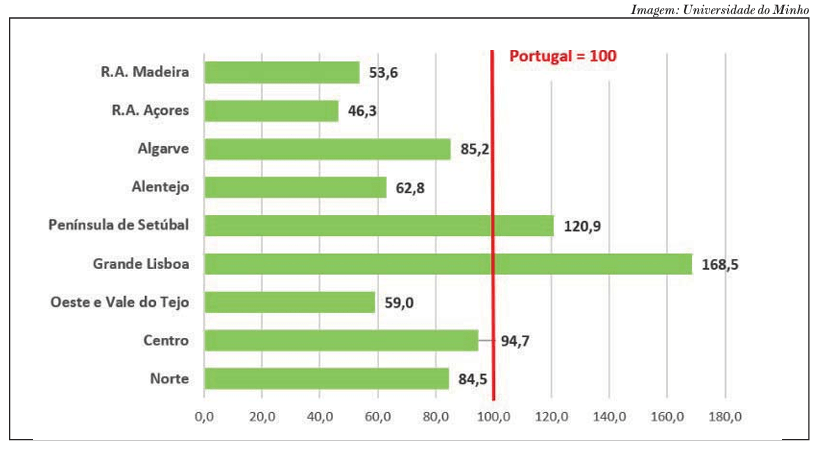
A study by the University of Minho, now released, concludes that the Azores have the lowest Regional Digital Index in the country, meaning that the different sectors of activity, as a whole, make less use of the digital tools and solutions available to support the success of their respective areas of activity. In the case of the Autonomous Region of the Azores, this index, which is the result of a combination of the sector of activity, the size of the company or organization, and the digital tools and solutions implemented, or not, and their relevance, is 46.3 points. By comparison, the Greater Lisbon region has a value of 168.5 points. According to the Regional Digital Index (IDR) 2024 published by the University of Minho, the Greater Lisbon region, compared to the other eight Portuguese NUTS II regions, performs extremely well, highlighting the significant regional asymmetries in the construction of the Information Society in Portugal. In second place is the Setúbal Peninsula (120.9), followed by the Central region (94.7), which comes in third place. As already mentioned, the Azores region ranks last.
In the four sub-indices that make up the index (Context, Infrastructure, Use, and Impact), the Azores rank last in three of them, except the Infrastructure sub-index, where the Oeste and Vale do Tejo region rank last. Accompanying the Azores at the bottom of the table, but with slightly higher scores, is the Autonomous Region of Madeira, with a rating of 53.6 points. It is second-to-last in the Context, Use, and Impact sub-indices and ranks sixth in the Infrastructure assessment. Nationwide, the supremacy of the Greater Lisbon and Setúbal Peninsula regions is evident, always occupying the 1st and 2nd positions, respectively, in the different parameters. In fact, they are the only ones with scores above the national average. Also noteworthy is the Northern Region, which ranks only 5th, behind the Algarve, which ranks 4th. The IDR is a tool designed by the University of Minho through Gávea – Information Society Observatory, to understand the reality of the Information Society in the different Portuguese NUTS II regions, comparing and contrasting them.
This edition (the 11th) is the result of the new organization of NUTs II in 2024, accompanied by the respective update of the indicators used, this time 113, 40 more than those used in the first edition, published in 2012. According to Luís Miguel Ferreira, co-author of the study, and as reported by the University of Minho, “in this year’s edition of the IDR, which underwent a major methodological review due to the entry into force of the new territorial organization around the new NUTs II, there continues to be a trend of Greater Lisbon lagging far behind the other Portuguese regions, which highlights the chronic existence of enormous regional asymmetries in the construction of the Information Society in Portugal, as is the case, in fact, in other areas of our country’s development.” After so many years and many millions of euros from the Structural Funds invested in territorial cohesion and convergence, after so many warnings and collective reflections on the need for greater balance and equity in regional development, the truth is that in such relevant aspects that characterize the Information Society, regional asymmetries persist and, in some cases, are even worsening,” argues the researcher from Gávea – Observatory of the Information Society at the University of Minho. Luis Amaral, the other co-author of the study, reinforces this point: “Even after decades of cohesion policies and high levels of investment, disparities not only persist but tend to become more entrenched. Thus, the study shows that the path to true territorial convergence in the digital domain is still far from being achieved.”
In Diário dos Açores – Paulo Viveiros, director.
Translated into English as a community outreach program by the Portuguese Beyond Borders Institute (PBBI) and the Modern and Classical Languages and Literatures Department (MCLL), in collaboration with Bruma Publication and ADMA (Azores-Diaspora Media Alliance) at California State University, Fresno. PBBI thanks Luso Financial for sponsoring NOVIDADES.

 Novidades - The Islands and the Diaspora