


For two days, Monday and Tuesday, a delegation of administrators from the World Bank Group was present in São Miguel to learn about the certification process for the Azores as a sustainable tourist destination and to discuss ideas on how to implement processes that already exist in other parts of the world.
Miguel Castro Coelho, one of the World Bank administrators, told our newspaper that, in conclusion, “all the meetings we have had so far have been very productive. I think it is clear that there are examples in the Azores’ experience, in the energy transition and in the path they have taken, also in terms of tourism sustainability and the blue economy, which are very relevant to the work of the World Bank Group, and we will certainly seek, in the future, to also convey this knowledge and these experiences that we have gained on this visit to our colleagues in Washington and to promote a dialogue between the institution, between the World Bank Group and the authorities in the Azores, a dialogue that we hope will be productive for both parties.”
When asked whether the World Bank is interested in holding more meetings of this kind in the Azores, Miguel Castro Coelho did not rule out this possibility, stating, however, that the focus would be different. “We intend to follow up on issues and specific topics that were discussed during these two days.
In those areas that are most relevant and most directly related to the Bank’s work, these are the issues we will focus on or give priority to in the near future, without prejudice, of course, to the possibility of a new visit in the future,” concluded the administrator.
Berta Cabral, Secretary of Tourism, Mobility, and Infrastructure, first emphasized the interest “that the Azores aroused in the World Bank to come here and gather information about our experiences, especially in terms of tourism sustainability on Monday, energy transition yesterday, and also EU funds,” in a session that took place yesterday afternoon.
According to the minister, after the sessions on tourism and energy transition, the delegation was “extremely pleased with our initiatives, with our approach to energy transition and sustainability and the future of the planet, which are our main and ultimate goals: to effectively preserve our planet and for everyone to do their part, and we are doing ours very well.
We are, in fact, nine islands, and we have the possibility of being living laboratories to test some technologies.“
”Projecting the Azores as a sustainable destination worldwide…”
Among the various topics discussed, geothermal energy was one of those that most impressed the World Bank representatives. Berta Cabral confirmed that the multiple administrators “visited the Pico Vermelho geothermal power plant precisely because it is a unique experience in our country, as geothermal energy only exists in the Azores, in Portugal, and in a few other countries in the world.
They were indeed delighted and very keen to try such experiments wherever possible. Therefore, for us, the World Bank is essentially an international reference that will promote the Azores as a sustainable destination, as part of our commitment to energy transition, and this is very good for us, not only because of what we are doing and our alignment with European policies in these areas, but also because it gives the Azores great international visibility.”
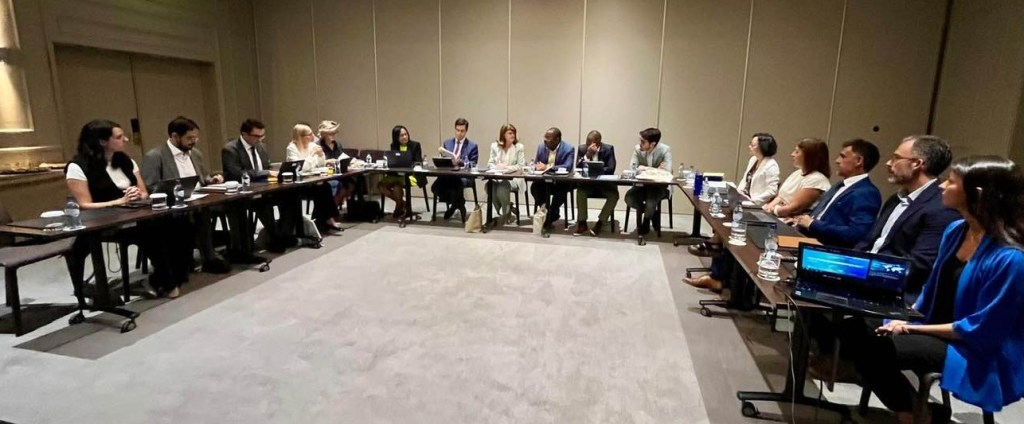
The issue of certifying the Azores as a sustainable destination was also widely discussed during the meetings held over the two days. For the minister responsible for tourism, “the issue of our gold-level certification as a sustainable tourist destination, which has projected us internationally from the outset, has been excellent for us, because our certification has been considered a case study and has been presented in multiple forums, especially European ones, and now it has been at the global level and they have come to us. Additionally, in terms of energy transition, as we have several sources of renewable energy, we combine them to create a stable mix of renewable energies, committed to ensuring the security of supply. This must always be our primary objective: to maintain security of supply. We are nine islands, all separate, and the networks are not interconnected. These are all very specific issues that islands have, which continents do not have, because they are connected to each other. Europe, for example, and the United States, the American continent too.
“Therefore, islands have these specific characteristics, and the people from the World Bank who are here, many of whom represent islands around the world, take these experiences and adapt them to their islands and their territories in the way they deem most appropriate,” said Berta Cabral, referring to the Azores as an example to follow.
For the Secretary of Tourism, Mobility, and Infrastructure, “the exchange of experiences is fundamental in these areas as in all others, but always with the care to adapt these experiences to our reality. That is how we do it, and certainly, they choose good practices here that they will also apply according to their specificities.
When asked whether this interest shown by the World Bank reinforces the importance of the Azores as a sustainable tourist destination worldwide, Berta Cabral was emphatic: “Without a doubt. At the European level, the Azores are already well recognized as a sustainable destination, but increasingly so at the global level. And now the World Bank is giving us this opportunity to take away a very rich experience that will certainly be reflected in the meetings they will have and the reports they themselves produce. The name of the Azores will go much further after these meetings we had with the World Bank, on their initiative, out of their curiosity about our reality, which is what I think is even more interesting,” the governor concluded to our newspaper.
Frederico Figueiredo is a journalist for the newspaper Correio dos Açores. Natalino Viveiros is the director.
Translated into English as a community outreach program by the Portuguese Beyond Borders Institute (PBBI) and the Modern and Classical Languages and Literatures Department (MCLL), in collaboration with Bruma Publication and ADMA (Azores-Diaspora Media Alliance) at California State University, Fresno. PBBI thanks Luso Financial for sponsoring NOVIDADES

 Novidades - The Islands and the Diaspora