

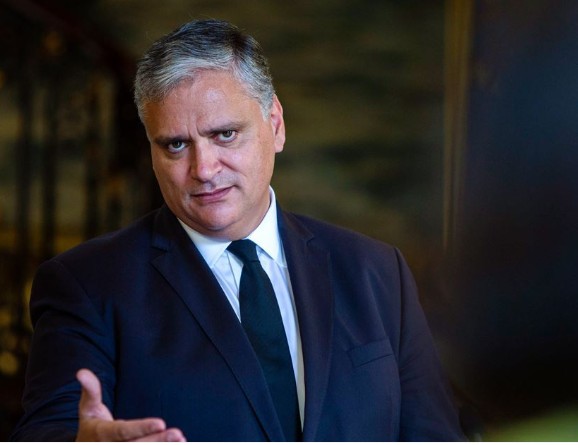
The São Miguel Seniors Association (ASSM) resumed its regular meetings for debate and reflection on current regional issues with a session dedicated to a central question for the future of island autonomy: the revision of the Finance Law of the Autonomous Regions.
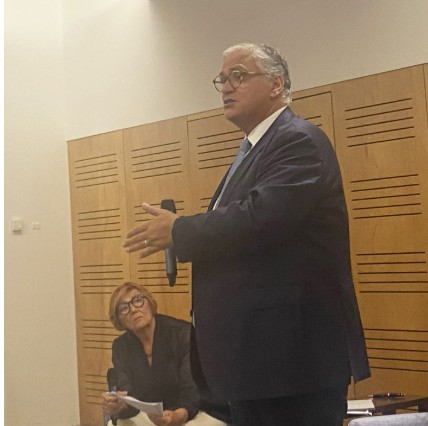
The event took place at the Hotel Marina Atlântico in Ponta Delgada. It brought together dozens of participants who listened to the analysis of Vasco Cordeiro, former President of the Regional Government of the Azores and former socialist deputy to the ALRAA. The title of the conference posed the fundamental question “Revision of the Regional Finance Law: an autonomist imperative or a financial emergency,” and, in its initial framework, a face-to-face meeting between Cordeiro and Mota Amaral, a leading figure in Azorean autonomy, was planned.
However, as explained by ASSM President Leonor Anahory, Mota Amaral was unable to attend for health reasons, leaving Vasco Cordeiro with the responsibility of developing the theme alone, moderated by former journalist Teresa Nóbrega. The session was still held in an open format, allowing for questions that proved to be relevant and brought both complementary and divergent contributions. The former head of the regional executive made a point of emphasizing that he would speak on his own behalf.
“What I bring is only my perspective on the issue, because there are people here who are much more qualified than I am to reflect on this and take this position. I am only sharing what, with my experience and knowledge, is the way I see this issue,” he said. Throughout his speech, which covered various areas, from the nature of the law to issues of additional costs, taxation, the European framework, the role of the Assembly of the Republic, and the very logic of the revision process, Vasco Cordeiro issued warnings, raised hypotheses, and posed challenges for the future of Azorean autonomy.
Resources or expenses?
Right from the outset, Cordeiro raised the fundamental question about the nature of the law in question. “What is the Autonomous Regions Finance Law? What is its purpose? Is it a law that guarantees us resources, which we then manage as we see fit? Or is it a law whose function is to ensure that the Regional Administration’s expenses are paid?”
For the former socialist leader, the distinction is deeper than it seems at first glance:
“If we understand that the law guarantees us resources, but the responsibility for managing them is ours, this means that our income is what we are owed. If we understand that the function of the law is to guarantee resources to pay the expenses of the Autonomous Regions, then our income is determined by the expenses we incur.”
Cordeiro’s position is clear: “I share the first perspective, because not following this path poses too many risks to autonomy, to our ability to determine the policies we want and the investments we intend to make. Perhaps even to guarantee differences that exist in the Azores or Madeira in relation to the mainland.”

Financial emergency or autonomist imperative
Vasco Cordeiro did not shy away from the duality of the meeting’s title, which contrasts the “autonomist imperative” and “financial emergency,” agreeing that the revision of the Autonomous Regions Finance Law is due to the latter. However, he warned against the risk of reducing the problem to a single component:
“The issue is somewhat determined by the Region’s current financial situation and by the repeatedly stated view that we need more resources. Revenues are not enough to cover expenses. We need to obtain more revenues. But perhaps the main problem is not on the revenue side, but rather on the expenditure side, in the way it is decided and prepared.”
He insisted that the revision of the law cannot be viewed solely as an instrument for immediate budgetary reinforcement: “If we approach the revision only as an opportunity to secure more revenue, we may end up ceding powers or creating a situation in which regional autonomy is weakened.”
He gave the example of the most sensitive areas of governance: “In health and education, once we ask for the Republic’s contribution, we become dependent on its political goodwill. And that opens the door for a Government of the Republic to question regional choices, comparing them with what happens on the mainland.”
Additional costs and new sources of revenue
The issue of extra costs was one of the central points of Vasco Cordeiro’s speech, in which he explained that reflection on this matter has almost always been based on the idea that it is the State’s responsibility to bear the additional costs of insularity. However, he considered that this should not be the only possible framework.
“The whole argument is based on the State having to bear the extra costs. Well, perhaps that is not the only way to approach the issue,” he said.
For Cordeiro, it is necessary to explore alternative models, for example, by transferring to the regions the amounts corresponding to national expenditure in sectors such as health and education, calculated on a per capita basis, with the areas then being responsible for accommodating the additional costs with the tax revenues already allocated to them.
“It is a reversal of reasoning in terms of what compensation for additional costs means. The advantage I see in this approach is that it completely eliminates the possibility or political temptation to judge what is the specific solution for the Azores or Madeira,” he argued, invoking the principle of subsidiarity.
Even so, he warned of the need for rigor in this discussion: “One can also look at this whole issue from a more moral perspective, from the point of view of what we, because we are here, in the vastness of the Atlantic, are entitled to and should be entitled to. This is important. But this component does not hold up if it is not tempered with rigorous, objective, quantifiable, and defensible judgment.”
In his view, additional costs should be understood only as what is necessary to ensure equal circumstances between the islands and the mainland. “We do in the Azores what is done on the mainland. The costs arising from political decisions taken by the Region are not included here in the supposed additional costs,” he explained, stressing that choices made in health or education may entail additional expenses, but cannot be confused with structural additional costs. “I think it is fragile and risky to base our argument regarding the Finance Law of the Autonomous Regions, its revision, and a possible increase in revenue on the issue of additional costs,” he warned.
For Cordeiro, the path should be different: fiscal accountability.
“I continue to defend the issue of accountability in terms of taxes. I think this is fundamental. And it is not just a financial or budgetary issue. It has to do with the survival of autonomy. If we are not able, in the face of any government of the Republic, to discuss on an equal footing, with rigor and objectivity, we are doomed.”
The former president of the Regional Government added that the Region has room to generate more of its own revenue, in addition to that provided for in the current Finance Law.
“How much is it worth to the country that we guarantee 30% of marine areas are protected? I think that this issue of obtaining revenue must always be done on a trade-off basis: we bring this to the country, we guarantee this benefit for the country.”
He also argued that regional fiscal policy should be used not only to balance accounts, but as an instrument of redistribution and social justice: “If we try to strike a balance between a fiscal system and our autonomy, which allows us to do this, I think we should use this 30% possibility also for the issue of fiscal and social justice.” Along the same lines, he maintained that the increase in revenue cannot be seen as dependent exclusively on the revision of the Finance Law. “If the Region needs more revenue (and this seems obvious to me), let’s explore other areas. Let’s put the issue of 30% of the marine protected area on the table. Let’s put the issue of space on the table.”
Regarding the Sea Law, he recalled that, although the Azores had tried to pass a bill in the Assembly of the Republic, it was rejected because it was understood in Lisbon as an attempt to appropriate the resources and economic value that could result from them.
The difficult unanimity in the Assembly of the Republic
Regarding its parliamentary approval at the national level, Vasco Cordeiro acknowledged that it will be difficult to achieve unanimity, recalling past examples: “I think it will be difficult to achieve unanimity on this matter. Just remember the Sea Law. But unanimity is not the most important thing. What is important is to shield the law so that it guarantees stability and predictability, because experience shows that it has already been amended, on the initiative of governments of the Republic, to the detriment of the regions.“ He added: ”What is essential is that the main political parties, old and new, manage to give the broadest possible political support to a new version of the law.”
The former government official also pointed out that European institutions have an unavoidable role to play in this process. “We cannot forget the impact of the European Union on the revision of the law. As early as 1998, the European Commission brought a case, considering that the tax reduction was illegal aid. The Portuguese State appealed, and the Court of Justice eventually ruled. This shows that any revision will have to pass through the European scrutiny.”
José Henrique Andrade is a journalist for Correio dos Açores. Natalino Viveiros, director.
Translated into English as a community outreach program by the Portuguese Beyond Borders Institute (PBBI) and the Modern and Classical Languages and Literatures Department (MCLL), in collaboration with Bruma Publication and ADMA (Azores-Diaspora Media Alliance) at California State University, Fresno. PBBI thanks Luso Financial for sponsoring NOVIDADES.

 Novidades - The Islands and the Diaspora