

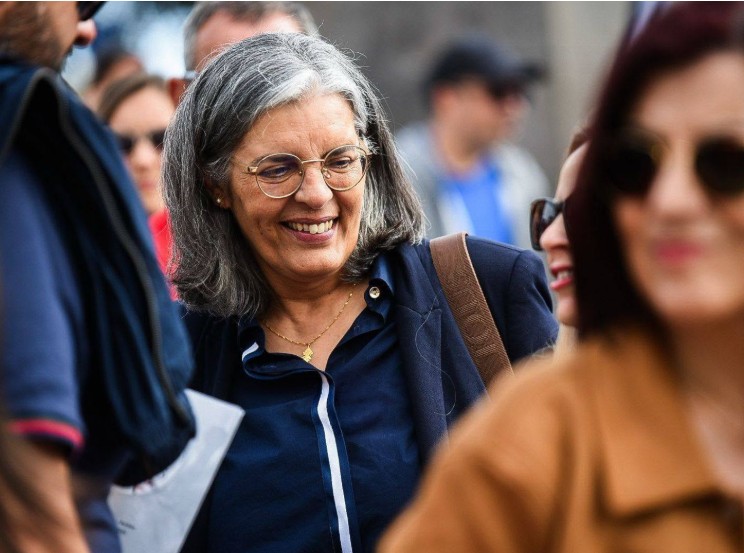
“We must bring people to live in the historic center; we can’t just have local accommodation and tourists.”
Isabel Almeida Rodrigues, candidate for the Unidos por Ponta Delgada coalition (PS, Bloco de Esquerda, PAN, and Livre), advocates for a new political cycle in the municipality. In an interview with Correio dos Açores, after a meeting with the editors of the newspapers, Américo Natalino Viveiros, from Correio dos Açores, and Paulo Hugo Viveiros, from Diário dos Açoers, she points out as priorities the fight against addiction with the principle of housing first, public investment in housing for the middle class, the creation of two bus terminals and new parking solutions, as well as the revitalization of Baixa and Mercado da Graça.
Correio dos Açores – You had a meeting with two daily newspapers in Ponta Delgada, from the Grupo Gráfica Açoreana. How important is the press in giving a voice to citizens and the policies to be implemented?
Isabel Almeida Rodrigues (Candidate for Mayor of Ponta Delgada) – This visit was precisely intended to convey our recognition of the fundamental role that the press plays, not only in providing citizens with access to independent and credible information, but also in defending democracy itself. We live in a time of great threats, in which social media allows the proliferation of news without any verification and without respecting the ethical rules that journalists must comply with. The survival of free and independent media is fundamental for us.
In the difficult context facing the media, public authorities must support private bodies because they perform this fundamental function, and we cannot conceive of democracy without their existence.

What do you propose to do differently from what has been the municipal governance of recent years?
I hope to win the elections and start a new cycle in Ponta Delgada, which needs revitalization and solutions to the concrete problems of the people.
The first priority area is addiction, which is now a very worrying issue, especially in Ponta Delgada, where there is a high concentration of homeless people with substance abuse problems. This is not a problem that the local authority can solve on its own: it requires coordination with the Regional Government and support for institutions that offer local solutions.
We advocate for the principle of ‘housing first’ because it is necessary to provide those living on the streets with a housing solution, while also referring them to treatment and reintegration programs. In Ponta Delgada alone, 153 people are identified as homeless. We cannot pretend that nothing is happening. We want to intervene not because it is unsightly, but because lives and people are at stake, and we believe that much more can be done. This challenge is made more difficult by the proliferation of new psychoactive substances, synthetic drugs, which are a major problem in themselves. But the answer is not to remove the problem from sight and move it elsewhere: we need to work on it and on these human lives.
The second area I would highlight is housing. People have immense difficulty finding a home to rent or buy at a price that their income allows. A very significant public investment in housing is needed, and this investment will cover several areas of our governance: the rehabilitation of vacant properties for housing; the provision of more land for housing, even if it means changing the municipal master plan, because there is also a severe shortage of land, which leads to an exponential increase in the price of those that are available on the market; supporting cooperatives, for example by granting them land with infrastructure, and then having the cooperative build at controlled costs, is another dimension. I would also mention that the local authority should have several homes on the market for the middle class. Because, at the moment, a young person from the middle class has immense difficulty in leaving their parents’ home and getting their own home. And even if they are a couple and have two salaries, the difficulty remains. We need only look at the price at which houses are for sale on the market and the cost of rent.
A third area that we believe is essential is mobility. We have a public transport system that is completely inadequate for the needs of the population and the volume of tourists we have. We cannot continue with tourist mobility based exclusively on rental cars. We need routes that serve the population and routes that also serve tourists. We need to improve the Minibus routes and take them to places that are essential to people’s lives, but we also need to work with the other three operators to find solutions that meet the needs of the population. We also have to intervene in the price of passes, which for some families are absolutely prohibitive. Therefore, we must consider mobility as an essential element of people’s daily lives. We have to take the buses off the avenue, and we have to provide conditions for those who use public transport.
This means having two covered bus terminals (one to the east and one to the west), equipped with facilities such as public toilets, which are currently lacking in the city, and even some essential services for the population.
A fourth area is sports facilities. There are parishes without a single space for practicing sports. We need to ensure that children and young people have quality leisure activities. Sport is essential for development and for preventing risky behavior. This investment in leisure activities must be accompanied by greater attention to the elderly population. We are a municipality with an aging population that needs care and support. We aim to collaborate with all local institutions to enhance the services they provide.
In short, these are the areas I would highlight, without forgetting the need to revitalize the city. You only have to walk through downtown today to see how the landscape has changed compared to a few years ago, when the city was vibrant and full of life. We need to recover this in partnership with local actors, namely with the people who have businesses and services in downtown.

You said that, if elected, you will move forward with the creation of two bus terminals. How does this proposal address the issue of insufficient parking in the city?
When I mentioned our priorities, I inadvertently failed to mention the issue of parking, which is currently a major problem for many people who travel to the city. It is possible to create several parking lots, identify vacant buildings where high-rise construction is possible, and where 60 to 100 parking spaces can be quickly made. And if we do this in different parts of the city, we will be effectively supporting parking.
Now, I think that creating more spaces cannot distract us from what I have already mentioned: a substantial improvement in the service provided by public transport, so that people feel safe and comfortable using it daily. Particularly in the case of tourism, it seems to me that we also have to make this transition. We cannot have thousands of tourists relying almost exclusively on rental cars for their mobility.
The historic center is depopulated because there are not enough incentives for rehabilitation. What measures do you consider a priority to address this problem in Ponta Delgada?
I couldn’t agree more. We need to bring people to live in the historic center; we can’t just have local accommodation and tourists, we need to have a resident population. First of all, I think the local authority needs to carry out a very thorough survey of vacant properties, whether or not they are in ruins, with a view to acquiring, rehabilitating, and making them available.
And as I mentioned earlier, we cannot forget middle-class families, who today have immense difficulty in accessing housing. Naturally, we must review and improve the incentive systems for heritage restoration as a mechanism to entice people to renovate properties in the historic center and live there.
This is a very important issue, because bringing life back to Ponta Delgada depends on it. Therefore, I believe that the City Council will have to make a very significant investment in housing and that, in the case of the historic center, this begins with identifying vacant properties and investing in their restoration, with a view to making them available to families who need them at affordable rents.
You recently stated that you want to “bring life back” to the Graça Market. Given that the building is nearing the end of its renovation, what specifically do you propose to achieve this goal?
First of all, I regret that it has not been possible to complete the work in four years, with the damage this has caused to traders and residents, who have been forced to put up with a space in terrible condition. It is urgent to complete it. But the work alone will not bring the market to life. With the collaboration of traders, it is possible to promote activities that increase the attractiveness of the space. There are several examples in the country of markets that, in addition to selling products, revitalize the space with activities that attract customers. This is my idea for the Graça Market: to involve traders and citizens in initiatives that enhance its attractiveness and encourage more people to visit.
Daniela Canha is a journalist for Correio dos Açores. Natalino Viveiros, director.
Translated into English as a community outreach program by the Portuguese Beyond Borders Institute (PBBI) and the Modern and Classical Languages and Literatures Department (MCLL), in collaboration with Bruma Publication and ADMA (Azores-Diaspora Media Alliance) at California State University, Fresno. PBBI thanks Luso Financial for sponsoring NOVIDADES.
Note: Elections in the Azores
On October 12, Portugal goes to the polls for municipal elections — a moment when local voices rise to shape the future of their cities, towns, and villages. In the Azores and Madeira, these elections carry a particular resonance, as they unfold across islands that live between sea and sky, and whose decisions ripple far beyond their shores.
To accompany this democratic rhythm, Novidades will bring a special feature for the Azorean diaspora in North America and for all who carry an interest in the islands. In collaboration with trusted press partners in the Azores, we will share interviews with candidates — their visions, concerns, and promises. These conversations reveal the pulse of municipalities: from questions of employment and youth opportunity, to the defense of culture, to the everyday challenges of infrastructure, housing, and environment.
Our aim is simple yet vital: to create awareness and connection. The voices that will be heard are not only those of politicians, but also echoes of the Atlantic, carried across generations of Azoreans who once departed but never ceased to belong. By making these perspectives accessible in English, we strengthen the bridge between islands and diaspora, between heritage and tomorrow.
In the days to come, as debates rise and the campaigns are in full swing, Novidades will continue to illuminate these paths — reminding us that democracy, like the ocean, is built of countless drops, each one shaping the tide.
 Novidades - The Islands and the Diaspora