


We are approaching 2026, the year that marks fifty years of political autonomy. What conclusions can be drawn?
It can be seen from two angles. The most important is that of autonomy, the system that underpins politics and governance and, ultimately, the whole of society. And on this point, overall, we have not been able to embrace Portugal’s revolution to become, with the Autonomous Region, a modern 21st-century state; we have not translated this into any improvement in the autonomous system. The other angle is that of policies and governance: with the total failure to improve the quality of the system and democracy, all policies, on the whole, are weak and mediocre. For example, two public companies are currently being privatized, not for reasons of development, but because it is necessary to stem the growing, unsustainable debt, and, worse, without a plan to improve the living conditions of the islanders. The balance is negative.
How did the Region reach this point?
We can divide Azorean democracy into three phases: the PSD-A phase, from 1976 to 1996; the PS-A phase, from then until 2020; and from then until today. In the first phase, the political actors were of regional quality: all projects served the region, all the islands as a whole. These actors were imbued with the perplexity of the novelty of autonomy. They had a matrix of doing well, knowing that autonomy had a solution if the islands walked hand in hand. In an archipelago that had almost nothing, in two decades, the islands, as a whole, took a quantum leap. Attention was given to regional unity. That was its greatest contribution. There were flaws, but this humanitarian condition of equality significantly strengthened the ties between all the islands, and that is the greatest value of this government. Even people who had not studied had the old 4th grade, which was equivalent in quality to almost a current 9th grade, and the general course, comparable to today’s 12th grade, prepared them for a level of education close to a post-Bologna degree. In other words, individuals at that time who did not have a degree, and I believe they were the majority, had a higher level of humanitarian knowledge than those who have a degree today, and even more so than those who do not. The second phase, although very important in the areas of public administration, education, health, social solidarity, and transportation in general, was a phase that destroyed regional unity: one of the vertices of the tripod of regional unity—which had existed since the settlement until 1998—was purged from the Political Statute of the Azores; the principle of harmonious development was also removed; the autonomous system of lawmaking was completely undermined, with all the consequences that this entailed, and all of this has already been studied. And the third phase, very small in comparison, but clear for all to see: we have autonomy, but, considering them as a whole, we have no politicians.

All governments face difficulties; no solution is universally pleasing. In your opinion, what do these governments have in common that makes them, in your view, almost always negative in these three phases following fifty years?
Autonomy encompasses two realities: one relating to the daily lives of the population in terms of government policies, and the other relating to the system that underpins these policies and their development, or regression, or simply ad hoc governance. Let’s look at the system, beyond what we have already mentioned. In the first phase, they were concerned with the issues of the flags and powers of the State, as well as those of the Ministers of the Republic, enforcing them, not for reasons of reason and constitutionality, but because of the usual sentiment of governments that “we are in charge here.” We never proposed the development of a regional finance law, which would only come about in the second phase, nor of various constitutional principles that have been provided for since the original 1976 Constitution and which are still not developed in working memoranda today: the dividends of international relations, the principle of shared management in a thousand matters, which has always existed, although the Statute of the Azores wrote it into its 2009 revision in the second phase; it has never been possible to find a system of governance on each island, either with island councils or with government representatives, worsening in the second phase with the concentration of government department services; nor has it been possible to implement the principle of cooperation between governments, and to this day it has never even been dreamed of making the plans set out in legal documents a reality. In the second phase, in addition to what has been said, it was one of the worst phases and created and enabled its implementation: it centralized all political autonomy in São Miguel. Before April 25, we would receive a simple letter in Terceira within a week; now it takes fifteen days. A book order, if placed through a company that uses a transport service, is received within a week; if put through the post office, it takes twenty days, and surprisingly, it is rarely delivered on the first attempt because, strangely, we are never at home when we are. This is unbearable. But that’s not all: on the issue of autonomy reform, he had the unfortunate idea of wanting to change constitutional powers of sovereignty solely through the Statute law, something that smacks of criminality. The third phase is not even worth mentioning; suffice it to say that even with specialized offices, mistakes are multiplying. There is no memory. Much has been studied and published. If the Azoreans could go into exile, we would all go for the quality of democracy there: here, on the islands, we pay the bill and remain stripped of democracy.
Who can save us? Is there a solution?
We are in a difficult and serious situation. Even the Presidency of the Republic, whose holder was a herald in the Constituent Assembly for autonomy issues, is against us: despite his great fondness for the islands and their people, he disregarded autonomy in the political message he sent to the Azoreans: he kept Cavaco Silva’s appointees as Representatives of the Republic for the autonomous regions: the average age of appointment for Ministers of the Republic was 58 for the Azores and 54 for Madeira; the average age for all positions, Ministers of the Republic and Representatives of the Republic, in these fifty years of autonomy, is 62 for the Azores and 63 for Madeira; but the average age of Marcelo Rebelo de Sousa’s Presidency is 72 for each of the regions. In other words, he wanted to keep incumbents in office for 20 years, and both incumbents will end their terms in 2026 at the age of 86, having been in office since 2006. In other words, Marcelo Rebelo de Sousa has not valued the legal and constitutional institution of political autonomy, nor does he value the rules of democracy. Worse still, he believes that politicians on the islands are angels and that the Azoreans, therefore, do not deserve political citizenship values. In other words, those on the inside exploit us in their weakness to govern and plan, and achieve living conditions commensurate with the large sums of regional budgets. We have no political or democratic means of defense. Those on the outside, with the responsibility of the State, instead of helping us in the simplicity of democratic normality, drag us further down.
Our salvation is up to us. The example of Pico: its people took advantage of the conditions of their island and now have more tourists than Faial, and it won’t be long before they surpass it in other areas. It is this type of case that demonstrates the value of regional unity, building on the previous three centers that aimed to project the development of other smaller centers. But beware: as they no longer exist and as it is a unique and exemplary case of the quality of its populations, and not because of any merit of the governments, there is a danger, through the imposed centrality, of provoking conditions to undermine them, perhaps also undermining Faial. The current centrality of autonomy is, by nature, business-oriented, that is, it is managed like a company that seeks only the profits of monopolies; when this is the case, it’s every man for himself…
What can we do?
Right now, nothing: the fifty years are coming to an end. Over the next fifty years, and based on what we achieve, we can and must take advantage of the opportunity to make the Autonomous Region what the Constitution envisages for us Azoreans: that we be happy in the middle of the Atlantic with the means we have and with a democracy appropriate to the nature of the country’s democratic rule of law. If we do not change the regional government system, we will never succeed, because it is this system that allows citizens to effectively communicate with governments. And this is where Marcelo Rebelo de Sousa failed: knowing full well that our model is unconstitutional because fundamental rights are not effectively guaranteed by the meager system of government, as we saw during Covid-19, with arbitrary arrests, and where people could only defend themselves through the courts!
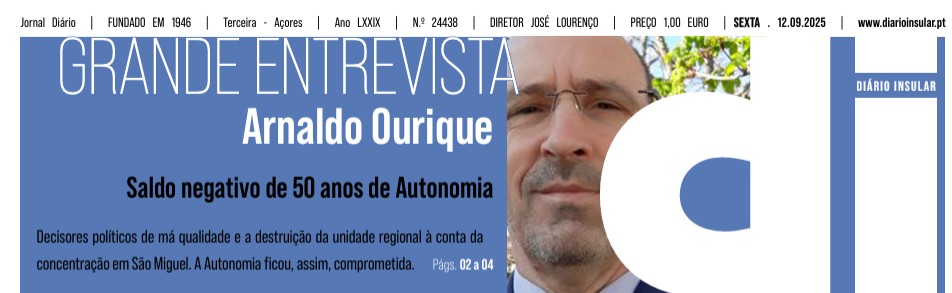
In Diário Insular-José Louenço, director-Armando Mendes (PhD), editor-in-chief
Translated into English as a community outreach program by the Portuguese Beyond Borders Institute (PBBI) and the Modern and Classical Languages and Literatures Department (MCLL), in collaboration with Bruma Publication and ADMA (Azores-Diaspora Media Alliance) at California State University, Fresno. PBBI thanks Luso Financial for sponsoring NOVIDADES.

 Novidades - The Islands and the Diaspora