


“It is often necessary to remove these young people from their circle of friends, because it is this environment that reinforces risky behavior. If they change their surroundings and routine, they become more open to realizing that there are alternatives,” says Sónia Rodrigues, who is of Portuguese descent, admitting that she is “aware of the statistics, but I know that the problem in the Azores, at least in terms of consumption among young people, is quite high. Therefore, projects of this type make perfect sense, especially because it is a small environment from which it is difficult to escape, where all help ends up being limited, and both young people at risk and the people or entities that try to support them no longer know what to do.”
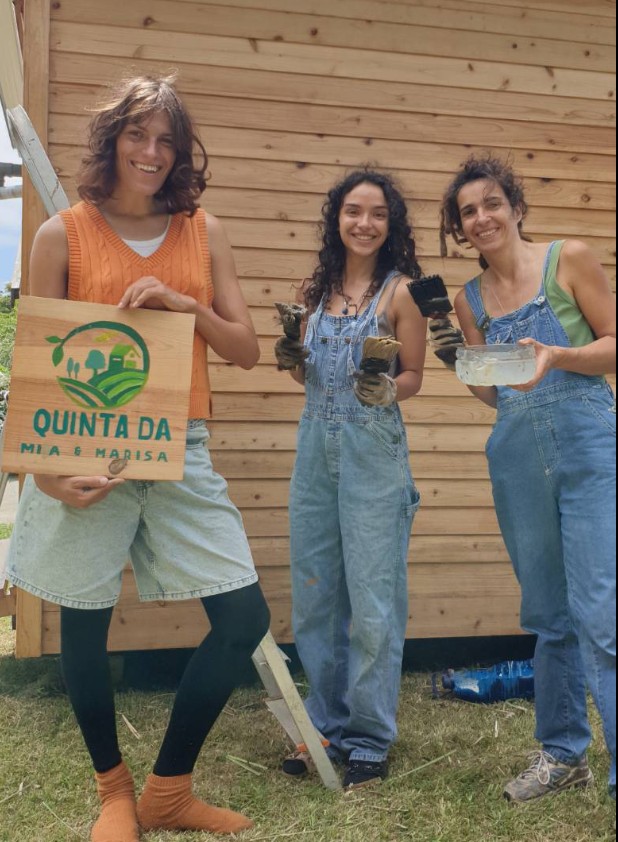
Created in 2020 by Sónia Rodrigues, of Portuguese descent, and her husband, David Thommes, Quinta da Mia & Marisa, in Ginetes, began as an animal sanctuary and has evolved into an educational and ecological project. The couple, originally from Luxembourg, moved to São Miguel with their children and collaborates with a German association, Ensemble, under which they act as a temporary foster family for vulnerable young people from Germany and Luxembourg. In addition, the farm is open to the local community, hosting meetings and camps that bring residents and foreigners together, promoting contact with nature.
In 2020, the couple found the land that would become Quinta da Mia & Marisa. For three years, the family divided their time between Luxembourg and the Azores until they settled permanently: “So that the change wouldn’t be so abrupt for our children, we lived between there and here for three years, and took the final step in 2023.” During that period, explains Sónia, “we had goats, we made cheese, and we even had groups of scouts from abroad who came to do activities and enjoy our nature.” Over time, the focus was also on environmental sustainability: “We collect rainwater and filter it. We have already planted more than three hundred fruit trees and want to make the farm increasingly self-sufficient, based on the principles of regenerative agriculture.”
The collaboration with the German association Ensemble has added a new dimension to the project. Now, this farm, which in the future also aims to function as a holiday camp, welcomes young people in vulnerable situations, offering them a family environment with educational support: “They refer young people to me because I have the required diploma, I am a social educator with experience with at-risk youth. My husband is a teacher, and he handles the teaching aspect. These young people usually have distance learning classes, and we try to integrate them into cultural or sports activities so that they can adapt gradually.“
To be part of this type of program, explains Sónia, you must meet formal criteria and possess specific skills. ”The association signed a contract with us because we have the required training. In this context, there has to be an association that handles multidisciplinary support, travel, and payment for those who host, because we are talking about paid work. They are also in contact with the juvenile courts in their respective countries to issue authorizations. Ensemble also works with Spain, Italy, and Greece.”
Sometimes we have to remove young people from their environment because, being so closed off, they can no longer see other possibilities for themselves. Luxembourg, like the Azores, is a very small environment, so it is difficult for them to disconnect, especially when there are difficult family circumstances. It also often happens that these young people are unable to distance themselves from friends who push them down complicated paths of alcohol, abuse, and substance use. If we remove them from this toxic environment and show them alternatives, it is like a rebirth; they start from scratch,” she explains.
The first young woman welcomed in São Miguel stayed on the farm for nine months and, despite having been out of school for several years, returned to Luxembourg intending to resume her studies: “The project was not extended because the young woman decided to continue her journey in Luxembourg, but here she went through important stages in understanding what her next steps would be. We accompany the transition of these young people who arrive without prospects, don’t know what their next step is, and need to rediscover a sense of purpose. We are a host family and professionals who help them set goals.” The educator explains that in Ponta Delgada, she was prepared to integrate into arts and sports classes at the Antero de Quental School as a step toward socialization and a gradual return to the school environment. At the end of the program, this model provides for a brief two-week trauma therapy in the south of France, co-funded by the German and Luxembourg governments.
Activities related to foster care include contact with animals, working in the garden, and cooking experiences. “One of the first activities we propose is contact with animals and in this case, we have a horse belonging to our neighbor and we make that connection right away because animals help us to calm down. Caring for the horse, having contact with it, helps to express emotions and release some of the burden that these young people carry with them. They also tend the vegetable garden and have a little corner where they prepare and plant something and then have to take care of it to see what comes out of it. If they take good care of it, there are results; if they don’t, they try again. It’s important to show them that if they take care of things, they get positive results. Then there are also the cooking activities where we encourage them to create recipes with the food they harvest.”

In addition, the farm is developing infrastructure for adventure and movement activities: “We have a fantastic cave and we are installing a zip line for young people to explore that area. We want to create an adventure trail, a space for climbing trees and, ultimately, encourage the motor skills that modern daily life has caused us to lose. I am also doing a three-year Biodanza training course, and next year I will be offering this modality to children and young people, here or in other places on the island. Because movement is very important and we can express many things through dance.”
When asked about the feasibility of applying this model to the Azorean reality, Sónia believes that it would be a very important response. For her, the principle of removing young people from their environment and from the circle of friends that reinforce risky behavior has a greater dimension in the island context. “It is often necessary to remove these young people from their circle of friends, because it is this environment that reinforces risky behavior. If they change their space and routine, they become more open to realizing that there are alternatives,” she explains. She adds, “I am not aware of the statistics, but I know that the problem in the Azores, at least in terms of consumption among young people, is quite high. Therefore, projects of this type make perfect sense, especially because it is a small environment from which it is difficult to escape, where all help ends up being limited, and both young people at risk and the people or entities that try to support them no longer know what to do.”
For the farm owner, prevention is essential, and the Azores have everything they need to pursue this path: “Prevention is very important, and in this sense, nature, especially the nature of the Azores, is our ally. For example, I really like the Azores TreeTop Park in Furnas. In terms of education and drug prevention, there is nothing better. Schools should visit and explore this issue in much greater depth. In the specific case of drug addiction, what young people are looking for is adrenaline. If we show them that they can experience this in other ways, we are taking the first step towards them not needing substances. The important thing is to show them that they can achieve these states, whether adrenaline or tranquility, in an organic and healthy way.”

Regarding the difficulties of implementing a project of this type in the Azores, Sónia points above all to institutional resistance: “The greatest difficulty is convincing entities, for example in education, that this is a complementary form of traditional teaching and that it is essential to have projects like this. We come from countries that are, I would say, thirty years ahead of Portugal in terms of the education system. And a lot does need to change. The evolution in education has been mainly technological, and it’s great to keep up with that, but there has to be a balance. Today, more than ever, we need to reconnect with nature, which is a form of therapy in itself.”
“It’s always a great success to know that we can help, even if it’s just a few young people, but that they are left with a positive mark on their lives, that they can find their way, that they can connect and that they have a little better mental health,” she says.
From here, the project continues to develop, with a focus on prevention and networking. Sónia is therefore available to liaise with local schools and associations and, in the future, to welcome young people from the Azores who are at risk. The intention is to continue to do everything possible to support those in need, without losing the family dimension that underpins Quinta da Mia & Marisa: “The priority is for our children to be happy here, in a more family-oriented environment and close to nature. Otherwise, I don’t look too far into the future, I focus more on the day-to-day. Staying strong, courageous, and persevering, that’s my focus. But whatever comes is welcome. Above all, with what is happening in the world, we cannot lose our humanity. It is very important that we are there for each other,” she concludes.
Daniela Canha is a journalist for Correio dos Açores-Natalino Viveiros, director.
Translated into English as a community outreach program by the Portuguese Beyond Borders Institute (PBBI) and the Modern and Classical Languages and Literatures Department (MCLL), in collaboration with Bruma Publication and ADMA (Azores-Diaspora Media Alliance) at California State University, Fresno. PBBI thanks Luso Financial for sponsoring NOVIDADES.

 Novidades - The Islands and the Diaspora