

“It would take 384% of our tax revenues to pay off the debt,” says João Teixeira, with Duarte Freitas guaranteeing “a savings plan of €30 million” in 2026.

At the conference on “Regional Public Finances,” organized by the Order of Economists, João Teixeira warned that the Azorean deficit is structural, Gualter Furtado defended several points to consider for a new revision of the Finance Law of the Autonomous Regions, and Duarte Freitas warned that 2026 will be “a year of brutal demands” to implement the PRR and Agenda 2030.
The Azoris Royal Garden Hotel in Ponta Delgada hosted the conference “Regional Public Finances,” organized by the Azores Regional Delegation of the Order of Economists. The panel brought together António Mendonça, president of the Order of Economists, João Teixeira, president of the Faculty of Economics and Management of the University of the Azores (FEG/UAc), Gualter Furtado, economist and advisory member of the Association, Duarte Freitas, Regional Secretary for Finance, Planning, and Public Administration, as well as university professors Mário Fortuna and Monteiro da Silva. The conference was moderated by journalist Rui Paiva.
The interventions focused on distinct but complementary central issues: the evolution of the budget balance, the rules and loopholes of the Regional Finance Law, and the pressures on the Azorean budget, especially in the PRR implementation cycle.
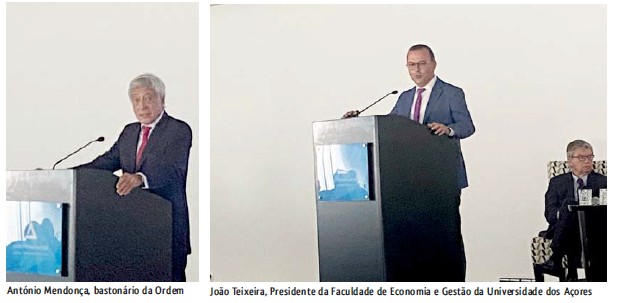
“Less party politics and more technical competence”
At the start of the conference, the president of the Order of Economists emphasized the need for an informed debate, free from ideological bias: “One of the best decisions we can make, as a society and as a professional class, is to have less partisan politics and more technical competence in public debate. A less ideological position and one more focused on finding concrete solutions to the country’s problems.”
Mendonça reinforced the role of the Association as a mediator, recalling that constructive dialogue is essential for consistent economic decisions: “Our goal should be to promote dialogue and agreement between different opinions. The Order of Economists can help overcome the barriers of politics and ideology by offering serious and well-founded contributions to economic decisions.”
“What affects Portugal also affects the Azores, and vice versa. In addition, the Azores also have their own specific characteristics: it is an archipelago, with additional challenges of coordination between the islands themselves,” he added.
“The Azorean deficit remains structural and difficult to reverse.”
João Teixeira made the first presentation of the panel, which focused on an analysis of the Azores’ budget balances and dynamics over the last ten years. “I chose 2015 as a starting point because that moment marks the post-Troika period and, at the same time, the liberalization of airspace in the Azores. From then on, the regional economy began to grow much more significantly, mainly driven by tourism.”
However, he warned that the data should be contextualized concerning the Troika and COVID periods. Nevertheless, until 2019, the region managed to stay within the deficit limit set by the European Union. From then on, according to the academic, the situation worsened.
As for the forecasts, he was clear: “To achieve a deficit of only 3%, we would need growth of close to 10%, which is unrealistic.”
Finally, he highlighted debt as a structural problem: “At first glance, we might think that we are in a better situation than the Republic or Madeira, because the debt-to-GDP ratio forecast for 2024 is lower. But I consider this to be illusory: debt is not paid with GDP, it is paid with revenue. It would take 384% of our tax revenue to pay off the debt, compared to 381% in the Republic and 373% in Madeira.”
“A Finance Law for the Autonomous Regions, to be fair, must respect fundamental principles.”

In his speech, Gualter Furtado presented a structured argument, advocating a revision of the Finance Law for the Autonomous Regions. He opted for a direct and expository approach, making clear what, in his view, should be included in the respective legislation.
“A Finance Law for the Autonomous Regions, in order to be fair and balanced, must respect: the Constitution of the Portuguese Republic, the rights, guarantees, and responsibilities of the autonomies of the Azores and Madeira, and the Political and Administrative Statutes of these Autonomous Regions. The principles of Financial Autonomy, National Solidarity, Territorial Continuity, Fiscal Autonomy, Regionalization of Services, and Predictability. A clarification of the tax revenues that belong to the Autonomous Regions and, when this clarification is not possible, apply the capitation method.” The economist emphasized the importance of the per capita criterion for VAT, recalling the practice that began in 1985:
“I advocate the application of the per capita principle, recalling that in 1985, when a 30% reduction in this tax was applied in the Autonomous Region of the Azores by the State, it was to compensate for the costs of insularity, and the transfer of revenues calculated on the basis of the capitation of this tax was always made in full, that is, without the deduction of 30%, as is currently the case with this Regional Finance Law No. 2/2013.”
Furtado also advocated greater fiscal power for regional assemblies: “Guarantee the initiative and fiscal power of the Regional Assemblies of the Autonomous Regions, respecting territoriality in the application and creation of taxes, changes in national tax rates and tax deductions, including the granting of tax benefits and tax incentives.”
He also stressed the need to ensure fair and direct transfers: “Tax and other revenues, transfers from the State Budget, and Community transfers will be transferred directly to the Autonomous Regions, to a Treasury account of the Regional Finance Secretariats.”
He highlighted the importance of a correction coefficient that is more favorable to the Azores: “The formula to be adopted for transfers from the General State Budget should compensate for the additional costs of insularity. (…) This formula should have a correction coefficient that is more favorable to the Azores, taking into account the distance from the mainland and the number of islands in each archipelago, and not just the number of inhabitants.”
The economist’s speech continued with proposals on projects of common interest, national incentives, coordination between public finances, and mechanisms for periodic review of the law: “As for Projects of Common Interest, these should be 85% financed by the State. (…) This Law should contain an article requiring its review every four years.”
Gualter Furtado concluded by arguing that autonomy should also cover benefits linked to the sea and airspace: “Finally, this law must create the possibility for the Autonomous Regions to have access, with the support of the State, to a set of benefits arising from financial movements created by the circulation and exploitation of the immense sea that surrounds these Autonomous Regions and also their airspace.”
“2026 will be the most demanding year in terms of financial execution.”

The Secretary of Finance, Duarte Freitas, began by characterizing the structural dependence of the regional economy on the public sector, pointing out the need for greater dynamism in private initiative: “The economy of the Azores, over many years, has been too dependent on the public sector. We still lack the dynamism of private initiative that we would like to have. I give a clear example: the comparison between IRC and IRS. In the Azores, the relative weight of personal income tax is much lower than in Madeira and mainland Portugal.“
In the Azores, the challenge is marked by changes in the labor market: ”We no longer face the problem of unemployment as much as in the past. What we have today is a labor shortage. But we still have an economy that is very dependent on the public sector and less vibrant in private initiative.”
The Regional Secretary made it clear that the next budget cycle will be decisive: “I want to point out a fact that will mark the next budget cycle: 2026 will be a brutally demanding year. Due to the N+3 rule of Agenda 2030 and the PRR targets, the Region will have to execute very significant amounts. In 2026 alone: €418.5 million from the PRR and €192 million from Agenda 2030.”
Freitas warned that this is a difficult budget to execute: “We are therefore faced with a budget that is not difficult to design, because the margins for choice are reduced, but it will be extremely difficult to execute. And I can already announce that in 2027, the Investment Plan will be much smaller than in 2026.”
The secretary also explained the growth in inelastic expenditure in relation to public administration, health, and education.
Despite the difficulties, he highlighted some positive signs: “The Azorean economy is now more robust than ever: GDP is expected to exceed €6 billion in 2025 and reach €6.3 billion in 2026; we have the largest employed population in the region’s history and the lowest unemployment rate in the country; tourism, agriculture, and exports are experiencing unprecedented growth; inflation in the Azores has been lower than in the rest of Portugal.”
Freitas pointed out, again mentioning the issue of the PRR, that the main challenge will be to combine economic growth with financial sustainability: “The great challenge of the 2026 Budget will be to ensure the implementation of the PRR and the 2030 Agenda, while at the same time ensuring the Region’s inelastic expenditure. We cannot escape this reality.”
“In the 2026 Budget, the Region will have a savings plan of around €30 million. It is not much, but it is what is possible given the inelastic expenses we carry. This effort will result from cost reductions in public administration, the disposal of assets, and cuts in payments for offices, consultancies, transportation, and travel.
This plan does not solve everything, but it will be an important contribution. First, to the sustainability of public finances. Second, to ensure that we can implement the PRR and Agenda 2030 without losing funds,” he concludes.
José Henrique Andrade is a journalist for Correio dos Açores, directed by Natalino Viveiros.
Translated into English as a community outreach program by the Portuguese Beyond Borders Institute (PBBI) and the Modern and Classical Languages and Literatures Department (MCLL), in collaboration with Bruma Publication and ADMA (Azores-Diaspora Media Alliance) at California State University, Fresno. PBBI thanks Luso Financial for sponsoring NOVIDADES.

 Novidades - The Islands and the Diaspora