

The Vice-President of the Regional Government, Artur Lima, yesterday highlighted the Region’s concern about the new Multiannual Financial Framework. Quoted in a statement from the Azorean executive, Artur Lima considered that the proposal for the new European budget “disregards the outermost regions.”
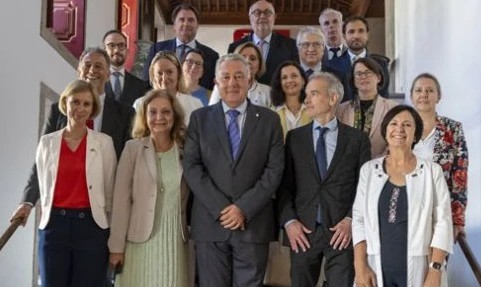
Artur Lima received the Danish ambassador, Lars Steen Nielsen, during an official visit by a delegation of ambassadors from European Union Member States to Angra do Heroísmo. The meeting took place following the Danish presidency of the Council of the European Union.
“We lead by example in environmental protection, biodiversity, and renewable energy,” said the vice president of the regional executive, who nevertheless considered it essential to receive “support from the European Union in the air and maritime transport sectors.”
Artur Lima added that “Santa Maria is 600 kilometers from Corvo” and that “we must address, for example, the conditions of maritime transport, education, and health in the nine Azorean islands.”
The region’s infrastructure “must also be multiplied across the archipelago,” he added, stressing that “Europe does not always understand this outermost condition.”
Artur Lima stressed that the Azores are one of the greatest European examples “in biodiversity conservation, also with the creation of Marine Protected Areas,” but that “Europe does not consider this value, especially our geopolitical and geostrategic dimension.”
He recalled that the Azores have the largest Exclusive Economic Zone in the European Union and are “Europe’s western frontier.”
However, he considered that the Azores “do not see the benefit of their position,” at a time “when it is essential to enhance their geostrategic dimension in this context of instability.”
The minister also stated that “it is the Azores and Madeira that give the country its true dimension” and that “Portugal does not value this Atlantic dimension.”
The official visit of the delegation of ambassadors from European Union member states accredited in Portugal began in São Miguel on Monday and continued yesterday in Angra do Heroísmo.

In parallel with the audience with the Danish ambassador, a presentation on the European Union’s Cohesion Policy in the Azores was given by Nuno Melo Alves, the regional director of Planning and Structural Funds.
The program for the trip to Terceira also included an audience with Pedro Catarino, the Representative of the Republic for the Azores.
“The new context and new threats have highlighted and reinforced the strategic importance of the Azores and their role in promoting international security, maintaining the North Atlantic as a zone of peace and ensuring the safety of transatlantic maritime navigation, air traffic, and digital communications—so crucial in our era. The Azores are also a valuable hub (logistics center) in the middle of the Atlantic,” Pedro Catarino said at the meeting.
The Representative of the Republic believes that “the Azores are an extraordinary resource for Portugal and also for NATO and the European Union, which we must all value and seek to strengthen in all areas—both military and civilian—by putting their capabilities at the service of the common good of our countries.”
Pedro Catarino highlighted the role of the Atlantic Center and the Air Center, as well as the advances in the space project for Santa Maria, with the first orbital flight scheduled for 2027.
“I believe there is vast potential for cooperation with our European Union partners, which we must promote,” he stressed.
The Representative of the Republic for the Azores also addressed the area of defense. “The Azores are a fundamental link between Portugal and the United States. The Lajes facilities played a crucial role during World War II in anti-submarine warfare. They have been available to our American allies for over 70 years under a Cooperation and Defense Agreement, and their use has been decisive for the US on several occasions, notably during the Yom Kippur War in 1973 and, more recently, in the Gulf War,” he said.
“Our Exclusive Economic Zone is one of the largest in the European Union, and surveillance and rescue operations are an essential part of the missions of the Portuguese Navy and Air Force. Monitoring the movements of the Russian fleet, which are increasingly frequent these days, is also an important mission for our Armed Forces,” he stressed.
In Diário Insular-José Lourenço, director, and Armando Mendes (PhD), editor-in-chief.
Translated into English as a community outreach program by the Portuguese Beyond Borders Institute (PBBI) and the Modern and Classical Languages and Literatures Department (MCLL), in collaboration with Bruma Publication and ADMA (Azores-Diaspora Media Alliance) at California State University, Fresno. PBBI thanks Luso Financial for sponsoring NOVIDADES.

 Novidades - The Islands and the Diaspora