

As part of the Azores Regional Government’s digital transition strategy, the Regional Secretariat for Education, Culture, and Sport (SRECD) began the dematerialization of school textbooks in the 2021/22 academic year, making digital books available to all 5th and 8th-grade classes in public schools in the Azores. This was the first step in a project developed in line with the European Union’s Digital Education Action Plan, which, from the outset, planned to extend to all students in the Azores from the 2nd cycle of basic education to secondary education. Its implementation began in a 5th-grade class at the Francisco Ferreira Drummond Basic and Integrated School on Terceira Island and in an 8th-grade class at the Antero de Quental Secondary School in Ponta Delgada. Last school year, the initiative already covered all classes from 5th to 10th grade, with full coverage of secondary education to be completed by the end of 2025, with the project being extended to all 11th and 12th-grade classes. Porto Editora, through its Escola Virtual 360º service and with the support of Samsung, Altice, and Expert, has been the main partner of the Regional Secretariat for Education, Culture, and Sports in implementing the project. Specifically, 31,900 new laptops and tablets have been distributed to public schools in the Azores for student use. The Digital Education (Azores) project, which includes other types of ICT equipment, such as interactive screens and simple printers, as well as essential connectivity hardware and software, is the result of an investment of €43.2 million. This fulfills an aspiration of the current Regional Government, and it is now time to assess the results of the digital transition in the education system. This option is not always consensual. For now, the Regional Secretariat for Education, Culture, and Sports, headed by Sofia Ribeiro, has the floor at the start of the actual “Year 1” of the digital school.
Correio dos Açores-On the 24th of last month, the Government Council approved the Resolution authorizing the acquisition of digital textbooks for the Domingos Rebelo Secondary School for the 2025/2026 academic year, at an estimated cost of €1.1 million under the PRR. This acquisition aligns with the Regional Government’s goal of making digital textbooks accessible to all students in the regional education system by the fourth quarter of 2025.
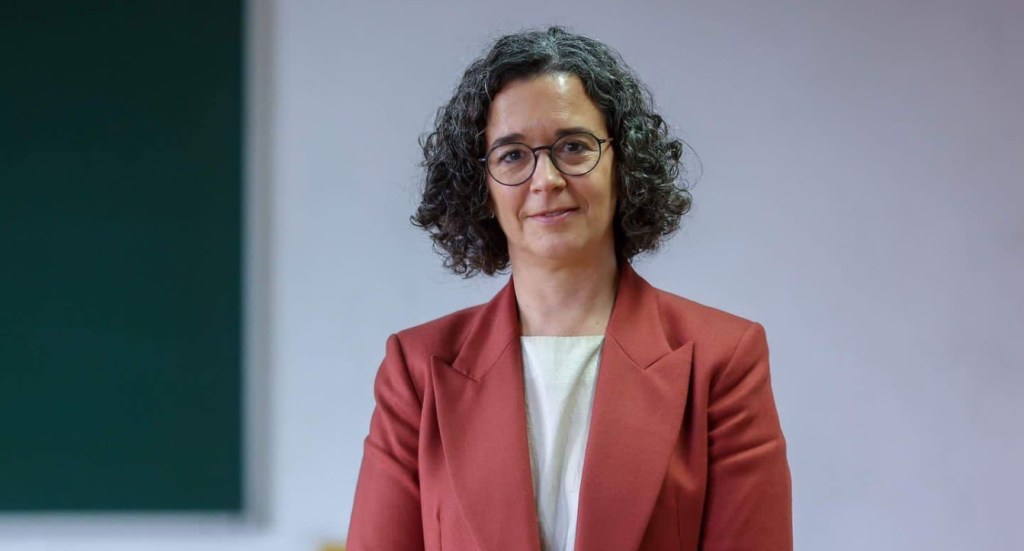
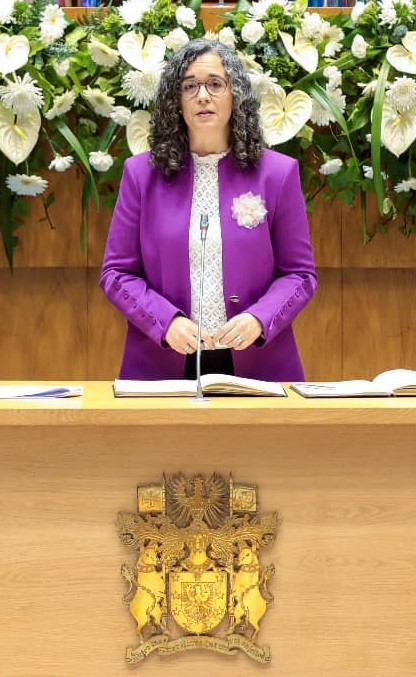
Sofia Ribeiro, Regional Secretariat for Education, Culture, and Sports: As described on the Education Portal, in the section dedicated to Digital Textbooks—which we recommend reading for information about the project— the Regional Secretariat for Education, Culture, and Sport (SRECD) began the dematerialization of textbooks in the 2022/23 academic year, making digital books available to all 5th and 8th grade classes in basic education in public schools in the Azores, as set out in plan C20 – Digital Education (Azores) of the Recovery and Resilience Plan of the Autonomous Region of the Azores, to cover all levels of education (from 5th to 12th grade) in the 2025/26 academic year, which is now beginning. There is no intention, nor has there ever been, to include 1st Cycle students in this project.
At the beginning of last week, we received information that the project to implement digital textbooks at Antero de Quental Secondary School would be delayed, and with no expected date for completion, which would be contested by teachers…
The acquisition of digital textbooks by ES Antero de Quental is subject to an international public tender, which has longer deadlines compared to tenders held by other Organic Units. SRECD proceeded with the direct acquisition of digital textbook licenses for all students at this school for a period of one month, the estimated time for the tender procedure to be completed. This will allow students at Antero de Quental Secondary School to access digital textbooks on the first days of school.
Are all the funds allocated to the project part of the PRR?
Yes, according to information available on the Education Portal, in the area dedicated to Digital Textbooks.
Using the full potential of digital textbooks requires prior training, but also ongoing training, for both teachers and students. How has this process been going, and how is its continuity planned?
At the beginning of each school year, publishers provide training to all teachers in all subject areas. These training sessions, which are set to continue, have been well attended. Teachers themselves, in the classroom, clarify any doubts and provide the necessary support whenever needed. When relevant, other training sessions are organized during the school year.
School textbooks, like any other ICT, require ongoing support for both software and hardware. Who is responsible for providing this support? The schools, the authorities? Through their own resources and/or by contracting services?
The SRECD provides ongoing support through its IT and Telecommunications Center (NIT), which, together with the service provider, gives all the necessary support to the Organic Units, both in terms of hardware and software. No additional services are contracted.
What is your assessment of the known results of schools that have already made full use of this technological resource in previous academic years?
The assessment is positive, taking into account the surveys that have been conducted so far with focal points, teachers, and students. An external evaluation of the project is currently underway, which may provide greater clarity regarding the use of digital textbooks as a teaching tool, their potential, weaknesses, and possible procedures for improvement.
What has been the reaction of parents and guardians?
Questionnaires for guardians are included in the external evaluation plan that is being carried out. In our direct contacts with parents’ associations and even through individual inquiries, we have obtained very diverse opinions.
To what extent is the possibility considered that new technologies, particularly digital textbooks, may affect the relationship between guardians and their respective students, due to the possible limitations of the former in the field of these same new technologies?
There is no data available to indicate the extent to which the relationship between guardians and their respective students may have been affected. This assessment may eventually result from the ongoing external evaluation. However, considering the questionnaire conducted in June 2024 among students, in response to the question “Since you have been using digital textbooks, do you feel more or less support from your parent or guardian (or other adult) in doing your homework?“ 18% of respondents consider that they have more support, 50% consider that they have the same support as before, 13% say they never had support even when using paper textbooks, and 19% consider that they have less support. As an additional note, it is worth mentioning that we do not consider these technologies to be ”new technologies.” They are technologies that have been firmly established in society and in the lives of everyone—students, teachers, and parents—for many years. The technologies that are truly designated as “new technologies,” and which have deserved the attention of this Regional Secretariat, particularly in terms of strategies for integration into teaching practices, are Artificial Intelligence and Machine Learning.
Is investment in Digital Education still a priority? What are the next steps?
Investment in Digital Education is, of course, an important aspect. Still, the highest priority is always to ensure that all educational stakeholders—students, teachers, and schools—have the best possible conditions for teaching and learning. Our goal is to ensure that education in the region provides a solid and equitable foundation for the citizens of the future, capable of responding to the challenges of a constantly changing society whose future is shrouded in a high degree of uncertainty.
What is your comment on the impact assessment report of the Digital Textbooks Pilot Project (PPMD) on the learning of students in grades 5 to 12, as presented by the Directorate-General for Education and Science Statistics, which concludes that “participation in the PPMD did not have a systematic effect on students’ academic performance”?
The report you refer to concerns the Digital Textbook Pilot Project implemented on the mainland, whose design and implementation model differed significantly from the reality of the Autonomous Region of the Azores. This difference is crucial: in the Azores, the implementation of digital textbooks was conceived from the outset as an integral part of a broader strategy for the digital transformation of schools, ensuring equitable and accessible conditions for all students. Unlike the mainland model, in the Region, it was ensured that each student has their own individual equipment, properly managed in the school environment, as well as access to digital platforms containing textbooks and other digital resources requested by the Organic Units. At the same time, training activities for teachers have been promoted, as mentioned above, in order to enhance the pedagogical use of these resources. Therefore, it is not appropriate to directly compare situations that are structurally different. What we can say is that, in the Azores, digital textbooks have not only modernized teaching and learning practices, but also ensured greater equality of opportunity and prepared our students for the challenges of an increasingly digital society.
Interview by Rui Melo Leite, journalist for the newspaper Diário dos Açores – Paulo Viveiros, director.
jornal@diariodosacores.pt
Translated into English as a community outreach program by the Portuguese Beyond Borders Institute (PBBI) and the Modern and Classical Languages and Literatures Department (MCLL), in collaboration with Bruma Publication and ADMA (Azores-Diaspora Media Alliance) at California State University, Fresno. PBBI thanks Luso Financial for sponsoring NOVIDADES.

 Novidades - The Islands and the Diaspora