


Interest in the Terceira Bearded Dog began in the 1970s, but the process for national recognition of the breed would only start decades later, in 2001.
This goal was achieved in 2004, bringing together the Biotechnology Center of the University of the Azores—which carried out the genetic work and morphological data collection—the Terceira Island Bearded Dog Association, and the regional secretariat of Agriculture (regional directorate of Agricultural Development), in addition to the Portuguese Kennel Club.
A new process is now beginning for the international recognition of the breed by the International Canine Federation. To this end, the help of those who have this type of dog in the Azores, in the rest of the country, and also abroad is essential, explains Paula Lima Braga, the breed’s technical secretary, to DI.
“We have nearly 1,700 dogs in the database. Half of them will have already died. Then there are a number of dogs that may not be in that database. These are dogs that were born without our knowledge, despite our efforts to reach all litters, but it is difficult… We need ‘new blood’, so to speak, ‘different’ blood in our database,” she summarizes.
Artur Machado, a researcher at the UAç Biotechnology Center, stresses that the number of dogs in the database is a decisive factor for internationalization. To facilitate new registrations, a proximity logic will be adopted. “We are asking for the collaboration of all parish councils. We will send a letter to all of them. We want to hold meetings in the parishes themselves, with the help of the councils, to reach as many people as possible,” he explains.

Artur Machado believes that this goal is positive for the localities. “It is also in the interest of the parish itself. Let’s suppose there are three or four breeders, or more. This international recognition opens doors for commercialization. It is completely different to be a breed known locally or worldwide,” he points out.
Currently, there are already Barbados da Terceira dogs in places around the world, such as the United States, France, the Netherlands, and the United Kingdom. “There are countries where there are breeders, and this step is fundamental. For this, we need as many families and animals as possible,” he emphasizes.
Paula Lima Braga stresses that there should be no fears about joining the project. “It is important to draw the attention of people who have Barbados dogs that are not microchipped or registered. We are able to microchip and register Barbados dogs free of charge. The Portuguese Kennel Club has provided us with microchips for this purpose, and we have been registering dogs for several years now, and many of them have been identified in this way,” she assures us.
Once this new survey is complete, the path to internationalization could be quick. “In principle, once all this documentation is done, the respective DNA tests, the genetics and population studies… Then the standards are set,” says Artur Machado.
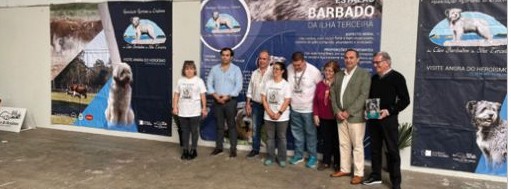
In addition to the entities involved in national recognition, the Angra do Heroísmo City Council is also lending its support. “The City Council has helped us with events and exhibitions and will also support the genetic work for international recognition,” emphasizes Paula Lima Braga.
For Artur Machado, international recognition of the breed is a project that goes beyond party politics. “All the institutions have come together to move forward with the Barbado,” he says.
“It’s a project that would be a shame if it didn’t come to fruition. There are already animals out there, and breeders are eager to compete with other breeds,” he adds.
On the mainland, the numbers speak for themselves, with more than five hundred Barbados da Terceira dogs registered. A club dedicated to the breed has also been created in the United States. The goal now is to obtain an international “passport,” which will open up new marketing horizons and open the doors to the world of competitions and exhibitions.

Part of the culture of Terceira
Several factors define a breed. “It is a group of individuals that, in morphological terms, differs from other similar breeds, but has a specific geography and cultural connection,” explains the researcher from the University of the Azores.
Artur Machado points out that the Barbado da Terceira dog “was ‘made’, selected by the people of Terceira, according to what they needed and wanted the dog to do.”
“The São Miguel Fila dog existed in São Miguel and not in Terceira. Culturally, it was ‘made’ by the people of São Miguel. The German Shepherd, etc… All breeds reflect cultural involvement. There are many breeds of long-haired dogs, but there is only one from Terceira,” he points out.
Therefore, he also sees international recognition of the breed as a way to take the name of Terceira to more places.
Paula Lima Braga recalls that these dogs were initially bred for work, and there are still farmers who use them to herd cattle. However, Barbados dogs are also companion animals today, docile, loyal, and good with children.
“It’s an irresistible dog for kids. As a puppy, it’s like a real stuffed animal. It’s a friendly dog, it becomes the desired companion animal,” agrees Artur Machado.
The “extremely beautiful, attractive, and gentle” dog that “kids love” is now heading for internationalization. “All that’s left is for people to get on board,” recalls the researcher.
in Correio dos Açores-José Lourenço, director
Translated into English as a community outreach program by the Portuguese Beyond Borders Institute (PBBI) and the Modern and Classical Languages and Literatures Department (MCLL), in collaboration with Bruma Publication and ADMA (Azores-Diaspora Media Alliance) at California State University, Fresno. PBBI thanks Luso Financial for sponsoring NOVIDADES.

 Novidades - The Islands and the Diaspora