

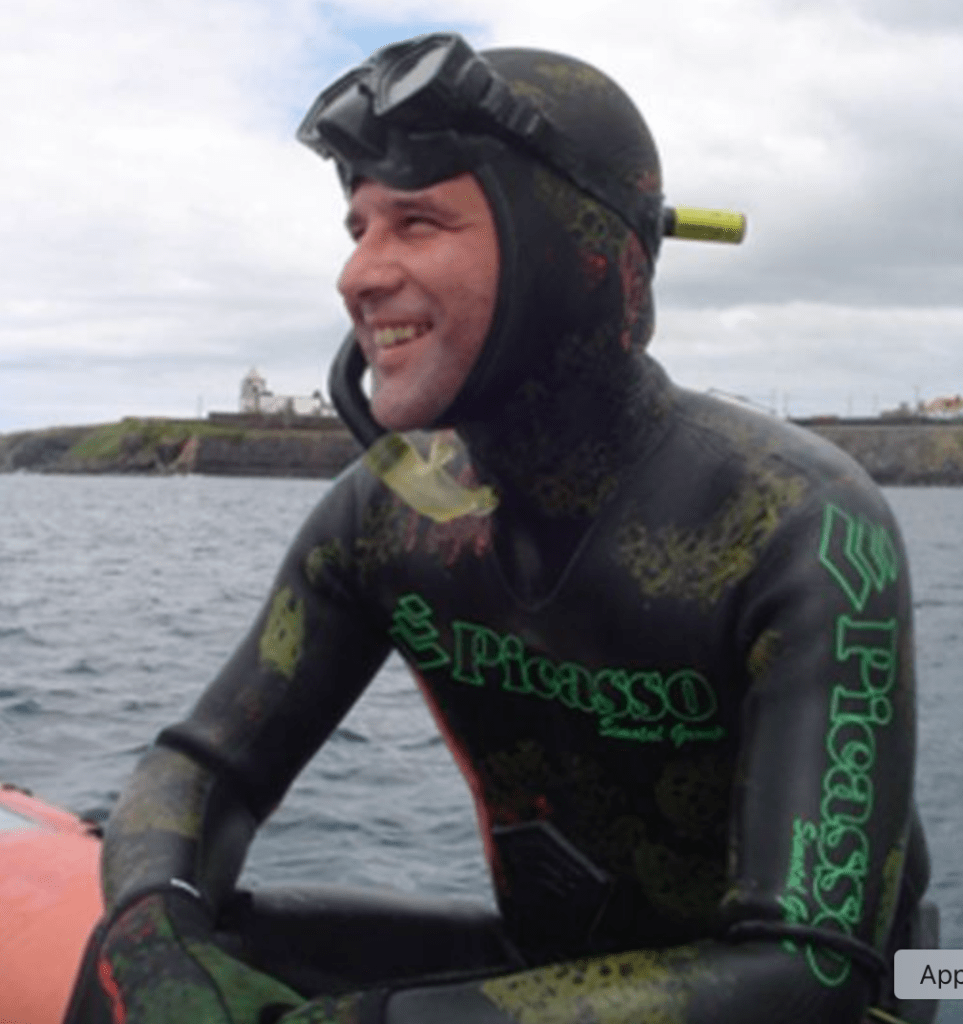
Marine biologist and researcher at the University of the Azores, João Pedro Barreiros, insists that the region should invest in coastal reserves.
The idea will be presented at the international webinar “Anthropogenic Impacts on Coastal Marine Waters: Assessment, Case Studies, and Solutions,” which will take place on the 26th.
The Regional Government has invested in a network of Marine Protected Areas (MPAs), which aims to protect 30% of the Azores’ sea, with 15% under total protection. However, João Pedro Barreiros maintains that the way these areas have been designed limits their impact on conservation.
“Coastal reserves do not need to be very large areas, but they were essential to repair some mistakes and bad decisions that were made in the past. Marine protected areas, when well designed and thought out, have several medium-term effects: repopulation is very rapid and there is biomass export. Animals that grow and reproduce within a protected area will then occupy immediately adjacent areas, which benefits fishing,“ he tells DI, stressing that ”this is not what is happening at the moment, it has never happened.”
The scenario in the archipelago, warns João Pedro Barreiros, is one of depletion of coastal resources, reduced biodiversity, and limited access to fish consumption, which is “scarce and very expensive.” Presenting the region as an example in this field, he argues, is “political propaganda.”
“I find it very strange that the University of the Azores, which has built up knowledge in this area, is not part of the decisions that led, for example, to this 30% plan, which in reality is 30% of nothing,” he criticizes.
“They resort to entities such as Blue Azores and the Waitt Foundation, which, in essence, take beautiful photographs and advertise the Azores sea, but it doesn’t amount to anything,” the researcher points out.
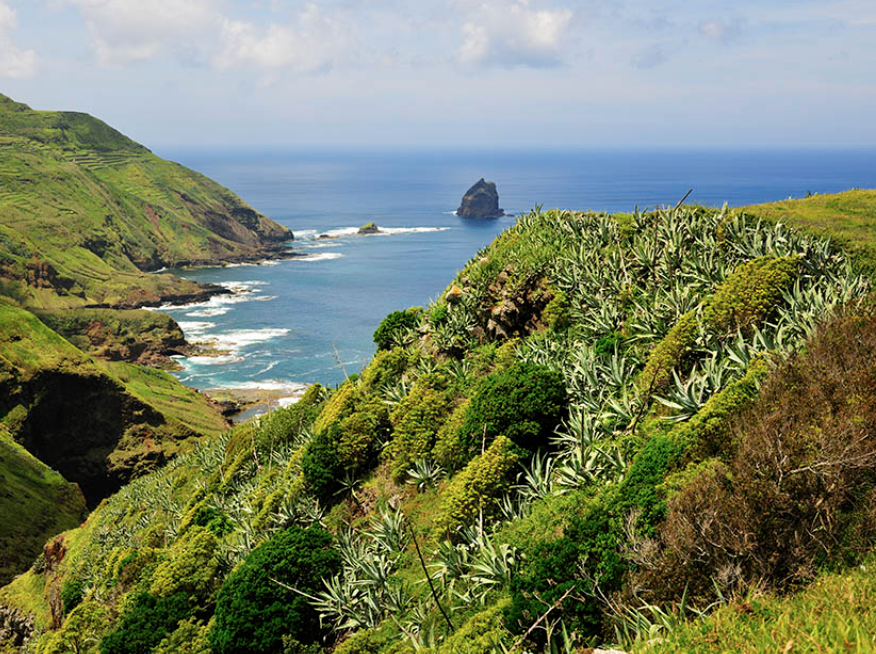
Marine protected areas, he recalls, were created in the Azores in areas of great depth. “The Azores have no platform; these are very deep, unproductive waters. What should have been done was to create small coastal reserves,“ he emphasizes.
João Pedro Barreiros also argues that resource management is being carried out incorrectly.
”It leads to very complex and even dramatic situations, such as throwing fish away. There is a legal imbroglio surrounding all this, which ultimately means that people do not have access to fish and that what does appear is then all exported,“ he says.
The region recently experienced controversy surrounding red seabream. ”The first mistake, right from the start, is to impose quotas and closed seasons on species that are fished in a non-selective manner. It is impossible to guarantee that, when dropping a hook, species A, B, or C, which is out of quota or protected at a given moment, will not bite the hook. Either there are areas where no one fishes anything, or this, as we can see, is inconsequential,” points out the marine biologist. He stresses that “the laws are ambiguous because, on the one hand, they prohibit the transport and retention of certain species when the quota has been exceeded or when it is a closed season, but then they also say that it can be used for bait.”
“The fact is that many fishermen are actually fined when they have fish on board at times when they are not supposed to. The question is, what do you do with the fish that bites the hook? Throwing it away seems to me to be the worst option,“ he reflects.
João Pedro Barreiros points out that the ”problem of overfishing“ is a global one and has never been ”properly addressed.”
In this area, EU laws leave little room for maneuver for the Regional Government. “In many of these matters, the Region can basically do nothing—except in coastal areas—because it derives from the Common Fisheries Policy. These are decisions that have to be resolved at the European Union level,” he says.
He argues that “good coastal reserves” remain the way forward.
João Pedro Barreiros also raises concerns about Lotaçor’s “monopoly.” “Historically, there was a first sale of fish to residents, which has disappeared. This monopoly of a public company was created, which I do not think is the best solution at all. Most of the fish caught in the Azores is for export. This is not an anti-profit or anti-capitalist argument, but simply an observation of a situation that I do not believe to be the most appropriate,” he argues. The international webinar is organized by MDPI (Multidisciplinary Digital Publishing Institute), in partnership with the Interuniversity Consortium of Structural and Systems Biology (INBB) in Italy.
Translated into English as a community outreach program by the Portuguese Beyond Borders Institute (PBBI) and the Modern and Classical Languages and Literatures Department (MCLL), in collaboration with Bruma Publication and ADMA (Azores-Diaspora Media Alliance) at California State University, Fresno. PBBI thanks Luso Financial for sponsoring NOVIDADES.

 Novidades - The Islands and the Diaspora