

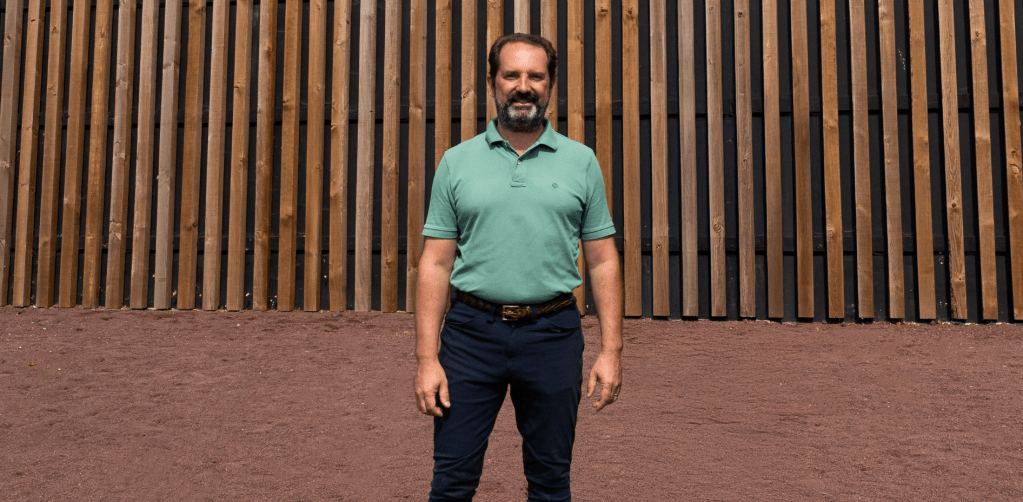
With its official opening scheduled for the end of October, following a soft opening in March, Lusitano Garden Villas is a four-star equestrian tourism development located in the parish of Arrifes, in Ponta Delgada. The project stems from the tradition of the Canto Tavares Stud Farm, founded in the 1940s and integrated into the family’s agricultural estate. It comprises 16 one-bedroom villas and three riding arenas, one of which is covered and the other two are outdoor, for equestrian activities. João Gomes de Menezes do Canto Tavares, owner and manager, recalls in this interview the founding of the stud farm by his father, Duarte Miguel da Silveira do Canto Tavares, talks about the evolution of Lusitano horse breeding at the family farm, and explains how this heritage led to the launch of the new tourism project.
Correio dos Açores – Can you tell us the story of the Canto Tavares Stud Farm and how this legacy led to Lusitano Garden Villas today?
João Gomes de Menezes do Canto Tavares (owner and manager of Lusitano Garden Villas) – This project stems from my interest in horses, as I was born among them. My father loved horses since he was a child and always had a farm with cows and mares. Breeding began in the 1940s, during World War II, when fuel was scarce in the Azores. My grandfather, who lived in Ponta Delgada and had pineapple greenhouses in Capelas, restored a horse-drawn carriage to get around and bought a mare, the daughter of an Arabian horse that had passed through here with a circus company. That was the first mare my father rode when he was still a child.
He was taught by João Rezendes, a well-known figure in the equestrian world in São Miguel, who later had a riding arena in Ponta Delgada and trained several generations of riders. My father was his first student at the age of 13. Rezendes was 17, in the army, had learned to ride there and had never been taught before, but he accepted my grandfather’s request.
That first mare had daughters that remained on the farm, crossed with horses bought on the mainland or with studs that the Regional Government had at the Zootechnical Station, always high-quality Lusitano horses. This is how a line of crossbred horses was formed.
Meanwhile, I went to study architecture in Lisbon and worked for a few years in an office; however, my father was growing older and needed help. I returned, devoted myself to agriculture, and developed the dairy farm, which was my father’s area of expertise. Later, under my influence, we began to purchase Lusitano mares registered in the stud book, as I had deepened my knowledge of genetics during my stay in Lisbon.
That’s when I had the idea of tourism. There was a plot of land above the Ponta Delgada ring road, with a good view of the city and the sea, which stood out within the farm. And that’s when I had the idea of turning it into a complementary tourism project, which would create a symbiosis between horses and tourists. The Lusitano horse is attractive in itself, a symbol of Portuguese identity, an ambassador of Portuguese culture. I already had the breeding and equestrian knowledge, and it seemed to me that equestrian tourism could be a viable option. The location was accessible, close to the center and the airport, and met the project’s requirements.
What distinguishes your stud farm from the others?
I have been a rider practically since I was born, and I am very concerned with the functionality of the animals. For me, the main reason for breeding horses is to obtain animals that are easy to ride and athletic, because the horse is an athlete and the rider is a trainer. But it is not enough for them to be athletic; they must also be predisposed to learning, what we call in equestrian slang “having a good head”: being easy to teach, pleasant to ride, and cooperative with the rider. For me, that is the big difference in our breeding: the horses tend to be easy to teach and easy to ride, because I am a rider. Some breeders don’t ride; they breed by what they see. I breed by what I feel.
What is the concept behind Lusitano Garden Villas?
The main differentiating factor is the riding arenas. We have a 20×40 indoor arena, as well as two additional outdoor arenas: a 20×40 arena and a 20×60 arena. That is the physical factor that sets us apart. Then there is an issue that, for me, is just as important, if not more so: we only have 16 villas. This allows us to give each guest special attention, to know their names, and to get to know them, ultimately guiding them to the best experiences during their vacation. We want them to take away the best possible memories of our space, as well as of the island. Holidays are not just spent within the resort, and as proud Azoreans, we like to welcome guests and recommend the best places to visit. This is only possible in a small resort. If it were very large, guests would become just a number.
What types of villas are there, and what is the accommodation capacity?
Lusitano Garden Villas features 16 one-bedroom villas, each measuring 44 square meters. The capacity is four people per villa, which can be increased to five in the case of a baby up to four years old, provided a crib is available. All have a double bedroom, a living room with a sofa bed, a bathroom, a kitchenette, and a balcony. Some overlook the pool and garden area, others the city and the sea. Of the 16, two are premium: in addition to the balcony, they have an additional deck with a dining table and a private jacuzzi.
The central building houses the reception, bar, and breakfast room, which we plan to convert into a restaurant in the future. This space also houses the gym, sauna, Turkish bath, staff support areas, laundry, and storage.
How is the team organized between the hotel area and the equestrian part?
The team consists of 18 people, ranging from the hotel manager, Helena Castanho, to the reception staff, including housekeepers, the gardener, and the horse groom. I am solely responsible for the equestrian side, as I have specialized training in this area. As a general rule, I conduct the equestrian experiences, but occasionally I have the assistance of two people who come in sporadically, although they are not permanent employees.
What equestrian experiences do you offer, and how do bookings work?
The experiences are open to both guests and visitors. They can be booked by phone and, later, also through the website. We have four main types. The first is a workshop for children aged six and up. The children do not ride, but they have direct contact with the horse: they learn how to feed it, clean it, and become familiar with the parts of the harness, its morphology, and the main names. It is a first educational approach. The second level is the equestrian baptism, designed for individuals who have no prior experience with horses. It works like a vaulting lesson, progressing very slowly at a walk on a gentle horse, with simple exercises that give the person the feeling of being on a horse for the first time. Then there is the experience for beginners, aimed at those who have already had riding lessons. Here, the goal is to control the horse at three gaits: walk, trot, and canter, ensuring that the rider can move forward and use the reins. Finally, there is the intermediate experience, intended for those who have already mastered low school exercises and some high school exercises.
How would you assess the soft opening and operation so far? What kind of audience have you attracted?
We have had a very diverse audience. As we had not yet targeted any marketing at horse riding, most visitors came to the island; some, because they were in a place with horses, decided to try equestrian activities, but few came specifically because of the horses. In terms of nationalities, we have welcomed people from various European countries, the United States, Canada, and Saudi Arabia. The assessment is positive, and occupancy has been good.
For me, having no prior experience in the sector, it has been a learning curve, and it has gone well, especially given the positive feedback and reviews from guests. The priorities now are to focus our efforts on markets with direct flights to Ponta Delgada, such as the United States, Canada, and some European countries, and to attract those who enjoy horse riding, which is our added value.
What are your ambitions for Coudelaria Canto Tavares and Lusitano Garden Villas over the next ten years? What is the role of each?
Lusitano Garden Villas is a hotel that offers horse riding, not a stud farm with accommodations. It’s the other way around. The Canto Tavares Stud Farm originated the project and today has the conditions to work with the foals and show them to customers, something it did not have before. The two realities complement each other: the stud farm benefits from tourism, and tourism benefits from the stud farm’s location in the same area.
And what do you expect for both of them in the near future?
The prospects are good, but the future belongs to God. We are living in turbulent times, and the international situation also concerns us. There is no point in worrying about things we cannot control. What we can do is work hard, welcome our guests as best we can, and thereby make the future more promising. Above all, I want to emphasize that Lusitano Garden Villas is a place that offers a luxury experience. When I talk about luxury, I am not referring to contact with horses or the facilities themselves, but rather to the people who use them. That is the greatest asset of Lusitano Garden Villas: the team and the care we give to those who visit us.
Daniela Canha is a journalist for Correio dos Açores-Natalino Viveiros, director.
Translated into English as a community outreach program by the Portuguese Beyond Borders Institute (PBBI) and the Modern and Classical Languages and Literatures Department (MCLL), in collaboration with Bruma Publication and ADMA (Azores-Diaspora Media Alliance) at California State University, Fresno. PBBI thanks Luso Financial for sponsoring NOVIDADES.

 Novidades - The Islands and the Diaspora