

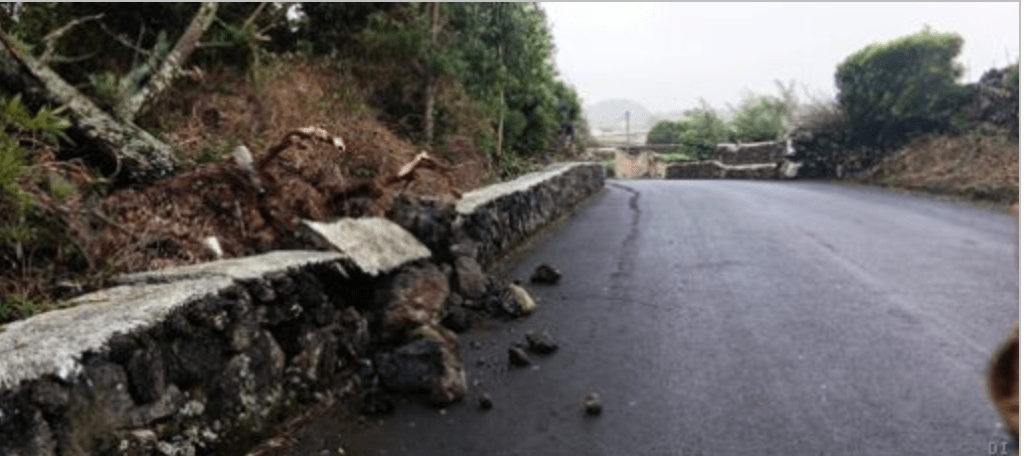
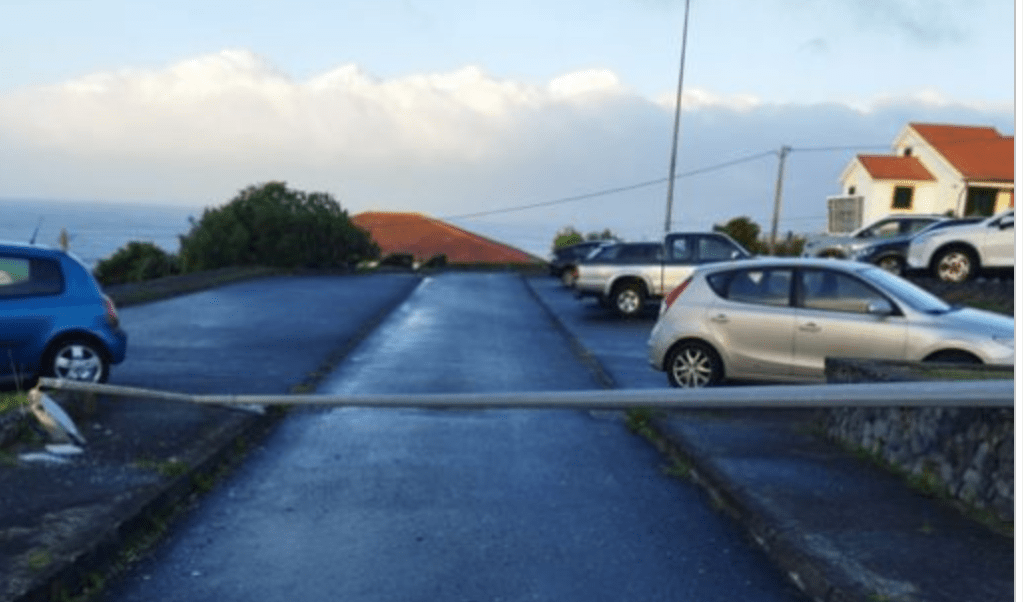
The passage of post-tropical storm Gabrielle through the Azores resulted in 196 incidents in the archipelago. It provoked the relocation of 16 people, according to the Azores Regional Civil Protection and Fire Service (SRPCBA). “There was a need to relocate 16 people (on the islands of Terceira, São Jorge, Pico, Faial, and Graciosa), with no injuries reported so far,” it said in a press release. Most of the reported situations were “related to fallen trees, collapsed structures, and damage to roofs.”
On the island of Graciosa, the storm caused a waterproofing sheet to collapse at the airport. There were concerns that the damage would impact air operations on the island. Still, the Regional Government assured that the situation did not compromise the structure and that SATA already had a technical solution in place that would be relatively quick to implement.

Tropical Cyclone Gabrielle was expected to pass through the Azores as a Category 1 hurricane. Still, by the end of Thursday night, it had transitioned into a post-tropical storm, albeit with hurricane-force winds. The most critical period of the storm occurred in the early hours of Friday morning, between 3:00 a.m. and 9:00 a.m., with the greatest impact on the islands of Graciosa, Faial, and Terceira.
According to Alonso Miguel, Regional Secretary for the Environment and Climate Action, who oversees Civil Protection, at a press conference, the maximum gust at low altitude reached 154 kilometers per hour on the island of Faial, and the maximum value at altitude was 185 kilometers per hour on the island of Terceira. As for precipitation, “the highest value occurred in Graciosa, with 53 millimeters of accumulated precipitation in three hours and a six-hour accumulation of 61 millimeters.”
In terms of rough seas, “the most worrying situation involved boats in Horta Bay, with ropes that ended up breaking,” but “the situations were resolved and no damage was reported.” There was also damage to agriculture, particularly to the forage corn crop. “Damage has been reported across all the islands, particularly the destruction of crops, and the extent of any damage to agricultural support infrastructure is still being assessed,” the Azores Agricultural Federation said in a statement.
In Diário Insular, José Lourenço-director
Translated into English as a community outreach program by the Portuguese Beyond Borders Institute (PBBI) and the Modern and Classical Languages and Literatures Department (MCLL), in collaboration with Bruma Publication and ADMA (Azores-Diaspora Media Alliance) at California State University, Fresno. PBBI thanks Luso Financial for sponsoring NOVIDADES.

 Novidades - The Islands and the Diaspora