

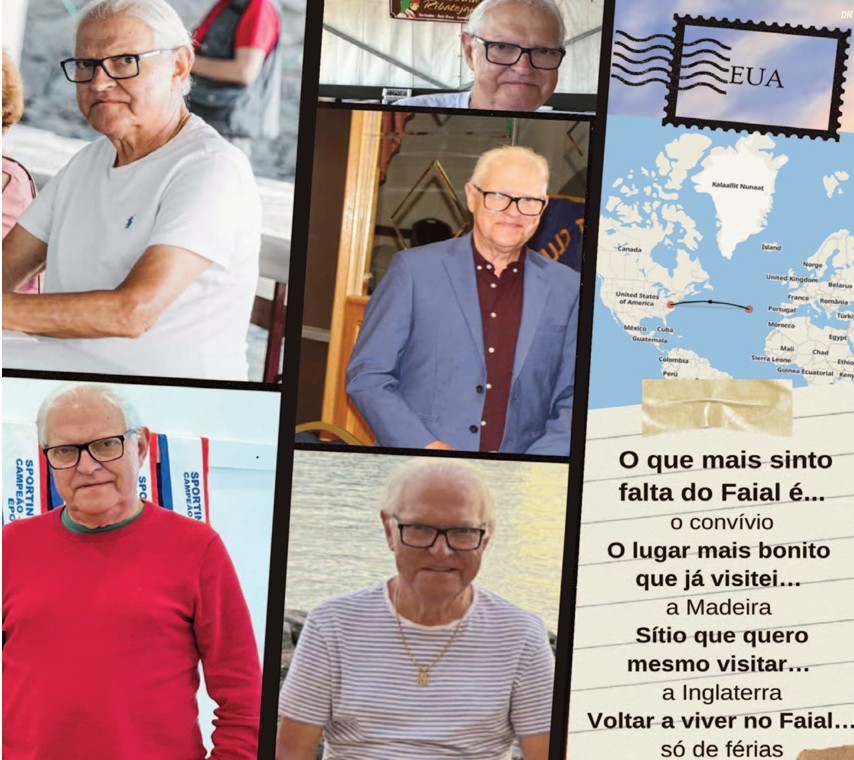
Rui Maciel was born on Pico Island but moved with his family to Faial at a young age. “As there was no high school in Pico, my father decided to open a café and we all came here,” he recalled in conversation with Tribuna das Ilhas. He attended school for a while, but began to realize that this was not the path for him. “I didn’t like it very much and wanted to go to work with my father in the café.” However, after returning from military service and with his father’s retirement, he took over the establishment. “My father retired, went to Pico, and I took over the café,” he said. Later, he decided to go on vacation to the United States.
During that time, and without really knowing how, he became a legal resident. “I went to ask for permission to return to Portugal because of the café, and someone who worked there asked if I wanted to become legal. Instead of giving me permission, they gave me a green card,” he said. He took advantage of the opportunity to start over, far from the island, at a time when life was not smiling on him. “I went back to sell the coffee and then returned to America.” He didn’t speak English very well, but he found the support he needed in the Portuguese community and soon started working. “I started at a trench coat factory. I didn’t earn seventy dollars a week. I went to iron the hems. At that time, they wore white raincoats frequently. Later, the boss said he was going to move me to the presses and that I would earn more money.
In the end, it was an extra three or four dollars on my paycheck at the end of the week.“ Over time, he moved to an Italian bakery. ”I started earning two hundred and something dollars a week. I worked an extra day, but I didn’t mind. It made no difference to me,“ he said. Then, through a friend, he joined a donut chain. ”He told me: When you leave in the morning, go there for a while to help out, you’ll learn. Only on Saturdays and Sundays. When the chef was absent, I already knew how to do some things.” Later, other friends of his started a restaurant that also sold doughnuts and invited him to join them: “I stayed until they sold the place, about twenty years later.”
Over the years, he realized that his retirement would be modest, despite his earnings being substantial. So he looked for another job. At the time, he got a position at Harvard University. “First, my wife went to work there as a cleaner. I had a job, but I didn’t want to go. After a year or two, I ended up going. I earned less money, but I had good benefits.” Although he has lived most of his life near Boston, he maintains habits, traditions, and memories that connect him to his roots.
Additionally, he found space to cultivate friendships and develop a social life. He was actively involved in the Faialense Sports Club, even serving as president for four years. “I was unlucky that the year I took over was the year of the pandemic. They closed the club right away. It would open some days and close others. But we did our duty. Then, in my second term, things were already looking up. After I retired, they asked me if I wanted to continue, and I said no.” Even so, he welcomed several regional political figures and is now recognized for the work he did while he was in charge of the club. Now retired, he divides his time between the United States and the Azores, taking advantage of each visit to see friends and reminisce about his childhood. “I like coming here. This is my homeland. I’m from Pico, but I really like Faial… I’ll come here as long as I can,” he said.
Carolina Maciel is a journalist for Tribuna das Ilhas, and Susana Garcia is the director.
Translated into English as a community outreach program by the Portuguese Beyond Borders Institute (PBBI) and the Modern and Classical Languages and Literatures Department (MCLL), in collaboration with Bruma Publication and ADMA (Azores-Diaspora Media Alliance) at California State University, Fresno. PBBI thanks Luso Financial for sponsoring NOVIDADES.


 Novidades - The Islands and the Diaspora