


Yesterday, the Azoris Royal Garden Ponta Delgada Hotel hosted the Second Annual Regional Sustainability Conference.
In the opening session, Rodrigo Costa, Executive Director of the EDA Group, highlighted the distinction awarded to the meeting by the Regional Directorate for the Environment and Climate Change. The event, organized in partnership between EDA and Finançor, was one of the first to receive the “Circular Event – Gold” Seal, created by the Government of the Azores to distinguish good practices and encourage the transition to a circular economy.
“We managed to be one of the first events with the Gold Seal, which makes us very proud. This demonstrates our commitment to sustainable practices and the responsibility we all have,“ he said. He emphasized that, for EDA, sustainability ”is no longer an option and is now an ethical and economic strategy that brings us advantages and puts us ahead. We have taken on this commitment with responsibility, given the central role we play in the energy transition of the Autonomous Region of the Azores.”
“We have three axes in our sustainability strategy: energy for the environment, energy for people, and energy with purpose. Combined with this, we have three fundamental pillars that guarantee the implementation of this strategy: decarbonization, digitization and innovation, and community involvement,” he explains. In terms of decarbonization, he stated that between 2025 and 2029, the company plans to invest €196 million in renewable energy and storage systems, thereby increasing the penetration of clean energy from 33% to 53%. “We intend to reduce our emissions by around 96% by 2050. Why not 100%? Because we intend to offset unavoidable emissions,” he explained.
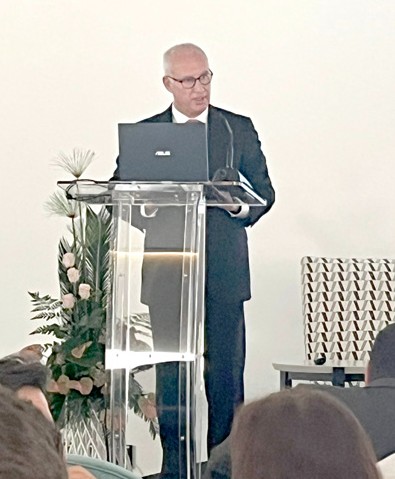
In terms of digitization, he highlighted the use of drones to monitor the network and the project to install 140,000 smart meters by 2028, which will have an impact on operational efficiency and consumer relations. In terms of community involvement, he mentioned environmental literacy initiatives in schools, biodiversity preservation, and encouraging electric mobility, while also emphasizing the importance of valuing employees. Pedro Amaral Frazão, vice president of GRACE, began by highlighting the vulnerable position of small and medium-sized enterprises in the market: “SMEs have an unequal relationship with large companies because, as they are small, they obviously do not have the muscle or capacity of large companies and therefore have many more concerns about ensuring their daily life, their cash flow and, ultimately, guaranteeing payment terms that allow them to have the liquidity to pay their bills: their suppliers’ bills and, of course, their obligations to the State.”
This inequality also extends to the State itself. “If any company dares not to pay the TSU (social security contributions) on time or not to refund VAT, the State is immediately on top of them, with fines and penalties. However, if the State does not pay on time, nothing happens to it. This relationship is indeed unequal.”
Even so, the manager argues that the balance may be less lopsided in the relationship with large companies, because they “know that there are no good suppliers without good customers, and vice versa.” Hence, the importance of “frank and open relationships, in which everyone understands each other’s limitations,” something that can be helped by “calibrating payment terms” to ensure that SMEs can survive within this framework.
In the field of sustainability, the manager highlighted the growing pressure these companies are under: “SMEs are increasingly obliged to provide information (…) First, they have to understand the language behind these requests. Second, they have to maintain consistency in the timeline of their responses. It is no longer enough to say that we are thinking of doing this or that, we have to say ‘we are already doing it, these are the metrics, these are the impacts, these are the results’.“
The problem, he acknowledges, is that this process represents a ”burden for small businesses, because it obviously requires a monitoring effort that requires resources, in terms of people and investment, which costs money. If it is not done carefully, SMEs sink into this type of thing and cease to focus on their business. They will have to follow this path, but each one has to take a step that suits them.“ As an example, he pointed to the transport sector: ”It does not cross the mind of a passenger transport company to decide to have electric buses overnight. These are painful investments, and then there aren’t even places to refuel. This needs to be done deliberately over time to ensure the safety of companies. The path is taken step by step, with a clear head and within what is possible.”
Asked how to turn the Sustainable Development Goals into competitive advantages, he highlighted the clarity of the 2030 Agenda: “The SDGs have color, they have logic, they are numbered, and they are easy to explain. They allow companies and communities around the world to speak the same language. The SDG here or in China is exactly the same.”
According to the manager, the merit of the SDGs is that they allow “any company, small, medium, or large, to identify where it can invest and what it should prioritize.” He further explained that “from an environmental point of view, it is more regulated, there are decarbonization targets, there are fees, there are taxes. From a social point of view, the sky is the limit. Companies can intervene internally, with their employees, or externally, in the community, as much as they want, as long as it is within the law. And it is very easy to then fit this into the corresponding SDGs.“

In the area of governance, he highlighted the central role of partnerships: ”For me, there are 16 plus 1, because the 17th is perhaps the most important. We are increasingly looking for projects that have a social impact, but above all that have partners. It’s not about writing checks, it’s about each company giving a little of itself within its value chain. It’s easy to add A plus B plus C, and in the end, the equation results in collaborative projects. This is more logical, easier to achieve, produces results, and even generates a multiplier effect for other actions.”
Pedro Silva, from Get2C, began by emphasizing the urgency of the issue: “Although there are politicians and world leaders who are increasingly discrediting science, the reality is that there are things that are undeniable. And the increase in the Earth’s average global temperature is one of them. (…) By 2024, we will have already exceeded what was agreed in the Paris Agreement. We are about 1.5 degrees Celsius above the pre-industrial era.”
As he explained, this increase is mainly due to greenhouse gas emissions, the consequences of which are already visible, such as the drastic reduction in ice, fires, droughts, and extreme phenomena: “Our islands, the Azores and Madeira, are not escaping this; they are highly vulnerable. They suffer from sea level rise, ocean acidification, and intense storms like the one last week that shook the Azores.“
The speaker also drew attention to the inequality in the contribution to emissions: ”Six countries or large regions account for 53% of the planet’s emissions in 2023. The United States with 11%, China with around 27% to 30%, and Europe with 7%. And 70% of global emissions come from just 100 companies. This is a staggering figure. And this is not today, it has been since 1988,“ he said.
In this context, he stressed that the role of companies ”is to decarbonize. Social pressure is increasing, companies are increasingly scrutinized. Environmental, social, and governance issues are becoming increasingly important. Both financiers and partners and customers are increasingly looking at these aspects, and not just at the regulatory level: there are legal requirements that are changing the paradigm of what companies have to respond to.”
Pedro Silva also highlighted the importance of new European legislation on reporting, which requires companies to be more transparent in environmental and social matters: “The first step in drawing up a decarbonization plan is to measure. It is knowing where we are, which areas of our company have the highest emissions. As we like to say, you have to plant the first tree, and in this case, the first tree is measuring your carbon footprint,“ he said.

”Over a period of time, we measured the greenhouse gas emissions, CO2, methane, nitrous oxide, and others, in our activity. I like to call this a snapshot. A greenhouse gas inventory is exactly the same thing: an annual snapshot of our impact,” he added.
He then explained the three areas of emissions. The first corresponds to emissions directly controlled by companies, such as the fuel they use, their own vehicles, or the buildings they own. The second concerns the production of electricity and energy consumed, which is the responsibility of entities such as EDP or EDA. The third refers to the value chain, encompassing everything from the acquisition of raw materials to the transport of goods to the end customer.
He acknowledged that the process is complex, but technological solutions already exist: “People often say ‘I don’t have the data’. Okay, we need to create processes for this collection to be automatic. (…) There are already tools that allow us to reach suppliers to obtain more direct information. There is also software that helps respond to audits, make projections, and predict where we are going.“
”We have three solutions: one for large companies, one for small and medium-sized companies, and another for individuals. For large companies, ‘Get2Zero Pro’ allows you to calculate carbon dioxide emissions, from scope 1 to scope 3, in a simplified and automatic way,” he explained.
To illustrate this, Pedro Silva presented tools created by Get2C and gave a practical demonstration of how to measure the carbon footprint with the audience itself.
João Maciel, from EDP NEW, stated that the company is “a player in the production, distribution, and consolidation of energy, with a strong focus on renewables. In 2024, 95% of the energy we produced was renewable, and to date, we are at 90%. According to the manager, “the energy transition is a big thing. In less than 30 years, we will have to do something that took 200 years to consolidate, the matrix of a more centralized energy and distribution. This paradigm is changing, and we must adapt to it. If we are to make an analogy, we will have to change the tires on the car while it is moving and with people getting in.”
For João Maciel, “much of the energy transition that will take place has to do with technology. Energies such as wind and photovoltaic production are high-impact energies. Technology is important, but it’s not just that. In 2024, $2.1 trillion was invested in energy transition worldwide, and this figure is expected to almost triple every year until 2050.”
Making the energy transition is labor-intensive. The EDP manager said, “we need to have enough trained people to make the transition. Robotics and artificial intelligence are tools that will allow us to leverage people’s work. Of all the technologies that are relevant to the energy transition, 70% are in China. We have to develop partnerships with China, but we also have to develop alternatives in terms of materials.“
”In innovation, we want to solve existing problems, and in research, we want to ensure that we leave no stone unturned,” concluded the manager.

The specificities of the islands in the context of energy
Bruno Vieira, manager of EDA, began his speech by saying that “given that we are an island system, we have some particularities that make the actions we have to take on our islands very specific. We have actions in three areas of energy: performance, distribution, and production. We are the only supplier on each of the nine islands. We are a regulated company, which means we have a regulatory body that, in some way, influences our strategy. This is because everything we do has to be financially supported in order for the business to be viable in the long term.”
“We currently have nine micro-systems that have survived on their own on the islands, and we do not have the capacity to interconnect between islands, meaning we cannot import or export energy either between islands or to the mainland,” added the manager.
Bruno Vieira, speaking about EDA’s decarbonization strategies, clarified that the company has “a set of 27 lines of action, and the decarbonization strategy was one of the company’s strategies to counter some of these lines of action and significantly help the region achieve its goals. We have a set of facilities that already take advantage of solar, wind, and water resources and also, specific to our region, geothermal resources. This results in promising results in our journey. We have already managed to achieve 100% renewable energy production in one day on some islands. Others are moving in that direction, with only São Miguel and Terceira, the largest islands, achieving figures in the order of 70%.“
EDA currently accounts for 37% of regional greenhouse gas emissions. According to Bruno Vieira, ”during our journey, it is clear that we have been undergoing continuous decarbonization. Our energy production is still supported by fossil fuels, accounting for around 55%, while the remainder comes from various other energy sources.
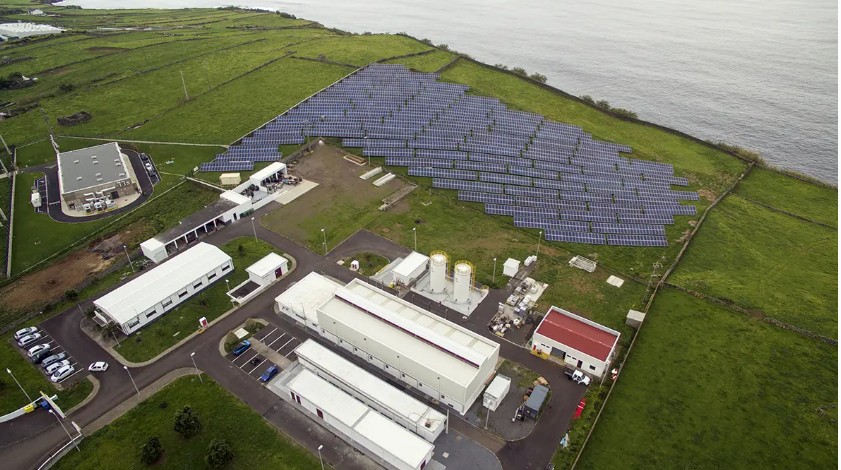
“EDA has invested heavily in innovation and, due to our specific nature, we have to be more daring when it comes to financial risk, which makes this area very important in order to find solutions for our specific needs. And that is what we have been doing through various projects and initiatives,“ said the manager when discussing the company’s investment capacity.
”We want to adopt strategies that avoid activities that produce emissions, and this is where renewable energies come in and what we think may be the future, using alternative fuels instead of fossil fuels. We have to find technological ways to achieve certain goals in different ways. By 2050, we hope that our strategy will achieve neutrality between emissions and retention capacity, with zero emissions,” said the manager.
Bruno Vieira emphasized the impact that EDA has as a company in the Azores. “As an energy production company in the region, we believe we have to play this role in order to leverage initiatives by society, both in industry and in the domestic sector, so that together we can find the right solutions. Sometimes the solution is not in technology or investment, but in the energy management strategy that is shared by all players who interact with the electrical system.“
”Some of the measures we are investing in are still in the pilot phase, such as ocean energy, using waves or tides. We aspire to an ecosystem that integrates all players who interact with the electrical system. Over the next four years, EDA will make its largest investment, in the order of €450 million, which represents the company’s commitment to achieving the goals that have been set for the decarbonization of the Azores,” concluded the manager.
Daniela Canha/Frederico Figueiredo are journalists for Correio dos Açores, under the direction of Natalino Viveiros.
Translated into English as a community outreach program by the Portuguese Beyond Borders Institute (PBBI) and the Modern and Classical Languages and Literatures Department (MCLL), in collaboration with Bruma Publication and ADMA (Azores-Diaspora Media Alliance) at California State University, Fresno. PBBI thanks Luso Financial for sponsoring NOVIDADES.

 Novidades - The Islands and the Diaspora