

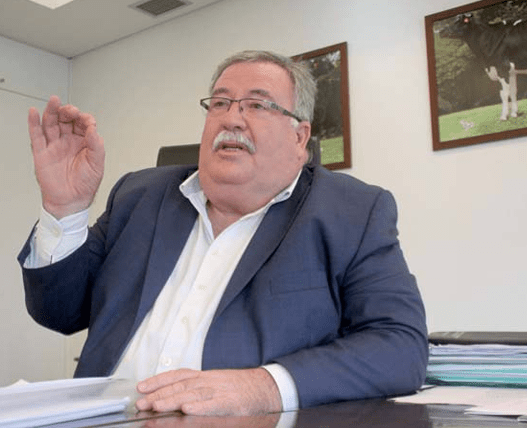
The president of the Azores Agricultural Federation rejects the notion that agricultural activity is the primary cause of water pollution in the streams on São Miguel island. Jorge Rita warns of “other sources of pollution, such as domestic sewage, industrial sewage, road runoff, or even the poor functioning of some wastewater treatment plants.” In his speech at the opening of the seminar “Farmers are Environmentalists,” promoted by MAPA – Movement for the Environment and Food Production, yesterday at the Faculty of Agricultural and Environmental Sciences in Angra do Heroísmo, the president of the Azores Agricultural Federation pointed out that “it is always farmers who bear the responsibility” and warned of the inevitability of water runoff on pastures “whenever there are flash floods that carry it to the streams and from there to the sea.”
“Agricultural activity has partial responsibility, yes, but not total responsibility, and this needs to be demystified,” Jorge Rita stressed. The leader acknowledges that, “with some flaws,” Azorean farmers are environmentalists, but warns that the lack of labor, “which is causing the concentration of farms, with the integration of smaller ones into larger ones, can clearly lead to us having a lot of organic matter available and make farmers less environmentally conscious.” Jorge Rita regretted that the Region has not yet been able to promote the use of organic matter, and drew attention to the “excellent” work that has been done in this area by researchers at the Azorean university.
“This is a concern for us and for the university, which can be resolved by applications to the PEPAC program – Strategic Plan for the Common Agricultural Policy 2023-2027, by companies specializing in the processing of organic matter.” The leader regretted, in this regard, that the implementation of the program is delayed, preventing applications from being made. The president of the Agricultural Federation also highlighted the willingness of farmers, whom he considered “the greatest and best landscapers on the islands,” to cooperate in implementing environmental solutions. He recalled the case of eutrophication in the lagoons of São Miguel, “a problem that has not yet been resolved,” he said. “When I joined the association movement more than 20 years ago, I agreed that action was needed because the lagoons are the island’s ex-libris. (…) I considered that the farmers’ departure was possible, but with compensation.
Unfortunately, 20 years later, the lagoons remain eutrophic, which proves that the problem is not only related to agriculture.” On the other hand, Jorge Rita expressed concern about the possible “large reduction in funding for agriculture” in 2026, in the Azores Government Plan. “This scares me, because with the introduction of a community program, we are receiving a signal that support will be residual,” he said. The seminar “Farmers Are Environmentalists” brought together experts and entities from the agricultural and business sectors. The intention, said Graça Mariano, head of MAPA, was to educate consumers about the food they eat and reflect on the importance of agricultural activity on the islands.
In Diário dos Açores, Paulo Viveiros-director.
Translated into English as a community outreach program by the Portuguese Beyond Borders Institute (PBBI) and the Modern and Classical Languages and Literatures Department (MCLL), in collaboration with Bruma Publication and ADMA (Azores-Diaspora Media Alliance) at California State University, Fresno. PBBI thanks Luso Financial for sponsoring NOVIDADES.

 Novidades - The Islands and the Diaspora