

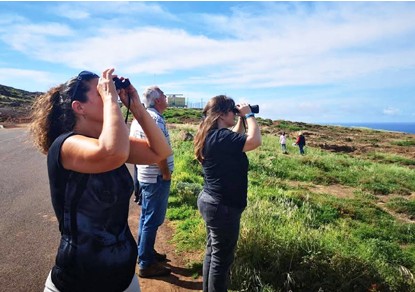
This weekend, the Portuguese Society for the Study of Birds (SPEA) is promoting the 12th edition of BirdRace Azores, an event that combines competition, socializing, and nature conservation. Under the slogan “Observe Birds, Protect Nature,” the initiative aims not only to reinforce enthusiasm for bird watching but also to encourage good environmental practices on the various islands in the region. Speaking to Correio dos Açores, Ana Mendonça, SPEA Environmental Education Technician and project coordinator, emphasizes that the Azores are attracting more and more foreign birdwatchers, thanks to endemic species, as well as the appearance of occasional species: “Anyone who wants to add them to their world list must come here.”
Correio dos Açores – What is BirdRace Açores?
Ana Mendonça (Environmental Education Technician at SPEA and coordinator of BirdRace Açores) – BirdRace Açores is essentially a team competition. However, more than the competitive aspect, the main objective is to promote birdwatching in the archipelago.
The Azores are an extremely privileged region for birdwatching, as they offer a remarkable diversity of birds, many of which are of great interest. However, the local birdwatching community is still relatively small. Therefore, through BirdRace, we seek to combine the spirit of competition with the encouragement to discover and appreciate the birds that exist here.
This year we are celebrating the 12th edition of the event. Over the course of previous editions, we have had a total of around 250 participants, with nearly 700 different species recorded. For this edition, we currently have 14 teams registered, with a total of approximately 25 participants.
The challenge is simple: during the weekend of October 4 and 5, which also coincides with EuroBirdwatch, the largest European birdwatching event, each team travels around the island where they are located and records all the species they can identify. Ultimately, the team that observes the greatest number of different species wins.

On which islands in the region does the BirdRace take place?
Any team can participate on any island, so applications are open to all islands in the Azores. This year, we already have participants on almost all the islands; only two are missing to complete our presence throughout the archipelago. We have teams in São Miguel, Santa Maria, Graciosa, and the other islands of the Central Group, with only São Jorge and Corvo remaining. This is great because it shows that the BirdRace message is reaching an increasing number of people and that more people are becoming interested in birdwatching.
It is important to emphasize that the BirdRace is not just for experienced observers. Over the years, we have had a wide variety of participants: from experts to beginners who are just starting to watch birds near their homes, in their gardens. The competition organizers are always available to support participants with any questions, allowing even the least experienced to feel at ease. Participation often takes place with family or groups of friends. It is common for former participants to always bring new people to their teams.
BirdRace is aligned with SPEA’s mission in the Azores and its commitment to bird conservation in the country. This year’s motto is: “Observe birds, conserve nature,” reflecting the connection between the activity and environmental protection.
Among the threats faced by birds in the Azores, specific problems such as light pollution, which mainly affects seabirds, stand out. This year, teams will receive shearwater rescue kits, with flashlights, gloves, and instructions on how to perform rescues properly. This initiative coincides with the start of the shearwater rescue campaigns, which are scheduled to begin in two weeks. Another global challenge addressed by BirdRace is marine litter. Teams, while traveling around the archipelago to observe birds, are encouraged to collect waste consciously. Teams participating in this action may receive beach cleaning kits developed by SPEA.
BirdRace has multiple objectives: to promote nature conservation, foster interest in birdwatching, and encourage outdoor activities. We also want to involve communities and young people, who are increasingly participating in the competition, helping to reconnect people with nature and the environment in which they live.

Birdwatching is a growing activity in the Azores, attracting an increasing number of foreign participants. What motivates this growth?
There is an increasing focus on nature tourism, and birdwatching is a key component of this segment. In fact, the Azores are a very popular destination for birdwatchers because they can find a unique array of species here. Our geographical isolation in the middle of the Atlantic and the diversity of habitats on each island favor the appearance of species that are exclusive to the archipelago. This is the case with the Priolo and the Tentilhão, which were recently elevated to species status. These birds are endemic to the Azores, so anyone who wants to add them to their global list must come here. Another example is the Painho-de-Monteiro, a marine species that is also endemic, with an even more restricted distribution than the previous ones.
In addition to the resident species, the archipelago’s strategic location makes the Azores a crucial stopping point on migratory routes: every year, we welcome birds that find rest and food here before continuing their journey. There is another factor that makes the archipelago particularly appealing: the arrival of species known as “occasional.” These are rare birds that are difficult to observe on the European continent, often coming from the American continent, which arouses great enthusiasm among observers.
We can say that the Azores, particularly the island of Corvo, arouse great interest among European observers, as they offer a unique opportunity to observe species that are not found anywhere else in Europe at certain times of the year. The Azores offer a unique set of natural conditions, diverse habitats, and, above all, the element of surprise: you never know exactly which occasional species may appear each season.
José Henrique Andrade is a journalist for Correio dos Açores.
Translated into English as a community outreach program by the Portuguese Beyond Borders Institute (PBBI) and the Modern and Classical Languages and Literatures Department (MCLL), in collaboration with Bruma Publication and ADMA (Azores-Diaspora Media Alliance) at California State University, Fresno. PBBI thanks Luso Financial for sponsoring NOVIDADES.

 Novidades - The Islands and the Diaspora