

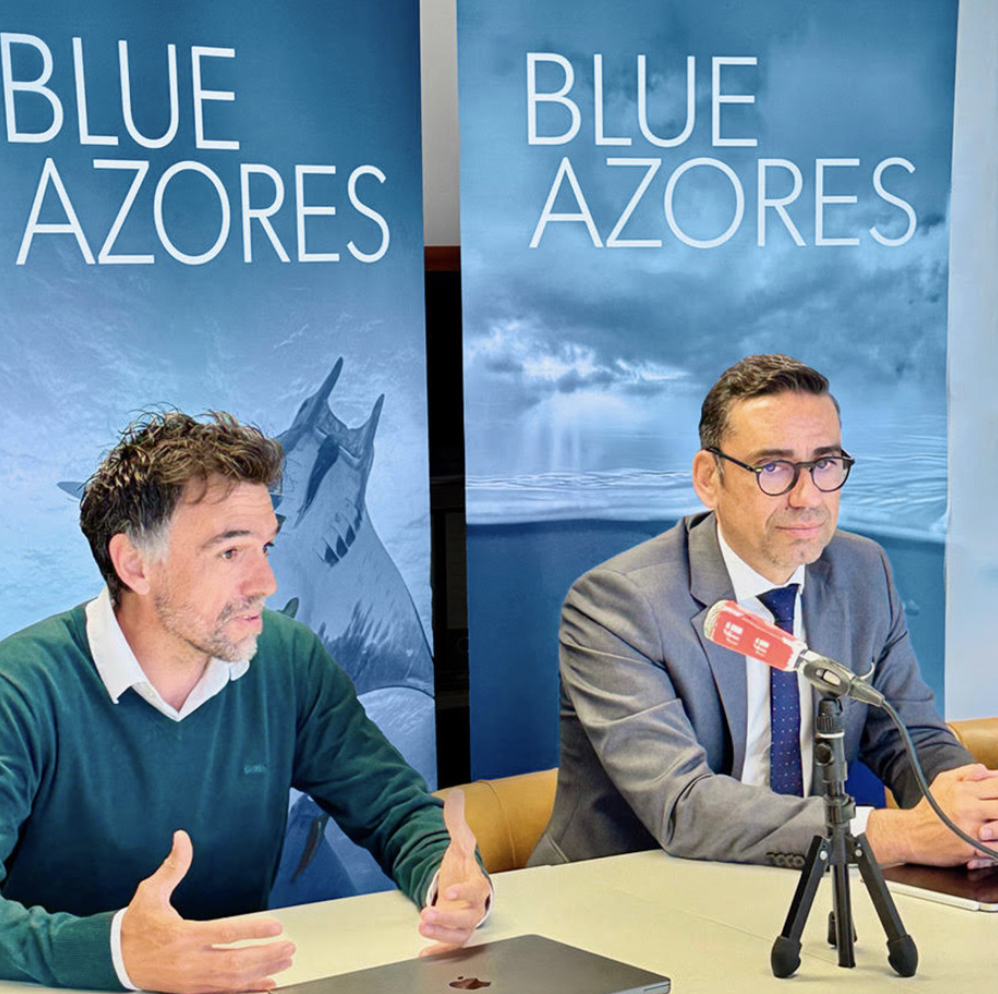
The United Nations Climate Change Conference – COP30 will take place from November 10 to 21 in the city of Belém, Brazil. Delegations from more than 190 countries are expected to attend, with most being signatories to the Paris Agreement, along with over 50,000 participants from various entities, NGOs, and civil society organizations. At the invitation of the COP30 Presidency, the Azores reaffirm their international leadership in the restoration of oceans and coastal regions, occupying a prominent place in the Portuguese delegation, a member country of the UNFCCC – the United Nations Framework Convention on Climate Change. Diário dos Açores obtained exclusive insights into the Azorean mission at COP30 in an interview with Bernardo Brito e Abreu, advisor to the President of the Azores Government with responsibility for the Sea and Fisheries, and Adriano Quintela, a biologist with a PhD in Geography from the University of the Azores. Both work in the Blue Azores Program, in coordination with the Government, and in operational and information management, respectively.
The COP in action
COP30 will focus on presenting solutions, technologies, and best practices that can serve as a brake on destruction, vulnerability, and climate injustices, especially among developing countries. In his opening speech at the United Nations headquarters, celebrating the institution’s 80th anniversary, Brazilian President Luiz Inácio Lula da Silva emphasized that “COP30 in Belém will be the COP of truth. It will be the moment for world leaders to prove the seriousness of their commitment to the planet.”
The Azores will be part of the Action Agenda Activation Group to Protect and Restore Ocean and Coastal Ecosystems, with the responsibility of sharing experiences, strategies, and tools for protecting seas and oceans, which are the main regulators of climate and capable of containing temperature, absorbing heat, and CO2. The appeal is both plural and urgent for human survival itself, as emphasized by the President of COP30, Ambassador André Correa do Lago, whose political career has centered on sustainable development and who, since March 2023, has served as Deputy Minister of Climate, Energy, and Environment at the Brazilian Ministry of Foreign Affairs.
“Climate action has a lot to do with the ocean. There is an ocean-climate nexus, and those at the forefront are the archipelagic regions, which suffer most from sea level rise, extreme weather events, and biodiversity loss. They have a very important voice on the climate stage.”
Bernardo Brito e Abreu
Blue Azores: a successful partnership between the government, academia, and public and private organizations ensures a leading role in ocean conservation
Protecting, promoting, and valuing the marine natural capital of the Azores is the raison d’être of the Blue Azores Program. Led by the Regional Government, it has the partnership of the Oceano Azul Foundation, the Waitt Institute, and the support of the University of the Azores. The government representative and coordinator of the Blue Azores Program is Luis Bernardo Brito e Abreu, who has a degree in Naval Military Sciences from the Portuguese Naval School and a master’s degree in Architecture from the University of Lisbon. He currently serves as advisor to the President of the Azores Government.
The Program has been in place for three terms and has been gaining relevance and showing results, hence its participation in COP30. The delimitation of Marine Protected Areas for total protection in 15% of the Azores sea began in 2021. The following year, the Government made a commitment to expand these areas to 30% during the United Nations Conference in Lisbon, which was ratified in Baku at COP29 Afghanistan in 2024. From then on, the Marine Protected Areas – Coastal and Oceanic MPAs – were reorganized into a network, in a strategy called RAMPA – Azores Marine Protected Areas Network, which will come into force as law on January 1, 2026.
“From a historical point of view, Blue Azores is beginning to break the paradigm of a region perceived by its own citizens as being ultra-peripheral, with many needs, to a vision of centrality and opportunities arising from the wealth of its 1 million square kilometers of maritime dimension and global assets. It has to do with the immense actions taken over the past six years, but these actions were possible because protection management is centralized in the head of government.”
Bernardo Brito e Abreu
Adriano Quintela, who has a degree in Marine Biology and a PhD in Geography, is a specialist in integrated coastal zone management. He has been part of the Blue Azores Program since 2021, corroborates this vision, and emphasizes the need to move towards consistent indices. “These are very concrete things, difficult to measure. We need to take the next steps in the species monitoring processes to assure stakeholders that the investments made to preserve these areas will generate benefits,” reveals the biologist.
A win-win program
In addition to people and the environment, the Blue Azores Program aims to ensure that economic sectors such as fishing, tourism, science, biotechnology, and many others develop and are equally sustainable, participating as co-creators. While proximity to the government’s interests is vital, support from partnerships is similarly valued, not only for the resources allocated, but also for the speed of execution and reduction of bureaucracy when compared to the public sector, which enables great advances in a shorter period of time.
“We must act now, we cannot wait any longer. By 2030, the Azores Government wants these areas to already be creating benefits, with effective implementation. This will have to be done by example. We will achieve this goal by doing it. And we cannot leave anyone behind.”
Adriano Quintela
The interviewees emphasized that the robustness of the progress achieved so far comes from more than four decades of scientific research by the Department of Oceanography and Fisheries (DOP), which, since 2022, has been operating as OKEANOS – Institute for Marine Science Research at the University of the Azores. This is the composition of the triad that fuels the foundations of success: government, private initiative, and academia.
Green Zone: coming soon, Global Climate Task Force
On the COP30 agenda, the collective and voluntary mobilization for a common goal, known in Brazil as a “mutirão,” will take place in the Green Zone. The Green Zone will occupy the entire space of Belém City Park, where global leaders, public and private institutions, and civil society will come together to pursue innovation and sustainable investment. The participants in the working groups will have the task of concretely complementing the decisions of the Blue Zone, restricted to heads of state, in which Portugal participates as a member country of the Paris Agreement. Among the premises are the exchange of high-impact solutions and return on investment for immediate application; the approximation of quality between climate advocates and awareness of the importance of the Amazon and its local culture. Several leading entities in the proposed areas of protection for forests, corals, and mangroves, among others, participate in the Green Zone. An entire pavilion will be dedicated to the ocean theme, and the work will be guided by Marinez Scherer, researcher and coordinator of the Integrated Coastal Management Laboratory at the Federal University of Santa Catarina. Coordination is already underway, even before the meeting, with the intention of accelerating proposals and defining improvement indices by 2028. It is with this purpose in mind that the Azores accepted the invitation to contribute to the upcoming COP30.
“Blue Azores has been viewed internationally as an exemplary initiative in ocean protection, capable of influencing and creating a model that can be replicated in other parts of the globe.”
Adriano Quintela
Halfway through the “Decade of the Oceans,” a response is still lacking.
It wasn’t due to a lack of warning. In 2017, the United Nations General Assembly alerted the scientific community and stakeholders to the seriousness of ongoing pollution and warming in the waters, calling for swift progress on climate preservation and mitigation, as well as the implementation of the Sustainable Development Goals (SDGs) within its 2030 Agenda. This led to the call for the Decade of Ocean Science for Sustainable Development (2021-2030).
Led by UNESCO, the Decade of the Oceans also highlights that 35% of the world’s fish stocks are being overexploited or are in a state of depletion, according to a study by the Food and Agriculture Organization of the United Nations (FAO). Since then, reversing global ocean warming has been a key topic of discussion and has reached its most critical point in this edition of COP, the first to be held after the 1.5°C temperature rise was consolidated in 2024.
“The Azores are leading a global agenda that is also global.”
Bernardo Brito e Abreu
The goals are to have more fish, healthier ecosystems, and greater resilience to climate-related issues.
In contrast to the global inertia in protecting the seas and oceans, the Azores protection network covers more than 300,000 km², making it the largest in the North Atlantic. It is not only related to the well-being of future generations through the proliferation of fish stocks and the containment of invasive species. The health of the marine and economic ecosystem also depends on the restoration of minerals and the reduction of pollution sources, such as microplastics. All of this happens slowly, out of step with the frenetic pace of human exploitation and scientific evidence. “The observation and measurement cycles will be defined in the management plans, in parallel with other monitoring of European directives, and will require a few years for the formation of ‘marine granaries,’” Quintela noted. Over time, it seems obvious that there will be a huge gain in marine life and resources through these “granaries.” There is no discussion about following the protectionist metrics of 30% by the UN, the European Union, and Portugal. However, the most optimistic projections show that RAMPA will be operating at full capacity from 2018 onwards. Financial and support mechanisms need to be established to support this transition, including compensation, income guarantees for families, and new alternatives for livelihoods, a concern that, according to Quintela, “is being worked on together with the government in order to balance the value chain and distribute the gains more equitably.” On another front, the change in mentality involves environmental education, training for fishermen, and the delimitation of nature reserves dedicated solely to tourism. “There are two very important fronts here: the external, international level of advocacy, visibility, and support, and the internal dimension. Because nothing can be done without convincing fishermen, teachers, the general population, NGOs, and economic agents,” explains Brito e Abreu, adding that “it is impossible to have unanimous decisions. There are many economic sectors and public opinion groups that have divergent views. No one is against sustainability. No one is against conservation, but there are differences of opinion on how to interpret and achieve these goals. Although there is no evidence in all the data, it is certain that the cost of inaction is greater than that of action.”
“Fortunately, the Azoreans have a common vision for their sea. Part of the success lies with the people themselves. They may have differences in method, in process, doubts, and fears about implementation, but we have the great advantage that everyone is aligned in this mission.”
Bernardo Brito e Abreu
The average global warming of 1.5 degrees is already a reality.
As expected, global movements have not been sufficient to prevent the temperature rise, which has been linked to various climatic phenomena and their consequences worldwide, including thawing, floods, torrential rains, massive fires, earthquakes, tsunamis, and the depletion of natural resources and species. The time for planning is over. Cooperation and implementation are needed with immediate effect to combat the climate crisis. With its commitment to meeting the UN’s 2030 Agenda goals ahead of schedule, the Azores are setting an example in ocean management. However, to date, there is no youth presence or critical mass of non-governmental organizations in the archipelago campaigning for climate action, which allows the Blue Azores Program to stimulate new fronts for active participation and engage more decision-makers in public policy. The seas and oceans belong to everyone. Plural debate will always be more effective for the common good.
Follow the series of reports on COP30, directly from Belém, by Marisa Furtado, exclusive correspondent for Diário dos Açores in Brazil.
Translated into English as a community outreach program by the Portuguese Beyond Borders Institute (PBBI) and the Modern and Classical Languages and Literatures Department (MCLL), in collaboration with Bruma Publication and ADMA (Azores-Diaspora Media Alliance) at California State University, Fresno. PBBI thanks Luso Financial for sponsoring NOVIDADES.

 Novidades - The Islands and the Diaspora