

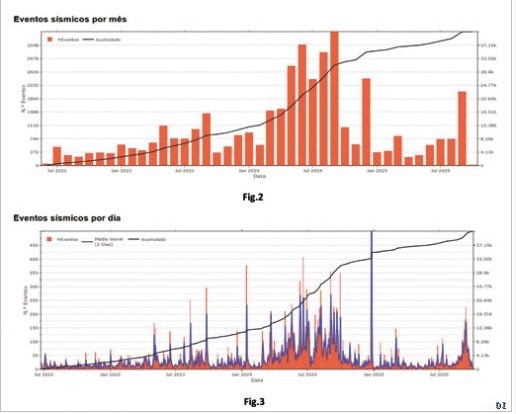
The Institute for Volcanology and Risk Assessment (IVAR) has announced an increase in the alert level for the volcanic system west of Terceira Island, which it considers to be “in a phase of instability.” The decision was made by the crisis cabinet in September, after a regular meeting on seismic-volcanic activity, with the level rising from V1 to V2, in view of “crustal deformation data.” A document from IVAR/CIVISA (Azores Seismic-Volcanic Information and Surveillance Center), to which DI had access, states that the seismic-volcanic crisis is “once again at levels close to those observed in 2024.” According to data contained in the same document, the number of seismic events rose from 737 in August to 2056 in September, with peaks of energy release, with up to 227 events in a single day.
“In September 2025, 2056 events (737 in the previous month) were recorded with their epicenter in the area where the crisis has been developing. On average, about 69 events/day were detected (24/day in the previous month). Seismic activity was characterized by alternating phases of lower seismicity, followed by phases marked by peaks of energy release that lasted several hours or days. In September, a maximum of 227 events was reached on the 13th, with more than 100 events occurring six times in a single day,“ it reads. It is noted, however, that ”the most energetic event remains the one that occurred on January 14, 2024, at 7:19 a.m.”
According to the University of the Azores, analysis of crustal deformation reveals that, since January this year, the deformation pattern has changed, with evidence of magma migration to deeper areas within the West Fissural Volcanic System of Terceira.
There are two sources of deformation, one under the Santa Bárbara Volcano caldera (between 3.5 and 3.9 km deep) and another to the east of the volcano, near the Mistérios Negros alignment (about 2.9 km deep). The magma is migrating from the volcano’s main reservoir to lower levels of the western fissure system of Terceira. Experts report that “the seismic activity recorded in the context of this crisis remains essentially centered within the perimeter of the Santa Bárbara Volcano and continues to be characterized mainly by the occurrence of microseisms, i.e., events with a local magnitude of less than 3.”
At the same time, it is indicated that seismicity has also affected, albeit less frequently, the Terceira West Fissural Volcanic System, especially in a section that crosses the Serra de Santa Bárbara and extends from Mistérios Negros to the vicinity of the Golf Club, to the east. The document also highlights activity to the south, “east of the area of influence of the Santa Bárbara Volcano, particularly between Cinco Ribeiras and Angra do Heroísmo (namely, north of Terra Chã and on the SW-NE axis that extends from São Mateus to Agualva).” However, no “significant activity” has been recorded at sea.
Given this situation, the volcanic alert level was raised from V1 to V2 in the West Fissural Volcanic System of Terceira, more specifically in the Mistérios Negros – Golf Course sector, which extends to the Cinco Ribeiras – Angra do Heroísmo segment. The crisis office also decided to maintain the volcanic alert level at the Santa Bárbara Volcano at V2. The document states that “in view of the above, for emergency planning purposes, it is important to consider the geological hazards outlined in previous information notes for the Santa Bárbara Volcano and the West Fissural Volcanic System of Terceira.”
Among the issues to be considered are “earthquakes, with magnitudes and intensities equal to or greater than those recorded to date, whose impact may be significant, particularly on structures that are more vulnerable to seismic activity”; slope movements, at the level of cliffs and slopes with greater inclination and/or instability in the interior of the island, namely in the caldera, in water lines and in areas adjacent to roads and paths, as well as gas emissions, at the level of fumaroles and areas of diffuse degassing.
Phenomena such as “low-magnitude tsunamis, associated either with earthquakes or slope movements that may occur in underwater structures, or with slope movements in cliff areas” are also mentioned. The seismic-volcanic crisis has been ongoing on Terceira Island since June 2022.
In Diário Insular, José Lourenço-director
Translated into English as a community outreach program by the Portuguese Beyond Borders Institute (PBBI) and the Modern and Classical Languages and Literatures Department (MCLL), in collaboration with Bruma Publication and ADMA (Azores-Diaspora Media Alliance) at California State University, Fresno. PBBI thanks Luso Financial for sponsoring NOVIDADES.

 Novidades - The Islands and the Diaspora