

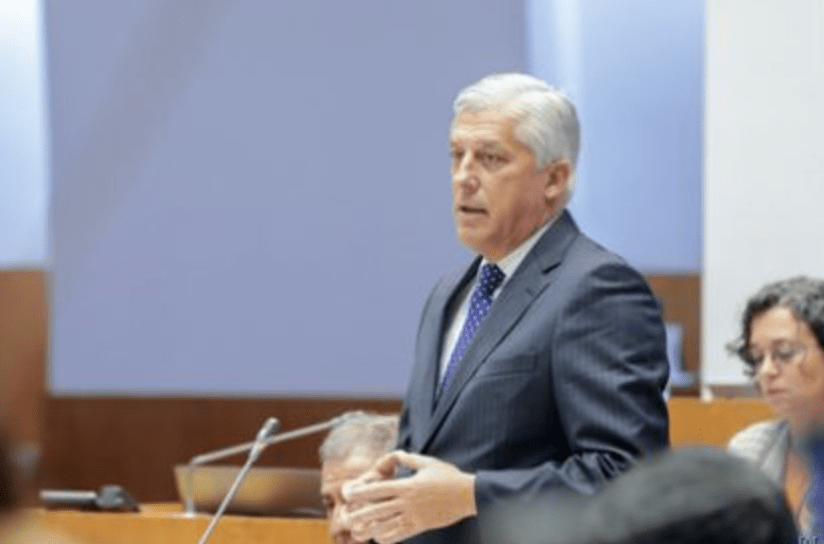
The Regional Secretary for Finance, Planning, and Public Administration, Duarte Freitas, defended in the Azorean Parliament, regarding an audit by the Court of Auditors that identified public expenditure outside the budget through Portos dos Açores, that “the Court of Auditors has its opinion, which does not mean that the Government agrees with the Court of Auditors.”
“This is not the first government that disagrees with the Court of Auditors, just as the government also disagrees with the approach taken by INE (National Statistics Institute) and Eurostat in relation to SATA Air Açores and SATA SGA (Airport Management). We disagree and believe we have valid arguments, which we have tried to present,” he said.
The minister was questioned on the matter by Left Bloc MP António Lima during a debate on the multiannual budgetary programming framework for the period 2026 to 2029.
António Lima considered that the Court of Auditors’ audit showed a serious situation. “How do you explain this situation, with €50 million in debt that should not be with Portos dos Açores, but should have been assumed by the Regional Government and the Region?” he asked, adding that this could represent a risk of the National Statistics Institute revising the deficits for 2024 and 2023.
“I recall numerous debates on this type of action, on Saudaçor, especially in a way that is not correct, because Saudaçor was already within the budgetary perimeter, which is not the case with Portos dos Açores, which does not consolidate and does not count towards the Region’s debt and deficit,” the parliamentarian stressed.
Duarte Freitas argued that “Portos dos Açores had a debt of €133 million on December 31, 2024,” which at the end of 2020 was €74.4 million. “The growth is less than the €60 million it was authorized to borrow due to Hurricane Lorenzo. Some of those funds have already been paid,” he continued.
“Of the 74 (million) that were in debt on December 31, 2020, do you know how much Portas do Mar still owed? More than 20 million, which is being paid now and which was inaugurated at the time, we know well by whom, such as the SCUTs and the Angra hospital,” said the government official in the debate that took place on Wednesday.
António Lima accused Duarte Freitas of trying to divert attention. “The truth is that there are courts, the Court of Auditors is a sovereign body, INE is the national statistical authority, and its decisions must be complied with and have consequences,” he stressed.
On behalf of the PS bench, Deputy Carlos Silva recalled statements made by the President of the Regional Government, José Manuel Bolieiro, in October 2022, when he considered that public companies cannot be “debt surrogates.”
Duarte Freitas considered, however, that there is no fear that Portos dos Açores will be regarded as for the deficit. “There is no indication of this,” he assured, adding that the 60 million debt “is already being paid.”
“The program contracts will also be paid to Portos dos Açores, which will continue on its path, as it has been doing,” he assured.
The Court of Auditors’ audit of Portos dos Açores between 2022 and 2024 reveals that, in 2023, the company had to take out a bank loan of €60 million “to cope with the recurring delays in the availability of funds from the Regional Budget.”
“The recurring delays in the payment of the regional component of the financing of those investments resulted in an increase in the Region’s debt to Portos dos Açores, S.A., which, at the end of 2024, reached €61.1 million, more than quadrupling compared to 2022,” the TC stressed.
According to the audit, the loan led to a 58% increase in the company’s liabilities (an additional €100.5 million), to a total of €272.8 million in 2024.
“The financial debt of Portos dos Açores, S.A., is unsustainable, given the company’s manifest inability to meet its emerging liabilities,” the judges warn.
In the same speech, Duarte Freitas addressed other areas, such as the average payment period to suppliers. According to the minister, in the third quarter of 2025, the average payment period was 135 days, compared to 139 days in the third quarter of 2019 and 179 days in the fourth quarter of that year. “Are we satisfied? No, we are not, but we have to be a little consistent,” he said.
The regional secretary for finance also noted that the proposed state budget for 2026 for the Azores will reduce the region’s borrowing needs to half the projected amount of €150 million.
“We had anticipated extraordinary transfers from the state budget of €75 million, as in 2025.
And what will happen? It won’t be 75, it will be 150,“ he said, praising the work of José Manuel Bolieiro in the context of institutional dialogue with the Government of the Republic.
Joaquim Machado, a PSD deputy, argued that ”good news for the Azores is always bad news for the Socialist Party.”
Carlos Silva, in turn, considered that the multiannual budgetary programming framework for the period 2026 to 2029 does not fully comply with the Autonomous Regions Finance Law and contains elements that were not even legible.
“What this reflects is a lack of accountability and budgetary irresponsibility (…) The secretary said that 2026 would be the largest budget ever, and we understand that, due to investment in the PRR (Recovery and Resilience Plan), and he said that the 2027 Plan would see a very significant reduction because, obviously, the largest investment will be in 2026. How is it that what is presented for 2027 represents an increase in public spending, and 2028 has another increase, and 2029 as well?” he asked.
For Carlos Silva, the document is “inconsistent with everything that has been said” regarding public spending in the Azores.
Duarte Freitas maintained that the executive is complying with the provisions of the Finance Law of the Autonomous Regions.
For Francisco Lima, a member of parliament for Chega, the situation is “like a remedy that does neither good nor harm, it serves no purpose.”
“A Chega government in 2029 does not want to be bound by this. It has positive aspects, namely that it met the deadline for submission, something it did not do last year. Everything else is a statement of intent,” he said.
Nuno Barata, a member of parliament for the Liberal Initiative, also considered that it is just “a piece of paper that serves no purpose.”
“Whatever we approve here, whatever we reject, the government does what it wants and what it feels like doing,” he argued.
The proposal for a multiannual budgetary programming framework for the period 2026 to 2029 was approved with votes in favor from the PSD, CDS-PP, and PPM, against from the PS, Bloco, and PAN, and with abstentions from Chega and IL.
Information on the Regional Health Service – Chega wants more data
Chega MP Hélia Cardoso argued on Thursday, in a political statement, for more information in the field of health.
Hélia Cardoso considered that the Public Portal of Regional Health Service Indicators should contain more complete and validated data.
“I expected more frequent data updates instead of stagnation in March. We hope that these indicators will evolve and cross-reference production with human resources so that benchmarking can be carried out, or in Portuguese, comparisons between professionals and between hospitals. There is no need to be afraid of evaluating productivity,” she argued.
The parliamentarian also addressed the “perception of excessive prescribing,” which, instead of treating health problems, can negatively impact individuals.
This expenditure on medical prescriptions provided by pharmacies will amount to more than €40 million.
“There is an application in the Regional Health Service that checks pharmacy invoices, which, when properly analyzed, allows us to know the profile of each prescriber, each user, and the psychotropic drugs prescribed, and allows us to monitor consumption and prescription/dispensing patterns by specialty, by pathology, and by therapeutic adequacy,” she explained.
According to the parliamentarian, the previous Saudaçor performed invoice checks, which identified anomalous prescriptions.
Hélia Cardoso pointed out that this component of the Regional Health Service’s expenditure is not being analyzed by the regional health directorate.
The regional secretary of Health, Mónica Seidi, emphasized that “interoperability within the Digital Hospital will be completed by the end of the first quarter of 2026.”
Concerning medical prescriptions provided by pharmacies, the minister said that the increase in expenditure in the region is in line with the rest of the country and is due to the rise in the cost of medicines.
In Diário Insular – MJosé Lourenço, director
Translated into English as a community outreach program by the Portuguese Beyond Borders Institute (PBBI) and the Modern and Classical Languages and Literatures Department (MCLL), in collaboration with Bruma Publication and ADMA (Azores-Diaspora Media Alliance) at California State University, Fresno. PBBI thanks Luso Financial for sponsoring NOVIDADES.

 Novidades - The Islands and the Diaspora