

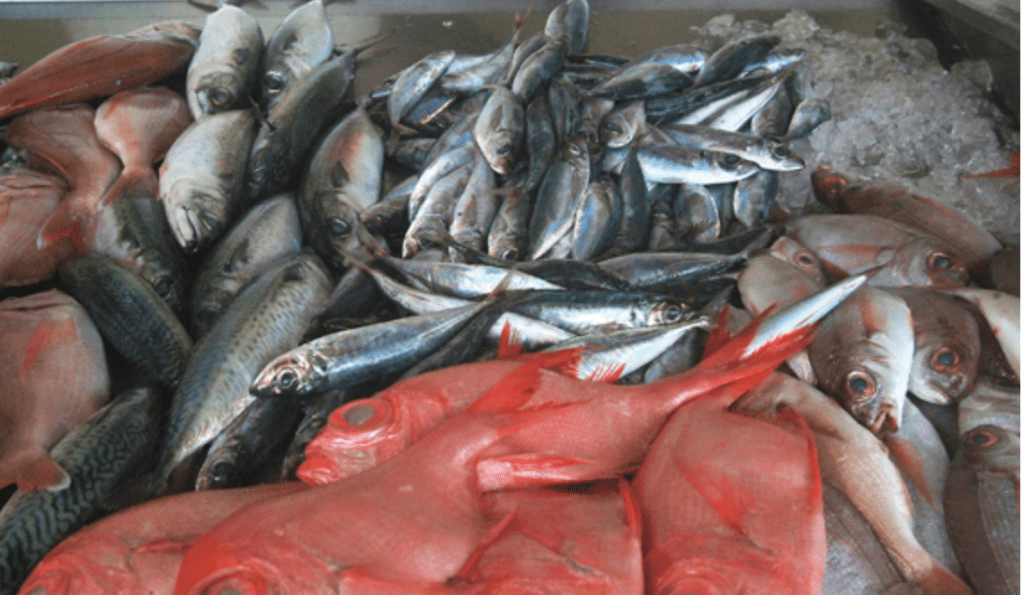
In September 2025, 1,463.6 tons of fish were unloaded at the fish market in the Azores, worth €4.45 million. In year-on-year terms, volume shot up 113.8% and value grew 37.2%, but compared to August, there were declines of 54.9% in volume and 45.5% in value, according to statistics from the Azores Regional Statistics Service (SREA).
The market was dominated by fish, which accounted for 98.6% of the total landed (1,443.6 tons) and 91.9% of the value. This was followed by mollusks, with 19.2 tons (1.3% of volume and 7.8% of value), and crustaceans, with 696 kilograms (less than 0.1% of volume and 0.3% of value). These figures do not include discarded fish, fish stew, or seaweed for non-food purposes.
By island, Pico led in volume with 36.0% of landings and 24.8% of the total value sold, immediately followed by São Miguel, which accounted for 35.1% of the volume and 35.6% of the value. São Jorge accounted for 10.1% of the volume (6.9% of the value), Terceira for 8.7% (13.0% of the value), Faial for 6.3% (8.9% of the value), and Graciosa for 1.2% (6.0% of the value). Flores, Santa Maria, and Corvo accounted for 1.1%/2.3%, 1.0%/1.4%, and 0.5%/1.2%, respectively. In absolute terms, the 527.5 tons sold in Pico (€1.10 million) and the 513.1 tons in São Miguel (€1.58 million) stand out.
The regional average price stood at €3.04/kg, 35.8% less than in September 2024, but 20.9% more than in August. The dispersion between islands was high: Graciosa had the highest average price (€15.59/kg), well above the Azores average, while São Jorge (€2.06/kg) and Pico (€2.09/kg) recorded the lowest values. Corvo (€6.93/kg), Flores (€6.24/kg), Terceira (€4.56/kg), Faial (€4.32/kg), Santa Maria (€4.10/kg), and São Miguel (€3.09/kg) complete the price map.
In the third quarter of 2025, Azorean fish markets handled 8,132.6 tons of fish, totaling €22.3 million. Compared to the same quarter in 2024, volume increased by 118.1% and value by 65.6%. Despite the increase in quantity, the average quarterly price fell by 24.1% year-on-year, indicating a context of greater catch abundance and pressure on prices.
In Diário dos Açores-Paulo Vivieiros, director
Translated into English as a community outreach program by the Portuguese Beyond Borders Institute (PBBI) and the Modern and Classical Languages and Literatures Department (MCLL), in collaboration with Bruma Publication and ADMA (Azores-Diaspora Media Alliance) at California State University, Fresno. PBBI thanks Luso Financial for sponsoring NOVIDADES.

 Novidades - The Islands and the Diaspora