


The cultivation of cereals, namely wheat and corn, is as old as the beginning of settlement in the Azores. From the mid-15th century to the mid-18th century, wheat cultivation was the dominant agricultural activity on the islands of São Miguel and Terceira. Still, it also had a significant presence on the other islands. Most of the wheat was exported to the Kingdom of Portugal and was the main driver of the Azores’ economic strategy of productive specialization at the time. Wheat production on the islands, especially on São Miguel and Terceira, was so intense that it led to the depletion of some soils, resulting in their abandonment and fallow.
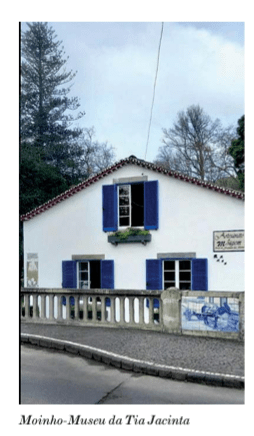
This period became known in the Azores as the Wheat Economic Cycle, which was later replaced by the orange economic cycle, followed by the financial cycle of agro-industrial products (tea, chicory, pineapple, cryptomeria, etc.), and later clearly dominated by livestock production, giving rise to the cow economic cycle, which has remained a feature of the Azorean economy to this day. However, tourism is now beginning to take hold, in many ways complementing the primary sector. What these economic cycles all have in common, even the first one, which was Pastel, is that they are largely driven from outside (external demand) and are based on a single, clearly dominant product. But returning to cereal production, the appearance and use of water mills was natural in this context of wheat and corn production, and in a natural environment favored by water and streams, with the municipality of Povoação having a spectacular presence of threshing machines and water mills, in accordance with its designation as the Granary of the Island of São Miguel.

In Vale das Furnas, a parish that administratively belongs to the municipality of Povoação, in the mid-1960s, I saw several water mills in operation in Furnas, namely three very close to Chão da Ribeira, one in Água Quente, the mill belonging to Mr. Aires Machado, another on the street where the hotel is located, the mill belonging to Mrs. Clotilde, now known as Tia Jacinta’s Mill-Museum, and yet another belonging to a relative of ours, Tio Carreiro, in Caldeiras das Furnas and very close to Água Azeda. Naturally, there must have been more. With the advent of electricity, larger mills, and the use of new technologies, traditional water mills, but also windmills scattered across the various islands, gradually disappeared until they were practically extinct, except for a few resistant ones that were no longer in operation or were turned into museums, such as the one in the Wheat Museum in Povoação, which is worth visiting for its heritage interest and as a testimony to an important period in the history of the Azores.
The restoration of these mills, where possible, should be supported, based on the logic of keeping our roots alive and even as a basis for sustainable, quality tourism. While it is not too late, it is necessary to survey and study these mills, as is done in developed countries. It is, therefore, an area to be restored and revitalized in the Azores.
Gualter Furtado, October 2025
In Diário dos Açores–Photo from Jornal Açores/Nove
Translated into English as a community outreach program by the Portuguese Beyond Borders Institute (PBBI) and the Modern and Classical Languages and Literatures Department (MCLL), in collaboration with Bruma Publication and ADMA (Azores-Diaspora Media Alliance) at California State University, Fresno. PBBI thanks Luso Financial for sponsoring NOVIDADES.
 Novidades - The Islands and the Diaspora