

A deep connection to nature and the sea led Luysa Pereira to thermalism. She currently manages several thermal spas and is preparing for new investments.
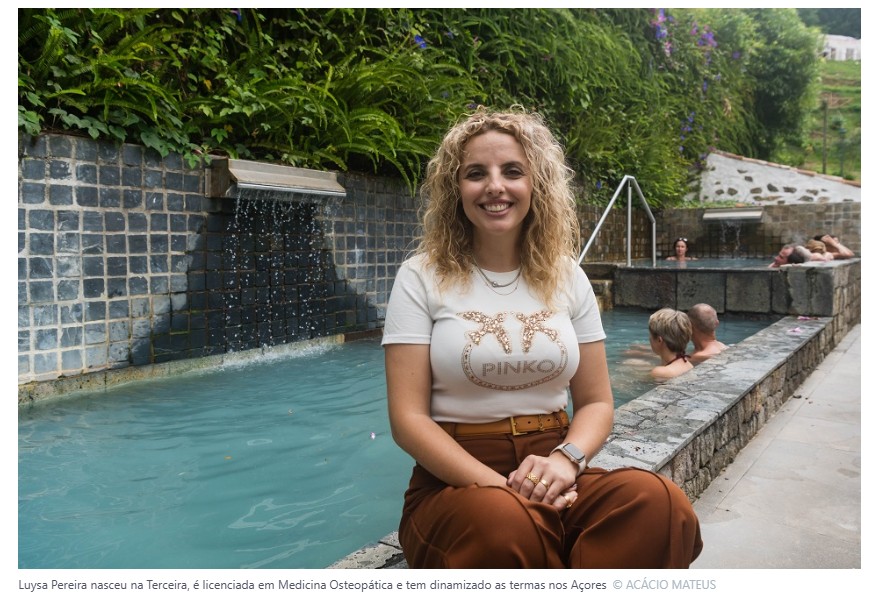
Luysa Pereira was born on Terceira Island, into an Azorean family, and from an early age nurtured a deep connection with nature and the sea. It was this passion that led her, at the age of 18, to move to Lisbon, where she began her academic career and completed her first degree in Osteopathic Medicine.
Later, she expanded her academic training to the field of Environmental and Health Engineering, seeking “always to understand human beings from a perspective where body, mind, and environment are interconnected,” she explained, seeking, throughout her professional career, “to combine practice with research, training, and the enhancement of the Azores’ thermal heritage.”
At the same time, he created and implemented two world-leading projects in the Azores: the thermal baby spa, dedicated to the use of thermal water adapted for skin treatment and relaxation; and the thermal hair spa, which uses the mineral constituents of the water with specific indications for hair health, both at Termas da Ribeira Grande.
In addition, a third innovative project is currently in its final stages at the Termas do Carapacho, which is distinguished by the use of three different thermal waters in the same spa, exploiting the diversity and complementarity of their properties.
Thermalism, as can easily be concluded, is more than just a business; it is Luysa Pereira’s passion. “Thermalism is a passion that drives me every day. It reflects everything I believe in: prevention, treatment, appreciation of the environment, sustainable tourism, the crossover between scientific and cultural areas, history, identity, and the unique potential of our waters. Each thermal spring tells a story, each water is unique. And it is this narrative, which brings together science and culture, that fascinates me and inspires me to invest in this area with such dedication,” she said.

It is this passion that drives her to travel to various islands in the Azores, from São Miguel to Faial, passing through Graciosa. In these islands, she has been rehabilitating thermal springs and restoring them to their essence from a thermal point of view, also associating them with tourism. And this is where another question arises: why did thermal springs fall into disuse?
“Thermalism, like many other sectors, has experienced cycles of boom and decline. In the past, thermal spas were social meeting places, places of treatment, and even symbols of prestige. With the advancement of conventional medicine and changing social habits, many of these spaces fell into disuse, losing the vitality they once had. Portugal has one of the greatest historical legacies in thermalism, often pioneering, as exemplified by the thermal hospital and spa in Caldas da Rainha. In the Azores, alongside our vast history of thermalism, we have seen remarkable growth in recent years, mainly due to the simple outdoor balneotherapy model, which attracts visitors seeking authentic experiences connected to nature. I believe that the secret to revitalizing thermalism lies in reinventing it, integrating it into the new global trends of wellbeing and health tourism, without ever forgetting the tradition and authenticity of our waters. Classic thermalism, with its proven therapeutic benefits, can be perfectly integrated into these new concepts linked to prevention and well-being. To this end, it is essential to have an appropriate communication strategy, capable of conveying to people the true value of our thermal waters, both scientifically and in terms of cultural and tourist experience,” he pointed out.
With ten years of experience in the field of thermalism, Luysa Pereira has no doubt that there is still a long way to go. “Thermalism has been part of my life for over ten years and I am fully convinced that it will continue to be one of my greatest missions. The goal is to revitalize our regional thermal heritage, respecting its history, but also innovating with new features and products that add value. Promoting health, preventing disease, and also promoting well-being and leisure.“ And doing this on different islands requires extra effort and timely planning, which ”is never an easy task“ because ”being Azorean means carrying an almost innate resilience, shaped by the condition of being an islander and the challenges that this entails. The biggest of these is undoubtedly travel, especially in winter, when the unstable weather often affects plans. But I believe that it is precisely this constant adaptation that makes us more creative and more persistent,” he added.
In Diário da Lagoa-Acácio Mateus, journalist, Clife Botelho, director.
Translated into English as a community outreach program by the Portuguese Beyond Borders Institute (PBBI) and the Modern and Classical Languages and Literatures Department (MCLL), in collaboration with Bruma Publication and ADMA (Azores-Diaspora Media Alliance) at California State University, Fresno. PBBI thanks Luso Financial for sponsoring NOVIDADES.

 Novidades - The Islands and the Diaspora