


One race, three days in three A decade Ten years connecting three islands, challenging athletes, and showing the world the unique identity of the Azores. The Triangle Adventure by Azores Trail Run® is not just a race; it is a story told in kilometers, a deep immersion in the culture and landscape of the Azorean Triangle. As the event celebrates a decade and the Azores are crowned the World’s Best Adventure Tourism Destination, Tribuna das Ilhas spoke with Mário Leal, the face behind an organization driven by passion, and invited him to take stock of the past, feel the pulse of the present, and project the future of this unforgettable adventure.
TRIANGLE ADVENTURE BY AZORES TRAIL RUN® T – Ten years is a remarkable milestone. To an outsider, Triangle Adventure seems like a great idea that has been consolidated. How did it all start?
Mário Leal (ML) – Triangle Adventure was born from a memory, from a feeling of sharing, long before it was a formal event. It was born from our own way of being and living on these islands. In the late 1990s, when the term “trail running” was not even part of our vocabulary, our way of living and showing the place where we were born and lived to our friends and colleagues from outside who visited us was through the trails. We went hiking, camping, and felt immense pride in sharing the natural beauty and our people of Pico, São Jorge, and Faial. The idea of uniting these three islands, of seeing them as a cohesive, continuous territory, was always present in our imagination. After gaining experience with the Azores Trail Run in Faial, we realized that we had the maturity, technical knowledge, and logistical capacity to make this long-held dream a reality. In 2015, the puzzle piece was Pico.

How could we create a trail stage that was challenging enough and long enough to capture its epic essence?
The answer came after much research and contact with the Azores islands of trails, soul, and the Atlantic: The History of Triangle Adventure local entities, namely the Natural Park, with the “Da Vinha à Montanha” (From the Vineyard to the Mountain) route, a connection that we designed and operationalized from scratch, from the Lajido area, a UNESCO World Heritage Site, to the Montanha house. This was the key piece that made the stage format on the three islands possible. From there, with the iconic trails of the Fajãs de São Jorge and the Faial Volcanoes, the Triangle took shape and soul. We launched it immediately with publicity and promotion, because we were convinced that the project had an international dimension and ambition from day one.
Organizing an event that spans three islands in the middle of the Atlantic sounds like a logistical puzzle. What does the public not see, but which constitutes a challenge?
ML – The public sees the beauty, the athletes’ achievements, the celebration at the finish line, and the joy of the organization and volunteers. But they don’t see the sleepless nights spent analyzing, the invisible web of transportation, or the teams of volunteers spread across three islands that have to work in perfect, delicate synchrony. Our biggest challenge, and at the same time our identity, is our “Atlantic insularity.” We are in the middle of the ocean, and it dictates the rules. Managing safety, which can shift from mild weather to extreme thermal conditions —heat, cold, and wind — in a matter of minutes, is a huge responsibility. Coordinating the boats that transport athletes and staff between islands, ensuring that everything and everyone is in the right place at the right time, is an operation of military precision. All this complexity on land would be absolutely unthinkable without the fundamental partnership we have with the authorities of all the municipalities of the Triangle, especially Horta, Madalena, and Calheta, which are the safe harbor and our support on each island. And, of course, the crossing between them is only possible thanks to the strategic partnership with Atlânticoline, which ensures the vital connection that embodies our multi-island race identity. It is a constant dance with the Atlantic’s unpredictability, which only works because we have these pillars to support us.

TI – There are countless trail races worldwide. What makes Triangle Adventure so unique and singular? How would you describe the “soul” of this race?
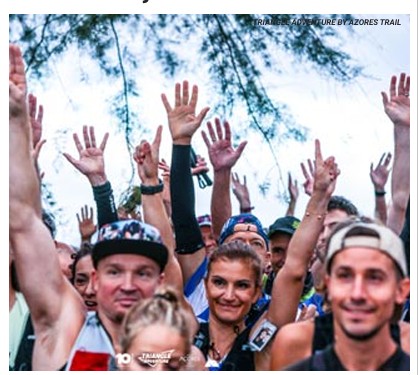
ML – The soul of Triangle is its territorial narrative and its human scale, which are the ultimate expression of our Azorean identity. First, the narrative, which is cinematic. This is not just a race; it is reading a landscape in motion, feeling the geological and human history through the work of our ancestors beneath our feet. In three days, the athlete experiences a whole range of experiences. It starts with their feet on the rough black basalt of the Pico vineyard, a testament to human resilience, and climbs to the imposing silence of the mountain. The next day, they are immersed in a radical change of scenery, in the lush greenery and geological force of the Fajãs de São Jorge, a world apart, isolated between the sea and imposing cliffs. And it ends in Faial, running over Portugal’s recent volcanic history, with the green center of Caldeira and the black desert of the Capelinhos Volcano. It is a sensory and emotional immersion that no other race offers. Then there is the human scale, which is a non-negotiable value for us. We deliberately limit the number of participants.We don’t want to be a mass event. We want a world-class athlete to cross the finish line alongside a local athlete, share a meal, and talk to the volunteers about life. This closeness, this family atmosphere, is our identity. It is what allows Azorean hospitality to manifest itself in its fullness. Genuineness is our greatest asset. TI – Over the past ten years, the race has evolved from a local dream to an international stage, hosting events such as the Golden Trail World Series. How do you manage this growth without losing your identity? ML – It is our most important strategic challenge, to grow without losing our soul. Internationalization was a natural consequence of the quality and uniqueness of the experience we offer. Hosting the Golden Trail World Championship in 2020 and the National Series Final in 2021 was more than an honor;
In Tribuna das Ilhas, Susana Garcia, director.
Translated into English as a community outreach program by the Portuguese Beyond Borders Institute (PBBI) and the Modern and Classical Languages and Literatures Department (MCLL), in collaboration with Bruma Publication and ADMA (Azores-Diaspora Media Alliance) at California State University, Fresno. PBBI thanks Luso Financial for sponsoring NOVIDADES.

 Novidades - The Islands and the Diaspora