

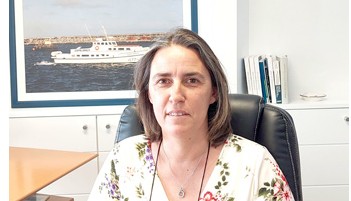
Founded in 2005, Atlânticoline, a wholly publicly owned company, is the public maritime transport company of the Azores.
Currently, Atlânticoline provides connections between Corvo and Flores and between the islands of the Triangle (Faial, Pico, and São Jorge). During the high season, the company not only increases the frequency of regular connections, but also offers seasonal connections. The Chair of the Board of Directors of Atlânticoline S.A. is Isabel Dutra, who has a degree in Economics, specializing in Business Economics, from the Lusíada University of Lisbon, and a postgraduate degree in Management and Training Coordination.
Can you tell us about Atlânticoline’s mission and its role in inter-island mobility in the Azores?
In 2025, Atlânticoline will mark two decades of service in maritime transport in the Azores. Since the integration of Transmaçor in 2015, the company has consolidated its position as a public operator of inter-island maritime transport, ensuring the mobility of passengers and vehicles with reliability, safety, and regularity. Atlânticoline plays a decisive role in the territorial and social cohesion of the archipelago, promoting exchange between islands and contributing to the economic and tourist development of the region.

How is Atlânticoline’s operations currently structured in terms of fleet, route count, and connection frequency?
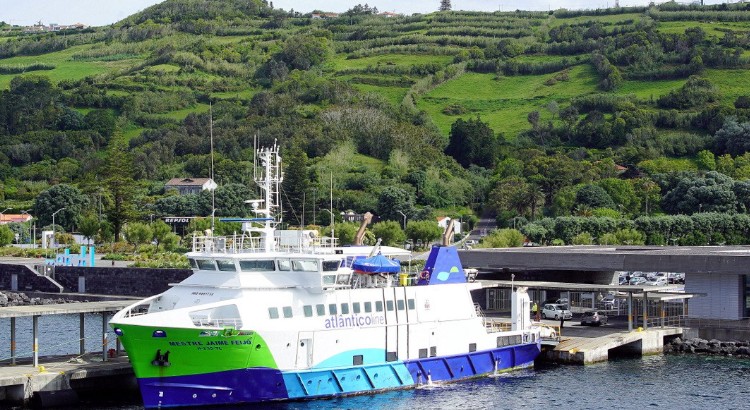
Atlânticoline currently operates in the Central Group with two ferries—Mestre Jaime Feijó (333 passengers and 15 vehicles) and Gilberto Mariano (296 passengers and 12 cars)—and with the ships Cruzeiro do Canal and Cruzeiro das Ilhas, both with a capacity for 191 passengers, which reinforce the service in the Triangle. In the Western Group, the company provides connections on the Ariel speedboat, which accommodates 12 passengers. The company invests heavily in preventive maintenance, ensuring high operational reliability and comfort.
The public service contract with the Regional Government, valid until 2029 (with the possibility of a two-year extension), defines the routes and frequencies. Atlânticoline provides regular service throughout the year in the Western Group and the Triangle. These routes are reinforced in the summer, when the Triangle operation is extended to the islands of Terceira and Graciosa, adjusting the offer to the increase in tourist demand.
How does the company liaise with regional port authorities and tour operators on the islands?
Atlânticoline maintains a close and collaborative relationship with Portos dos Açores, S.A., the entity that manages regional port infrastructure, and with the National Maritime Authority, through local port authorities. This coordination is essential to ensure safety, efficiency, and punctuality in operations.
In the tourism sector, the company works with around 40 Azorean commercial partners, continuously adjusting its offer to the dynamics of inter-island tourism and the needs of operators.
What are the main criteria used in defining routes, schedules, and the number of connections in each season of the year?
Connections and frequencies are defined in the public service contract with the Region, but Atlânticoline sees this framework as a starting point, not a limit. The company takes a proactive stance, increasing trips during periods of higher demand—such as municipal festivals or cultural events—and responding flexibly to the population’s needs within the means available.
How is the balance between the company’s economic sustainability and the essential public service it provides to communities managed?
Atlânticoline sustains its activity through ticket sales revenue and compensation provided for in the public service contract. It is a complex structure with more than 100 employees and five vessels, requiring rigorous, efficient management.
The company maintains an intensive preventive maintenance policy to ensure a high operational rate. We must bear in mind that, in the Triangle, Atlânticoline has connections every day of the year. The days with the fewest trips are December 25 and January 1, when there are still three daily connections between Pico and Faial. Between these islands, the company’s operation is vital, with four daily trips year-round, intensifying in the summer, and we have up to eight connections per day on this route. This is essential, as the Horta Hospital is the only hospital in the Triangle, so maritime transport is necessary to ensure the population’s access to healthcare. There are also companies with businesses on the three islands that need regular naval operations, as well as citizens who work in Pico and live in Faial or vice versa, who commute daily on our ships. The regularity of our operations provides the necessary mobility for students traveling within the Triangle and supports air transport, ensuring the practical complementarity between the airports of Faial and Pico.
The balance between financial sustainability and public service is ensured by careful management, focused on efficiency without compromising the essential mission of providing mobility within the public service.
Has the company made investments in digitization, such as online ticket sales, mobile apps, or passenger information systems?
Atlânticoline is implementing a new sales system, accompanied by the launch of a new website and mobile application. These projects aim to thoroughly modernize the customer experience by offering more intuitive, faster, and more functional digital channels. The goal is to simplify the purchasing process, improve operational management, and increase the accessibility of the service.
What is Atlânticoline’s average annual budget, and what percentage of that budget comes from its own revenue versus regional public support?
Atlânticoline’s annual budget for 2025, in addition to revenue from Public Service Obligations amounting to €6.6 million, also forecasts revenue of around €5.1 million.
The Regional Government says it intends to resume the Ponta Delgada–Vila do Porto maritime connection. Is there any indication of this?
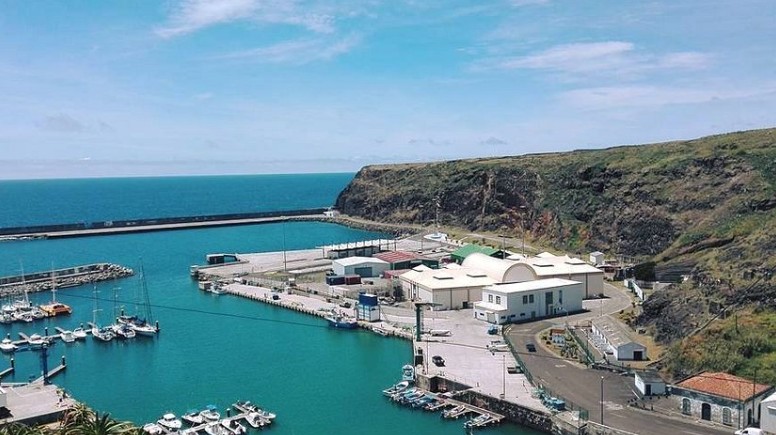
The public service contract provides for the possibility, at the request of the Regional Government, of resuming the connection between Ponta Delgada (São Miguel) and Vila do Porto (Santa Maria) between June 15 and September 15, or on specific occasions, such as the Festas do Senhor Santo Cristo.
It should be noted that Atlânticoline’s current fleet does not allow it to operate this route without compromising other regular connections, especially during the summer, when inter-island demand is highest.
Are there plans to resume other long-distance connections within the archipelago?
Experience has shown that long-distance routes within the archipelago are not economically sustainable due to low demand and competition from airfares, especially after the introduction of the Azores Tariff. Therefore, any resumption of these connections would be viable only if it fell within the scope of Public Service Obligations.
Investing in electric ships is an important environmental step. What are Atlânticoline’s goals for reducing emissions in the coming years?
Atlânticoline remains firmly committed to environmental sustainability. Despite the failure of the recent tender for electric ships, the company remains committed to reducing the carbon footprint of its operations by optimizing consumption, investing in more efficient technologies, and preparing for a future progressive energy transition.
Electric boats are a recent technological development that is not yet very mature in the maritime sector. Are you not concerned that, in terms of maintenance or technical assistance, there may be some additional constraints that could have recurring consequences for Atlânticoline’s operation of these new ships?
Atlânticoline was rigorous in defining the technical requirements for the two electric ships to be financed by the PRR, precisely to ensure that the energy transition would not compromise operational efficiency.
However, the first tender (early 2024) received no valid bids. In the second tender (November 2024), the selected consortium submitted changes incompatible with the specifications, leading to the cancellation of the process.
Despite this setback, the company remains committed to renewing its fleet with environmentally sustainable solutions. It is keeping an eye out for new financing opportunities and technological developments in the sector.

Regarding electric charging for ships, has EDA already given assurances that it can maintain a continuous supply? What is the status of the electrification of the ports (Horta, São Roque, Velas) necessary for the electric charging of ships?
From the outset, the entire electric charging process was properly coordinated with EDA and Portos dos Açores to implement the necessary solutions.
The tender for the construction of the ships under the PRR went badly. How did the requirements in the specifications (strict deadlines, technical characteristics) make the tender less attractive? Was this where the problems arose?
The requirements defined by Atlânticoline in the specifications were strict because they reflect the real needs of the inter-island public service.
Making these criteria more flexible just to attract bids would be a strategic mistake: the priority is to ensure that the ships fully meet the operational requirements and serve the population with the same level of safety and efficiency that the company has always guaranteed.
What are Atlânticoline’s prospects for the coming years?
Atlânticoline will continue to play its essential role in the territorial and social cohesion of the Azores, focusing on modernizing the fleet, digitizing services, and advancing environmental sustainability. The focus remains the same since its foundation: to bring the islands closer together, promote mobility, support the economy, and ensure that every Azorean has equal access to goods, services, health, sports, and culture.
Rui Leite Melo is a journalist for Diário dos Açores-Paulo Viveiros-director
- jornal@diariodosacores.pt
Translated into English as a community outreach program by the Portuguese Beyond Borders Institute (PBBI) and the Modern and Classical Languages and Literatures Department (MCLL), in collaboration with Bruma Publication and ADMA (Azores-Diaspora Media Alliance) at California State University, Fresno. PBBI thanks Luso Financial for sponsoring NOVIDADES

 Novidades - The Islands and the Diaspora