


ARMANDO MENDES, COORDINATOR OF THE CIBL STUDY
You coordinated the study to implement an Interpretive Center at Lajes Air Base on Terceira Island. How important is the creation of this center for the Azores? How can it contribute to the region’s development?
The Lajes Base Interpretive Center (CIBL) must accommodate what Azorean policymakers want from it, and that is how we will gauge its importance and the contributions it should make to the development of the Azores.
It is in the parliamentary speech at the time of the unanimous approval of the CIBL and in the speech by the Vice President of the Regional Government (author of the original idea and the impetus that led to parliamentary approval on the initiative of the party he leads, the CDS-PP, and the effective start of work) when signing the protocol with the Historical Institute of Terceira Island (IHIT) that gave rise to the work now being carried out, that we must seek answers.
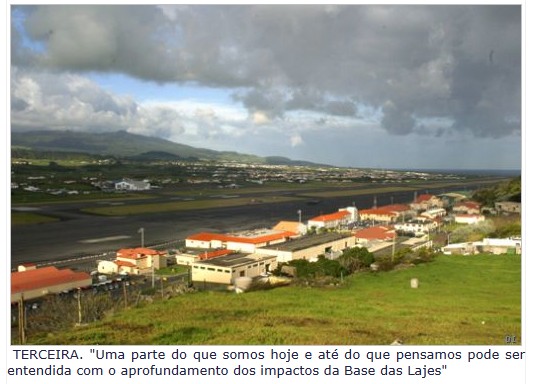
First of all, the CIBL must place the geostrategic importance of the Lajes Base on the international agenda and must report on the Base’s impact on the local community. It must also be a place for interpreting the creation of the Base, its functions over time, and its importance for the powers that use it, for Portugal, and for the Azores, in addition to conducting research and scientific production on the geostrategic role of the Azores in general.
The CIBL will also be responsible for collecting all possible documentation on the Lajes Base and, in general, on the geostrategic space of the Azores, and should also support scientific research carried out by other institutions or individual citizens. Policy makers also want the future Center to be established as a space for learning and socializing, in addition to promoting activities related to the interpretation of local history, without neglecting the promotion of cultural tourism on Terceira Island, as well as being a space for facilitating the recovery of heritage associated with Lajes Air Base.
It is clear that the CIBL will, according to the wishes of Azorean policymakers, have a multifaceted role, with implications for the promotion of knowledge, culture, and the economy, with an emphasis on the latter area, in the promotion of tourism. All of this is strategic for the Azores and likely to generate value.

Preliminary work indicates that the center should have three dimensions. One of these dimensions is the creation of a research center. Has the region not yet produced knowledge in this area? What background can it give to policymakers to defend the geostrategic position of the Azores?
The Azores have an inexplicable gap in promoting knowledge of the geopolitical and geostrategic dynamics surrounding the islands. There is some high-quality work being done, both on and off the islands, but it is limited and not systematic. There is no critical mass—a significant group of researchers and thinkers who produce knowledge and theorize systematically, keeping up with current events and seeking to anticipate the future.
For example, although the Lajes Base has existed, with foreign forces, since 1943, its impacts are not well known, to the extent that in the research we have been developing, new information always emerges, although poorly documented, which, for example, raises very significant doubts when attempting to synthesize and make decisions about interpretive nuclei to be prioritized in the future CIBL. The question is whether there might be more, and much more important. This is a terrible question, because we could make a big investment, always costly to the public purse, that could quickly become outdated.
The autonomous region has exceptional powers in international relations, to the extent that it has the right to participate in the negotiation of global agreements or treaties with implications for its territory and the benefits of such agreements or treaties. However, involvement in negotiations requires knowledge of what is being negotiated and of the interests of the other party or parties. It is necessary to build understanding through professional, broad-scope research. This knowledge will serve as a basis for constructing a forward-looking narrative that will enable policymakers, for example, to anticipate what will be at stake in a negotiation, thus allowing them to effectively defend the interests of the Azores.
The design of the research center planned for CIBL, in accordance with the expressed wishes of Azorean policymakers, will include pure research with permanent staff but will also prioritize the collection of documentation that will be made available to anyone who wants to produce knowledge, institutions, or individuals. The vision is to create a research community—a critical mass—capable of beginning to fill the knowledge gap we believe has been identified. We know that achieving this goal will take time. But the truth is that we have to start somewhere.
One of the difficulties identified in this work is access to documents. The US archives that were at Lajes Air Base were moved to Ramstein, and most of them have not been digitized. How can this constraint be overcome?
The problem of documentation is critical. With the downsizing in 2015, Lajes Air Base lost its Historian position, which led the Americans to remove all documentation from the Office of the Historian from Terceira, which is believed to have been transferred to Ramstein, Germany, where the headquarters of the US European Command, to which Lajes Air Base belongs, is located. On the other hand, it has been determined that less than three percent of US archives that may be important for the preparatory work of the CIBL have been digitized, which may lead to serious gaps in knowledge, for example, about the impacts of the base and the motivations behind those impacts, if we rely solely on online consultations. At the local level, some collections are difficult to consult because they have not been processed.
Efforts are being made, above all, to return the Lajes Base archive to Terceira. The Luís da Silva Ribeiro Public Library and Regional Archive (BPARLSB) has already offered to receive the collection, process it, and make it available for consultation. We believe this willingness may be decisive for the success of our endeavor. This return would be vital. As for the paper archives in the US, a decision will have to be made on the importance and feasibility of on-site consultation. The Azorean archives are evolving significantly, and important collections stored at BPARLSR are expected to be fully accessible soon, according to our information.
The existing documentation, work already done, and questionnaires/interviews are the solutions found so far to establish a satisfactory framework that we know has gaps, especially regarding the base’s impact and the motivations and visions of the Americans.
In addition to the research center, the interpretive center would also include a space for tourists and students to visit, and walking trails would be created in the parishes near the base. What tourism potential does this project have?
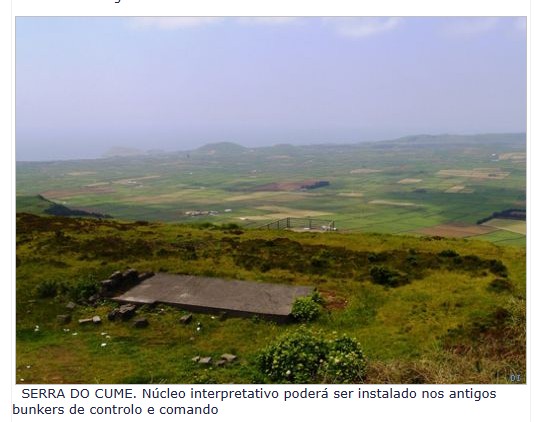
The CIBL should have three dimensions, and we have already seen the dimension of knowledge production. We will seek to locate the interpretive center in a Portuguese military control and command structure, now deactivated, located in Serra do Cume, next to Lajes Base. This will be the traditional interpretive center, based on multimedia structures with content aimed at visitors in general and schools. For example, a general knowledge film for schools could be 45 minutes long, while a 10-minute version could be selected for other visitors. Printed content should also be available in both versions. A day dedicated to the CIBL, for visitors and students alike, could begin there and continue along interpretive/tourist trails to be built in parishes around the Lajes Base, where we can find references—infrastructure, etc.—to the foreign presence at the base. Also, within the Lajes Base, it is possible to build routes related to the present and the past. There is already significant work that can be used, such as the Portuguese Air Force museum, which is open to visitors and can be integrated into a route or even serve as a hub for a visit to the base.

The focus of this center is the “meeting of cultures.” Is there still much to study about how Terceira Island has changed with the presence of the Americans?
Unfortunately, almost everything remains to be studied. This meeting of cultures, which began with the British and lasted only briefly, has continued with the Americans for nearly a century and occurs in two ways. On the one hand, the “American way of life,” with its distinctive features associated with a military base abroad that resembles an American suburban town, is projected onto the local society, which is deeply rural. On the other hand, American “soft power,” according to the official definition, designed to win hearts and minds in the bipolar struggle of the Cold War, aligns the American way of life with local ways of life to exert influence. All of this, which has taken place over a very long period of time, seems to have transformed the people of Terceira and, to some extent, the Azoreans in general, on various levels, from mentalities to diverse practices, including the introduction of plants and animals, new industries, new food models, and much more. American higher education itself was made available to locals, and sports such as golf and basketball were also introduced and developed. The list is almost endless and would not be complete without a foray into music, such as jazz, rock, and other genres that we did not know. Nearly all of this remains to be studied or has only been touched upon, precisely because such studies were never seen as a local priority, which is incomprehensible, since part of who we are today and even how we think can be understood by delving deeper into the impacts of the Lajes Air Base.
In Diário Insular-José Lourenço-director
Translated into English as a community outreach program by the Portuguese Beyond Borders Institute (PBBI) and the Modern and Classical Languages and Literatures Department (MCLL), in collaboration with Bruma Publication and ADMA (Azores-Diaspora Media Alliance) at California State University, Fresno. PBBI thanks Luso Financial for sponsoring NOVIDADES.

 Novidades - The Islands and the Diaspora