


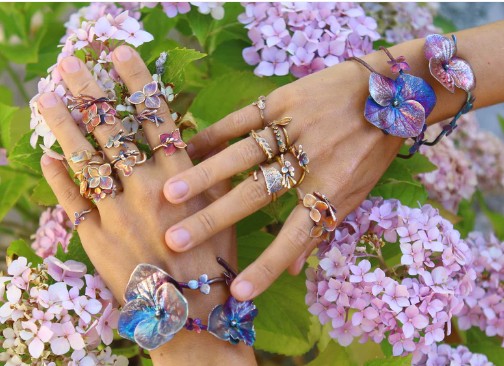
The flowers of the Azores are Constantino’s greatest inspiration in creating his jewelry. Each piece is unique and “always ends up finding the right person.” The creator of the website and also of the Azores flower page, explains to Correio dos Açores why he chose the Azores as his inspiration, why he devoted himself to the art of jewelry, and states: “The most emblematic and inspiring flower in the Azores is undoubtedly the hydrangea. You can see it in many of the pieces of jewelry I produce.”
Correio dos Açores – How has your life journey been so far?
Constantino (Creator of the Floresdos Acores brand) – I was born in the far north, where until I was seven, I had hardly seen any flowers—only moss, lichen, and rare tundra grasses. Everything changed when my parents moved to Ukraine: there, I discovered the abundance of plants and realized that nature would always be my path.
From an early age, I was interested in science, especially chemistry and biology. I completed several specialized studies and obtained a master’s degree. I worked as a chemical analyst, but plants continued to attract me, and I felt the need to express my creative potential. About ten years ago, I managed to gather the means to devote myself to developing my own technologies. Thus was born the idea of transforming real plants into gold and silver jewelry — preserving each flower’s shape, structure, and inner energy.
When the war in Ukraine started, I shut down production and left. I lived in Sri Lanka for two years, working with tropical plants, and later chose Portugal as the ideal place to continue my work. Here, I created a new product—unique jewelry made with local plants and materials—and I am dedicated to its development. Portugal is a wonderful country, generous in light, inspiration, and beauty.
Why did you move to the Azores?
I chose Portugal for several reasons. The Azores and the central region have rich flora, with many flowers and extraordinary shapes. It was important to have access to quality local materials and opportunities to develop the business. And, of course, the sun, air, and energy of the country create an incredible atmosphere for creativity. People are kind and welcoming—that’s very important too.
Why did you devote yourself to the art of jewelry making?
I wanted to create a product whose beauty could be appreciated and felt often. Ideally, something you could carry with you or touch. Beauty is perceived not only with the eyes but also with the touch.
Nature is abundant, but often its splendor becomes just a backdrop. I want my jewelry to help people stay in touch with that beauty. And it’s not just jewelry—it’s an alchemical product: a real plant transformed into gold or silver, which retains the energy of the place where it grew.
What inspires you most about Azorean flowers?
I create pieces with all kinds of plants, even ethereal dandelions. But the most emblematic flower for me in the Azores is the hydrangea. I have made jewelry using all types of plants, even ethereal white dandelions. But the most emblematic and inspiring flower in the Azores is undoubtedly the hydrangea. You can see it in many of the jewelry pieces I produce.
This flower impresses me not only for the beauty of its forms, but also for the incredible diversity of varieties and species. It is difficult to find another plant that presents so many variations of inflorescences, flower shapes, petals, and color shades. Each hydrangea seems like a small, unique miracle of nature.
Even the name of this flower sounds special, radiating nobility, elegance, and grace —qualities I seek to reflect in my creations. For me, the hydrangea is a symbol of beauty, richness of form, and the delicate harmony of nature, which inspires me in the creation of each new piece.

How have sales been going?
I don’t have any jewelry that won’t find a buyer—they are all unique. I am currently focusing on the domestic market in Portugal and am looking to expand production, seeking collaborators to help with both orders and sales, as well as manufacturing.
I work with retail and wholesale customers. In the future, I plan to export my pieces, mainly to Europe. My jewelry is Portuguese, made with local materials and plants.
When do you sell the most?
There is no great seasonality—people like to give gifts to themselves or others throughout the year. Naturally, there is a peak in sales during festive seasons, such as Christmas, Valentine’s Day, and other special dates.

Is there any jewelry that is a best seller?
I don’t have any jewelry that doesn’t sell—each piece is unique and always finds the right person.
The most popular are hydrangea-flower jewelry —rings, ear cuffs, bracelets, and necklaces — in gold and colored silver. Hydrangeas have become almost a symbol of my collection. There is also great interest in pieces with more complex flowers, such as apple blossoms or small spring flowers with many stamens. There is no jewelry like it anywhere else in the world, and many people want to add one of these pieces to their collection.
An important part of my work is custom orders. I like to create jewelry with special meaning — for example, using customers’ favorite flowers or exploring unusual color combinations. For me, it’s a way to convey each person’s story through the beauty and shape of plants.
Do you have a physical space in Ponta Delgada? If not, do you plan to have one?
I don’t have a physical store yet—all my time is devoted to creation and orders. Soon, when I have employees, I will be able to dedicate myself to opening a physical space.
What is the best way to contact you?
You can learn more about my work on the website http://www.floresdosacores.com and on Instagram. On the floresdosacores page. But probably the best way to contact me is by email. If you have any questions, suggestions, or comments, write to me at floresdosacores@gmail.com
Frederico Figueiredo is a journalist for Correio dos Açores-Natalino Viveiros, director.
Translated into English as a community outreach program by the Portuguese Beyond Borders Institute (PBBI) and the Modern and Classical Languages and Literatures Department (MCLL), in collaboration with Bruma Publication and ADMA (Azores-Diaspora Media Alliance) at California State University, Fresno. PBBI thanks Luso Financial for sponsoring NOVIDADES.

 Novidades - The Islands and the Diaspora