

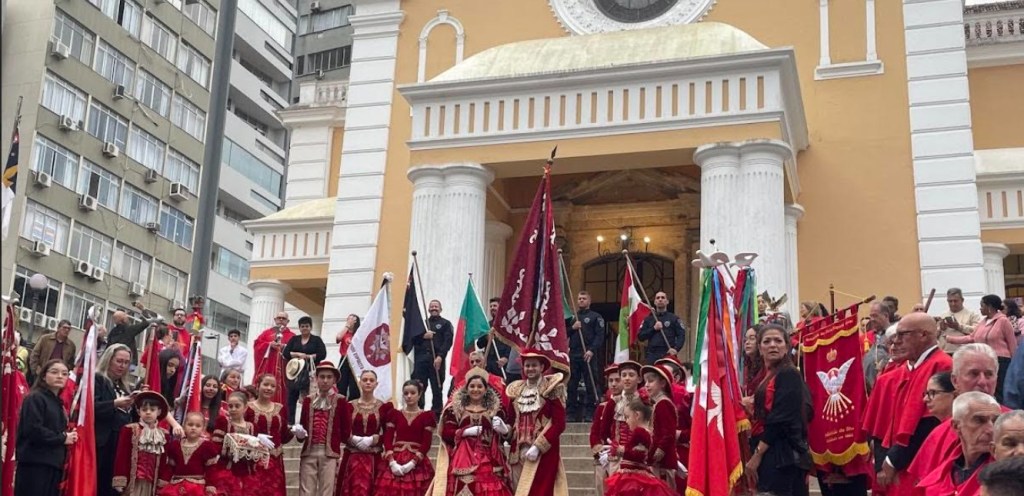
… And so we went for the first time to the lands of D. Pedro and Santa Cruz, more specifically Florianópolis, Santa Catarina, at the invitation of the Regional Directorate of Communities of the Government of the Azores to participate in the third stage of the First Global Forum of the Holy Spirit, part of the closing ceremony of the Cycle of the Holy Spirit, which took place on September 25 and 26, and as a speaker to talk about the cult of the Divine Holy Spirit as experienced here in New England, and more specifically about the Great Feasts of the Divine Holy Spirit in New England.
Miguel Ávila (Portuguese Tribune, California), Ilda Januário (Toronto, Canada), José de Mello (Great Feasts of the Holy Spirit in Ponta Delgada, S. Miguel), Canon Helder Fonseca Mendes (festivals of the Holy Spirit in Portugal), Lélia Nunes (festivals of the Divine in Brazil), and Roseli Pereira (Great Festival of the Cycle of the Divine of Santa Catarina) were the other speakers at a day of healthy conviviality among all participants and attendees, marked by a deep sense of spirituality and Azorean identity.
After a somewhat troubled journey, I barely recovered from a cold and had my flight from Miami to Rio de Janeiro postponed until the following day. Still, with American Airlines providing us with a hotel and meals, we arrived in Florianópolis at 11:00 p.m. the following day. We stayed at the Hotel Faial, right in the city center and about 12 kilometers from Hercílio Luz Airport. The next morning, at 9:30 a.m., the proceedings began at Casa José Boiteux, the current headquarters of the Santa Catarina Academy of Letters, a building with 26 rooms built in the 1920s. José Boiteux, it should be noted, was a distinguished journalist, historian, lawyer, and politician who died in 1934.
The report in the last edition covered the event itself in detail. This time, we intend to share our impressions and historical notes on Florianópolis, the state of Santa Catarina, and what we saw and experienced in just two days. Yes, two days.
The first time
Of course, we had already heard about Florianópolis and the state of Santa Catarina, its people, its Azorean descendants, the cult of the Divine Holy Spirit, and the first Azoreans who arrived there in the mid-18th century, especially through our friend Lélia Nunes, a contributor to the Portuguese Times, who, upon our arrival on that “Island of Magic,” replied: “Dear Francisco, how wonderful it is to meet you here in my homeland. Finally, you will get to know Florianópolis, and you will love it.” And honestly, we did love it. It was wonderful, unforgettable. Floripa will remain in our memories forever. The truth is that days before our departure, our friends Onésimo T. Almeida and Francisco Viveiros, who had already visited that beautiful city, which is entirely focused on tourism and culture, warned us: “You’re going to love Florianópolis!”

The emotions and pride of Azorean ancestry
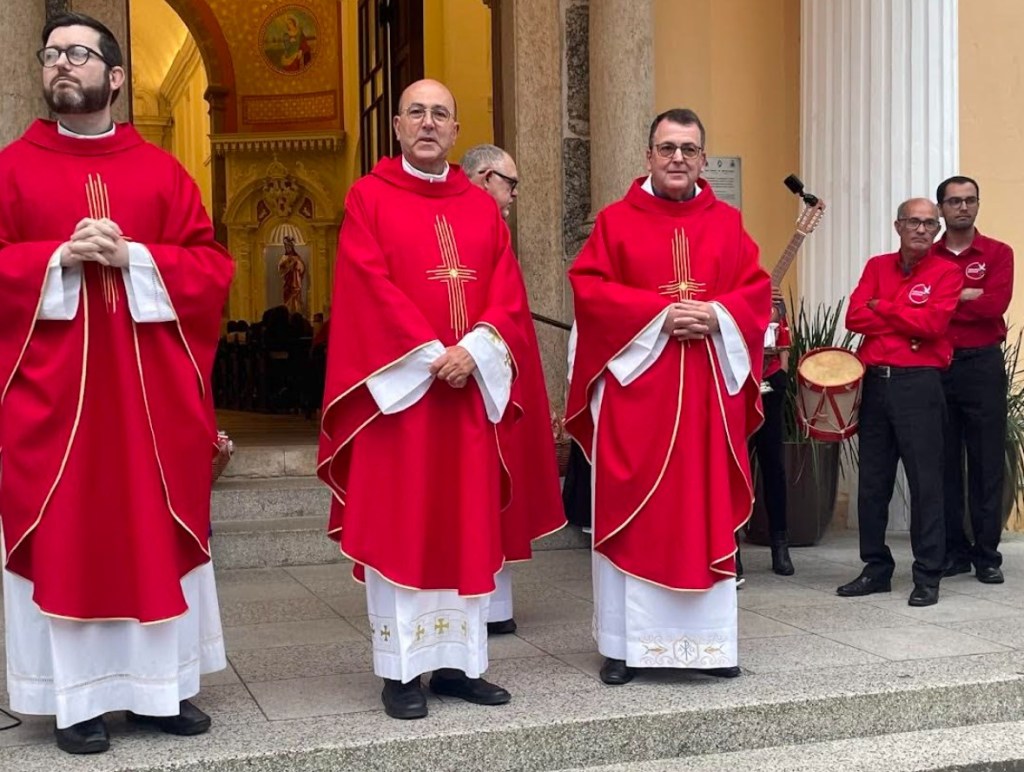
The delegation from the Azores, the US, and Canada was very well received, in such a way that it left a mark and will remain forever in everyone’s memory, not only for the friendliness, kindness, and hospitality of these beautiful people whom we will never forget, but above all for what we witnessed: the pride of Azorean ancestry and that faith and total devotion to the cult of the Holy Spirit. What we experienced at the Álvaro Carvalho Theater and later at the Metropolitan Cathedral of Florianópolis was truly impressive, infused by this emotional empathy of deep faith and devotion to the Divine Holy Spirit, which transcends generational and even ethnic barriers. For us, it was an authentic spiritual experience to see grandchildren, children, parents, and grandparents all united in the worship of the Divine. I have known Azorean communities in various latitudes and geographies. Still, I have never seen a community as proud of its Azorean roots and devoted to the Holy Spirit as Florianópolis, Santa Catarina.
In his speech at the closing ceremony of the Holy Spirit Cycle, Sérgio Luiz Ferreira, president of the Casa dos Açores de Santa Catarina, said: “The heart of the tenth Azorean island is here in Santa Catarina”. Perhaps it is. This is due to the history of Azorean immigration —first waves of migrants from the archipelago heading to southern Brazil, the ways they preserve and cultivate their roots, and the impact that future generations have had on the state and the country at all levels. The signs of the Azorean presence in southern Brazil are evident not only in the most distinctive tradition of the nine islands – the cult of the Holy Spirit – but also in the people themselves, who assert and express their pride in their ancestry from the North Atlantic islands, preserving and cultivating this identity through customs, institutions created over the years, and entities that stand out in various areas of political, social, and economic life in the state of Santa Catarina.
A little history
The city of Florianópolis, capital of the state of Santa Catarina and located in the southern region of Brazil, is known as the “Magic Island” and Floripa. In 1823, the village was elevated to city status with the name Desterro and founded as the settlement of Nossa Senhora do Desterro. Later, in 1894, during the Federalist Revolution, its name was changed in honor of Marshal Floriano Peixoto.
It is a popular tourist destination with paradisiacal beaches, a historic center, and influences from Azorean culture. Tourism has grown significantly in recent years, with an increasing number of visitors coming from other large cities in Brazil, such as Porto Alegre, Curitiba, São Paulo, and Rio de Janeiro. Visitors from abroad come from Europe and the US.
With a population of around 540,000, it is the second most populous municipality in the state, after Joinville. It is also worth noting that Florianópolis is one of three Brazilian capitals located on islands (the other two are Vitória and São Luís), and is the fourth coldest capital in the country, behind only Curitiba, Porto Alegre, and São Paulo. With a subtropical climate, characterized by well-defined seasons, with hot summers and cold winters, and abundant rainfall well distributed throughout the year, Florianópolis has an economy based on the information and communication technology sector, offering historical attractions, including the sites of the original Azorean settlers, Lagoa da Conceição, and Santo António de Lisboa.

Azorean immigration to Santa Catarina
Most of the Azoreans who settled in Santa Catarina, and consequently in Florianópolis, between 1748 and 1756, were sent to colonize the island, which until then was a sparsely populated territory. This colonization, encouraged by Portugal to strengthen its control and defense of the southern regions of Brazil, brought a vast cultural wealth, including customs and traditions that influenced the cuisine, architecture, and way of life of Santa Catarina. It is estimated that in early 1748, precisely 277 years ago, 460 Azoreans arrived on the island of Santa Catarina. Between 1748 and 1756, it is estimated that more than 4,500 Azoreans settled in Santa Catarina, and approximately 1,500 migrated to Rio Grande do Sul.
According to history, the first Azoreans arrived in Uruguay in 1763, when 140 families were taken prisoner by the Spanish governor, Don Pedro de Cevallos, during a military action in Rio Grande do Sul and transferred to Uruguayan territory, where they founded the city of San Carlos.
It should also be noted that many Azoreans living in Brazil immigrated to the US and Canada, especially from the mid-20th century onwards.
The Azorean ancestry of Hercílio Pedro Luz
Hercílio Luz, after whom the famous bridge in Florianópolis is named, connects the island to the mainland, the international airport, the stadium, in the city of Itajaí, the professional soccer club in Tubarão, the Memorial inside the Casa de Campo Museum in Rancho Queimado, avenues, streets, and squares in municipalities in Santa Catarina, not to mention the mansion on Avenida Mauro Ramos in Florianópolis, has Azorean origins. Hercílio Pedro Luz was born into a wealthy family with an appetite for politics. Son of Joaquina Anania Neves da Luz, a descendant of bandeirantes, and Jacinto José da Luz, a merchant of Azorean origin, it is known that his maternal grandfather, Joaquim Xavier Neves, was a deputy in the Provincial Legislative Assembly of Santa Catarina seven times.
Hercílio was the first governor elected by direct vote, and days after taking office, he changed the name of Desterro to Florianópolis. He was born in 1860 and died in 1924, having been a political engineer and three-time governor of the state of Santa Catarina, as well as a senator and federal deputy.
(Historical data extracted from Wikipedia)
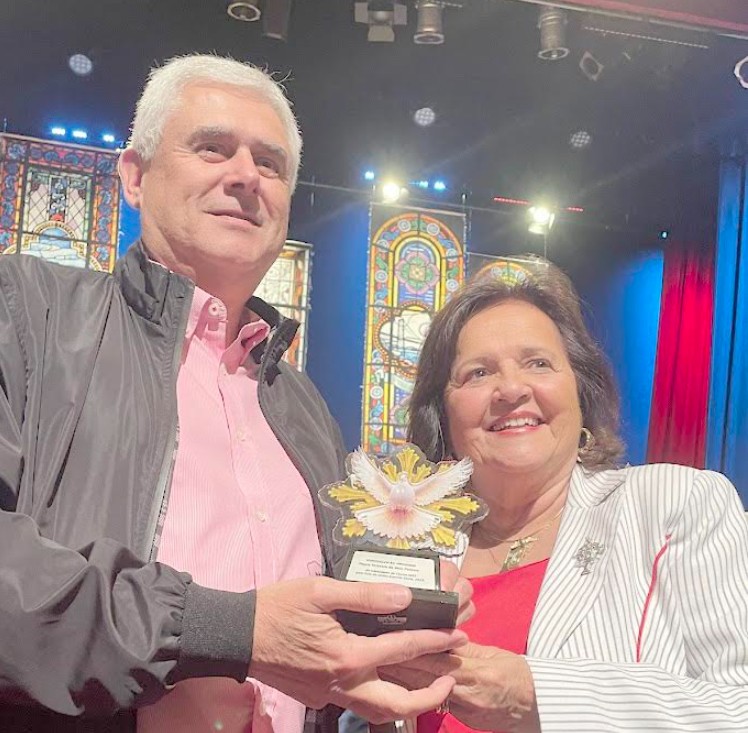
The Azores are so close by, and Lélia Nunes’ message: “After all, you are one of us!”
It was worth traveling so far to discover another reality of Azorean life and experience that made us feel so close to the archipelago because of the way these signs of the Azorean presence are lived, celebrated, and perpetuated. The truth is that in Florianópolis, we feel at home, more proud and more aware that the Azorean diaspora is vast. Some say that, because of their strategic and geographic position, the Azores are not at the center of the world. Paranoid as we are, the Azores are in the four corners of the world where there are Azoreans and descendants who are proud of their traditions and keep them alive: from Scandinavia to Hawaii, from Rio Grande do Sul to Kitimat, British Columbia, Canada, from New England to California, certainly covering other areas of the globe with small pockets of Azoreans and their descendants.
Here in Uncle Sam’s land, we received this note by email from our dear collaborator Lélia Nunes, who has contributed greatly to strengthening the Azorean identity in its transatlantic dimension:
“Dear friend Francisco Resendes! It is with great affection that I write to express my joy at your presence in Florianópolis, on the ‘Island of Cá’, as I like to call it, during the third stage of our Global Forum of Espírito Santo. As president of the Santa Catarina Academy of Letters, it was a privilege to see our Casa José Boiteux decked out to welcome friends from the Azores, New Bedford, San José, and Toronto, under the blessings of the Holy Spirit.
Congratulations on the article in the PTIMES edition… A big hug with the esteem of friendship, and we are here waiting for you. After all, you are one of us! Lélia!”
Acknowledgments
We would like to thank the Regional Secretariat for Parliamentary Affairs and Communities and the Regional Directorate for Communities of the Government of the Azores for inviting us to participate in such a worthy and commendable initiative, which allowed me to enrich and deepen my understanding of the concept of Azorean identity, and for the spiritual experience I had in Florianópolis. Unforgettable and remarkable!
Extensive thanks to all the entities in Florianópolis, Santa Catarina, for the way they welcomed us and contributed to this memorable experience. Thank you, my friends!
– Francisco Resendes, Portuguese Times

“The Feast of the Holy Spirit has been truly subversive over the years because it brought the concept of equality, fraternity, and sharing.”
– Paulo Estêvão, Regional Secretary for Parliamentary Affairs and Communities of the Government of the Azores, in Brazil
Paulo Estêvão, Regional Secretary for Parliamentary Affairs and Communities of the Government of the Azores, during his visit to Florianópolis, in the state of Santa Catarina, met with the state’s vice-governor, Marilisa Boehm, who welcomed the entire delegation from the Azores, Canada, and the US to her official residence, Mayor Topázio Silveira Neto, who offered the delegation lunch at his office, where souvenirs were exchanged, and State Representative Mário Motta.
One of the highlights of the visit, as PT mentioned in its last edition, was the signing of cultural cooperation protocols between the Azores and Santa Catarina, as well as with representatives from various cultural institutions in the region.
At the closing ceremony of the First Cycle of the Holy Spirit of the state of Santa Catarina, where several speakers took the floor, Paulo Estêvão acknowledged the enthusiastic strength with which the descendants of Azoreans in the region keep alive the tradition of the Divine Holy Spirit and the pride of their Azorean ancestry. In a curious reference to the celebrations in praise of the Third Person of the Holy Trinity, he stated:
“Many people think that the ideas of equality, fraternity, and social justice began only with the French Revolution, but I believe that what truly triumphed with the liberal revolutions were the ideas of the cult of the Holy Spirit, created in a society of order, where there was the clergy, the nobility, and the people, with the first two enjoying privileges, particularly in terms of taxes. What we see is that the festival of the Divine Holy Spirit was truly subversive in that period, lasting for centuries. I say subversive because it brought the concept of equality, of everyone sitting at the same table as equals, men and women, with the same dignity, and it also brought an idea of sharing and putting it into practice, and only then was it possible for many Azorean communities to prevail in areas that until then were wild, isolated, where it was necessary to survive each winter or summer, and in a country with the continental size of Brazil and a whole range of difficulties that your ancestors had to endure so that you could be here today,” said Paulo Estêvão, who adds:
“We must be a more equal, more fraternal society, and this can only be achieved through the ideals of the cult of the Divine Holy Spirit. That is why it grows and has this vitality and modernity and these gestures of evolution and this triumph of all our times, knowing that we still need to deepen this cult of the Divine Holy Spirit, because we have to be that fairer and more equal society,” emphasized the Azorean regional secretary, adding that he was feeling the same sensation he felt in distant lands such as Canada, Uruguay, and Hawaii, places where the cult of the Holy Spirit is still maintained from generation to generation.
“I must say that the cult of the Holy Spirit unites this strength of tradition with the strength of modernity based on these ideas of equality and fraternity, and it is a source of pride for me and certainly for the Government of the Azores to be here and see your faith and how tradition is part of your identity. This cult unites us in this vast diaspora,“ he said, extending an invitation to celebrate the 600th anniversary of the discovery of the Azores, for which a preparatory committee should be appointed.
”In 2027, we will celebrate 600 years since the discovery of the Azores, where it all began… Those islands were indeed uninhabited, and in the decades following 1427, the Azores began to be populated in such a way that in less than a century, the islands became prosperous. I invite everyone to celebrate our existence and Azorean identity with us,” explained Paulo Estêvão, who added:
“It is incredible that such a small archipelago, with 2,100 square kilometers and now with 240,000 inhabitants, can have a diaspora estimated at more than 3 million people, and that is truly surprising, especially because the Azores have also become a destination, as is the case with Cape Verdeans and even Brazilians and other European countries,” concluded the Regional Secretary for Parliamentary Affairs and Communities of the Government of the Azores, who was moved during his speech at the closing ceremony of the First Cycle of the Holy Spirit of the state of Santa Catarina. His speech was warmly applauded by everyone present at the emblematic Álvaro Carvalho Theater in Florianópolis, attended by several representatives of the city’s municipal government, including the mayor, Topázio Silveira Neto, a descendant of Azoreans from São Jorge and Terceira.
Note from NOVIDADES:
We extend our heartfelt gratitude to our longtime friend Francisco Resendes, director of The Portuguese Times, for allowing us to translate and share his luminous reportage on this celebration. His work is more than journalism—it is an act of cultural devotion. Through his words, we glimpse the living pulse of the festas, their power to adapt and readapt to both place and time, and their enduring light as a beacon of Azorean spirit in southern Brazil—nearly three centuries after the first Azorean families cast their roots in that distant land.
In these articles, Francisco has given voice to what our diaspora most needs: truth spoken with clarity, dedication, and tenderness—the understanding that to direct a newspaper is to write about our diaspora throughout the world, to bring us together with words.
This event, offered here in two parts (the first published on October 28), reminds us of the invisible thread that binds all Azoreans—those on the islands and those scattered across the oceans. It is a testament that, wherever we dwell, we remain one people, joined by memory, faith, and the salt of our shared beginnings.
 Novidades - The Islands and the Diaspora