


“We want to put technology at the service of our sea and our marine resources with the mission of protecting and preserving the sea of the Azores,” say the students who won the Norma-Açores 2025 Award.
The ALGACLEAR project, created by two young students from the University of the Azores (UAc), was the big winner of the 1st Edition of the Norma-Açores Award, which took place on the 21st of this month. The award is intended to reward the best Entrepreneurship and Innovation project at UAc. The initiative developed by the young people aims to assist concessionaires in bathing areas in removing invasive algae from beaches and port areas in the region.
Our newspaper spoke with Bernardo Silveira and Diogo Tavares, the creators of the idea. Bernardo, 22, is from São Roque, has a degree in Management, and is currently pursuing a master’s degree in Business Sciences at UAc. Diogo is 25, from Santa Cruz, and is completing his degree in management at the same institution.
“We want to solve the problem of invasive algae because they compromise marine biodiversity and prevent bathers from enjoying our beautiful beaches and bathing areas. This also affects the perception when you arrive at the beaches and harms the fishing sector, which is unable to carry out its activities,” Diogo and Bernardo emphasized.
According to the founders, ALGACLEAR is an innovative solution that aims to support concessionaires in the bathing and port areas of the island of São Miguel. “The idea is to monitor and remove invasive algae. In our region, we have the invasive algae, Rugulopterix okamurae, a species that often appears on our beaches and affects marine biodiversity and water quality,” they revealed.
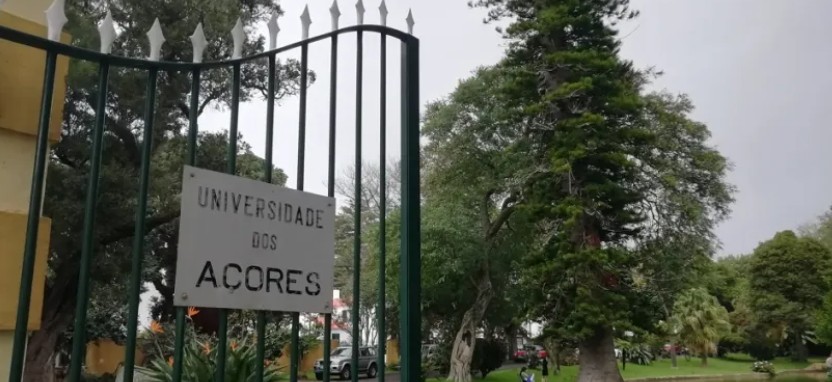
The creators reported that the idea of working with algae arose during an interview with Portos dos Açores for an academic project, which served as the catalyst for consolidating the ALGACLEAR project. They were also supported by institutions such as the Faculty of Economics and Management (FEG), InUAc, and Portos dos Açores. “We consider this interview very important because we left satisfied that we had something more concrete and that we had understood one of the pain points of our target segment,” the two young people pointed out.
To solve this problem, the students intend to collect the algae using two autonomously operated vehicles equipped with a net box. A door that opens from the outside in would be the way to store the algae inside the object, the São Miguel natives explained. They added that they intend to use a drone, which they say will “detect patches of algae floating near the coast.”
“In terms of environmental sustainability, we aim to protect marine ecosystems by trying to mitigate an invasive species. The other aspect would be economic. We perform the task of collecting algae, but the issue of storage, transport, and use of algae would have to be done by third parties. With this, we are promoting economic cooperation with other companies and other activities,” emphasized the founders on how the project contributes to the sustainability of the Azores region.
Regarding the method used, Diogo and Bernardo guarantee that it could work, since the project has not yet been implemented. However, they say they want to surround themselves with experts, engineers, and researchers to obtain the best advice on finding the best alternatives to this obstacle.
“In the end, what we want is as much advice and ideas as possible so that we can minimize the environmental impact, because our idea is to help and not to harm,” they said.
The Azoreans also faced some obstacles, revealing that the path to the final idea “was not very linear.” “We had a lot of ideas to include in a single robot, such as cutting, collection, and analysis, but as we received mentoring, we realized that we had to focus on one idea and not several,” the young people confessed.
Participation in the project was initiated by Professor Ricardo Machado, who teaches the Entrepreneurship Course. The young people felt they had nothing to lose and decided to participate in the award, which debuted this year.
In the future, ALGACLEAR intends to create jobs and use the collected algae. “The project’s activity is the collection of algae, but there is a whole environment that is necessary, whether for transport, storage, or putting the algae that has already been collected to use,” said the students. They also intend to establish partnerships with Norma-Açores, which awarded the prize.
The two colleagues aspire to “put the idea into practice. Our main goal is for this idea to be put into practice and to have practical and beneficial results for people, especially for our target segment, beach concessionaires, and port agents.”

The young people also left a short message of support for all young people who have innovative ideas: “Believe. You must believe in your own ideas and not be afraid to start or try. We must always try to experience everything that comes our way, everything that we think makes sense for our lives, even if we gain nothing in monetary or physical terms. The experiences and lessons always remain in our minds, and that is what we take with us through life. The best ideas come from simple ideas that are even present in our daily lives.”
“We want to put technology at the service of our sea and our marine resources with the mission of protecting and preserving the sea of the Azores,” concluded Diogo Tavares and Bernardo Silveira.
The Faculty of Economics and Management of the University of the Azores also announced the other winners of the Norma-Açores award on the 21st of this month. The award is the result of a partnership between the institutions Norma Açores, InUAc, and FEG.
In a press release, they announced the winner, ALGACLEAR, as well as the second and third-place projects. The Mar&Terra project, by student Francisca Sousa, took second place in the awards.
Mar&Terra supports farmers and agricultural cooperatives in using natural fertilizers derived from algae and shells instead of chemical fertilizers.
In third place was the HARMONY project, by student Tatiana Pires, which aims to support tourists’ well-being by offering a diverse range of outdoor therapies in contact with the region’s nature, including regional natural products such as essential oils and Porto Formoso tea.
In Correio dos Açores-Natalino Viveiros, director
Translated into English as a community outreach program by the Portuguese Beyond Borders Institute (PBBI) and the Modern and Classical Languages and Literatures Department (MCLL), in collaboration with Bruma Publication and ADMA (Azores-Diaspora Media Alliance) at California State University, Fresno. PBBI thanks Luso Financial for sponsoring NOVIDADES.

 Novidades - The Islands and the Diaspora