

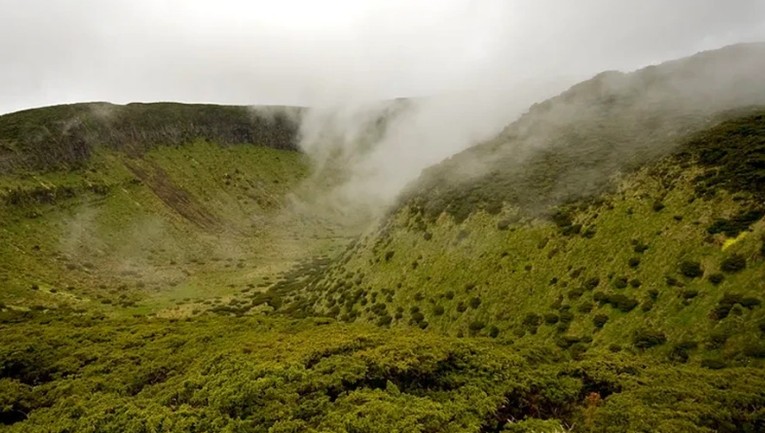
The alert level for the Santa Bárbara volcano has risen again to V3 (volcanic system in a phase of reactivation).
“In view of the increase in seismic activity, the Crisis Office has decided to raise the alert level to V3 for the Santa Bárbara volcano, while maintaining the V2 alert level for the West Fissural Volcanic System of Terceira,” the Volcanology Institute of the University of the Azores (IVAR) announced yesterday.
Since June 24, 2022, seismic activity at the Santa Bárbara volcano has been “above normal reference values,” with the most energetic event occurring on January 14, 2024, with a magnitude of 4.5 on the Richter scale.
Increased monitoring
In view of the increased alert level, the Volcanology Institute of the University of the Azores will increase its monitoring of the Santa Bárbara volcano. “We are currently doing some more fieldwork and next week we will carry out some missions, which we are preparing, to collect gases and water in the perimeter of the Santa Bárbara volcano,” revealed yesterday geologist João Luís Gaspar, coordinator of the IVAR Crisis Office.

According to João Luís Gaspar, the alert level was raised due to an increase in seismic activity in the western part of Terceira Island in September and October. “This was not only due to a greater number of earthquakes recorded, but above all to more earthquakes of slightly higher magnitudes, between 2 and 3 on the Richter scale. In addition to the number of earthquakes increasing slightly, we had an increase in the energy released,” he explained. Added to this parameter is “some crustal deformation above reference levels.”
However, the data issued by the permanent stations in this area of the island, 24 hours a day, do not indicate “any change in physical-chemical parameters, gases, or water.” “This alert 3 requires us to develop more campaigns around the volcano to check if there are any other changes that may not be apparent at the level of the permanent networks. As far as the Civil Protection authorities are concerned, it means that it is time to reassess the emergency planning in place for such occasions,” said the coordinator of the IVAR Crisis Office.
According to João Luís Gaspar, the current situation is very similar to that of the summer of 2024. “We continue to see a pattern very similar to last year’s, with only signs of seismicity and crustal deformation,” emphasized João Luís Gaspar.
The seismic-volcanic crisis on Terceira Island has been going on for more than three years, with alternating periods of greater and lesser energy release, which, according to the geologist, is normal for this type of phenomenon.
“We are experiencing a phase of greater energy release, but it is a phenomenon that generally follows this pattern. It is not like a seismic crisis that begins with an earthquake and then has aftershocks that gradually diminish. Volcanic crises, as a rule, have this very long development, lasting months or years, always with these oscillations,” he explained.
“That is why we have to keep monitoring it, and the alerts indicate the degree of attention we should give to this type of phenomenon, whether in terms of monitoring or adopting preventive measures,” he added.
At this stage, the crisis is “on an upward trend again,” which requires monitoring “day by day, hour by hour, to understand how it will evolve.”
In June 2024, the alert level rose to V3. Still, it reverted to V2 (a volcanic system in a state of instability) in December of that year, as evidenced by reduced seismic activity and crustal deformation. At a meeting in October to assess seismic and volcanic activity, the IVAR Crisis Office decided to raise the volcanic alert level at the Santa Bárbara Volcano again.
According to the Crisis Office, seismic activity on Terceira Island, “although low in magnitude, is well above reference levels, particularly at the Santa Bárbara Volcano and the West Fissural Volcanic System of Terceira.” The statement notes that there is a “growing trend compared to what was observed in the first months of this year.” Seismic activity was also recorded in the area between the parish of Cinco Ribeiras and the city of Angra do Heroísmo.
In Diário Insular-José Lourenço-director
Translated into English as a community outreach program by the Portuguese Beyond Borders Institute (PBBI) and the Modern and Classical Languages and Literatures Department (MCLL), in collaboration with Bruma Publication and ADMA (Azores-Diaspora Media Alliance) at California State University, Fresno. PBBI thanks Luso Financial for sponsoring NOVIDADES.

 Novidades - The Islands and the Diaspora