

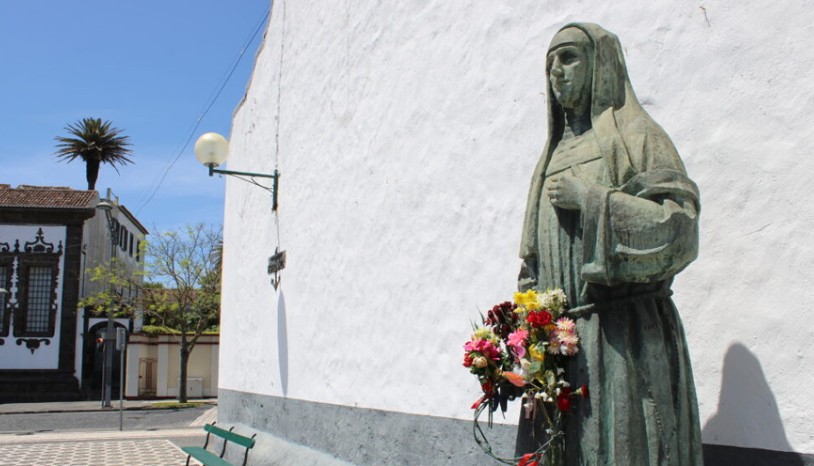
The rector of the Shrine of Senhor Santo Cristo dos Milagres considers that the presentation of the Beatification Process of Mother Teresa D’Anunciada in Rome is “a duty of the Church” and a sign of hope for the faithful who have venerated the “Nun of the Holy Christ” for centuries, according to the website Igreja Açores.
The Diocese of Angra took a decisive step in this process on Monday with the appointment of the Historical Commission responsible for gathering and validating the documents that could lead to her cause in Rome.
The process, which has suffered advances and setbacks and has never been truly investigated, and which could be said to have begun shortly after the death of the Poor Clare nun in the 18th century, now seeks to be completed with greater rigor and objectivity, to allow a solid judgment on the holiness of Mother Teresa.
“It is important that the work of this Historical Commission be carried out with greater rigor and objectivity, so that when it is sent to Rome, a proper judgment can be made about the holiness of this woman,” says the rector, emphasizing that “there are no time limits, because the essential thing is that the truth come to light and be recognized by the Church.”
“If you ask me if I would like the work to be completed next week, of course, but I will not press for anything, because what matters to us above all is the truth, so that the truth may come to light and be recognized by the Church,” says Father Manuel Carlos Alves.
Born into religious life within the cloister of the Convent of Nossa Senhora da Esperança, Mother Teresa da Anunciada dedicated her life to the image of the Holy Christ of Miracles, promoting the worship and devotion that continue to this day.
“She is a heroic woman in her dedication to the image of the Holy Christ,” says the rector, recalling that she faced “much opposition, even within the convent and from the Franciscan authorities.”
With courage and a deep spiritual life, Teresa da Anunciada realized the importance of showing the image of Ecce Homo, bringing it to the people as an instrument of evangelization and conversion. “She understood that people needed to see the Savior in order to benefit from that same salvation,” adds the rector.
The newly appointed Historical Commission will have the mission of gathering, analyzing, and validating all existing documentation on the nun’s life, virtues, and reputation for holiness.
The rector emphasizes that the process is “almost complete,” with only “putting all the pieces together” and awaiting the final pronouncements of the canonical authorities remaining.
“Not everything depends on me. Much will depend on the canonical judicial authorities who will rule on each document, on the opening and closing of the process,” he explains.
Taking the case to Rome is, in his words, “a duty of the Diocese and a right of Christians, so that the Church may pronounce, in its highest authority, on the life and teachings of this extraordinary woman.”
One of the decisive elements on the path to beatification is the verification of a miracle attributed to Mother Teresa’s intercession. The rector acknowledges that “many have occurred over time,” but that “rigorous documentation” is lacking to officially prove them.
“This documentation is essential, and that is why we ask people to communicate to the Shrine the graces received through the intercession of Mother Teresa. Only then can we assess the importance of these testimonies in the canonization process.”

The reports that reach the Shrine are countless—healings, family reconciliations, liberation from personal afflictions—signs of a living faith that spans centuries.
“People turn to her when they feel at a crossroads in life, when they realize that, on their own, they are unable to resolve their difficulties. And they communicate these graces to us, which are then carefully analyzed,“ says the rector.
The verification of a miracle, he recalls, involves scientific and medical commissions, which assess whether a healing or event is ”inexplicable” in the light of science. Only then is its spiritual dimension recognized.
“The miracle happens not by our work, but by the work of God, through the intercession of Mother Teresa. It is God who works, but it is up to us to recognize and document it.”
Since she died in 1740, Mother Teresa of the Annunciation has been venerated by the people of Ponta Delgada, who recognize her as the “Nun of the Holy Christ.” The rector recalls that, at the time, “people flocked to the convent to obtain her relics,” a sign of the reputation for holiness that accompanied her from an early age.
Today, more than two centuries later, this devotion remains alive in the hearts of the faithful and in the spirituality of the Sanctuary of the Holy Christ of Miracles.
“This is a very serious goal that I have set for myself as rector,” he admits.
“We want to complete the work begun almost three centuries ago, so that the Church can propose Mother Teresa of the Annunciation to the world as an example of faith, courage, and love of God,” he concluded.
In Diário dso Açores-Paulo Viveiros-director.
Translated into English as a community outreach program by the Portuguese Beyond Borders Institute (PBBI) and the Modern and Classical Languages and Literatures Department (MCLL), in collaboration with Bruma Publication and ADMA (Azores-Diaspora Media Alliance) at California State University, Fresno. PBBI thanks Luso Financial for sponsoring NOVIDADES.

 Novidades - The Islands and the Diaspora