

Founded in 2021 in São Miguel by Daniela de Sousa and Daniela Carvalho, ‘Handy Dany’ emerged as a response to the unemployment generated by the COVID-19 pandemic. The project is dedicated to creating personalized wooden products using techniques such as string art, pyrography, and laser engraving, producing original pieces that combine tradition and creativity. “We are increasingly noticing people’s interest in offering unique and personalized gifts and in being able to purchase exactly what they have in mind,” explain the entrepreneurs.

Correio dos Açores – Who are the founders of the project?
Daniela de Sousa and Daniela Carvalho (Founders of Handy Dany) – The name of the project comes from the fact that we share the same name, and we both love crafts. We both have degrees in Sociocultural Animation from the Lisbon School of Education.
How did the Handy Dany project come about?
Handy Dany was born in 2021, at the height of the COVID-19 pandemic. We were living in Lisbon and decided to move to São Miguel, where we had difficulty finding work due to the circumstances at the time. That’s when we decided to start the project using the string art technique, which one of us had already wanted to try.
What motivated you to create a business that uses wood as its main element?
Wood is one of the best materials for string art. It is one of the most widely used raw materials; it is durable and versatile, so we decided to continue using it in other techniques.
Why did you choose string art, pyrography, and laser engraving techniques?
We started the project with the string art technique as an alternative to unemployment, and because one of us had a strong personal interest in the practice, sparked by ideas she found online. Pyrography came later, after we watched some excellent videos that sparked our interest in the technique.
With the growth of social media, the increase in order volume, the need for quick stock, and the fact that we started street vending in 2023, pyrography was no longer viable for some products. So, we decided to start using laser engraving for our customizations, which, although it doesn’t have the same handmade touch as pyrography, allows us to put much more of our creativity into each piece.
Who are your most frequent customers?
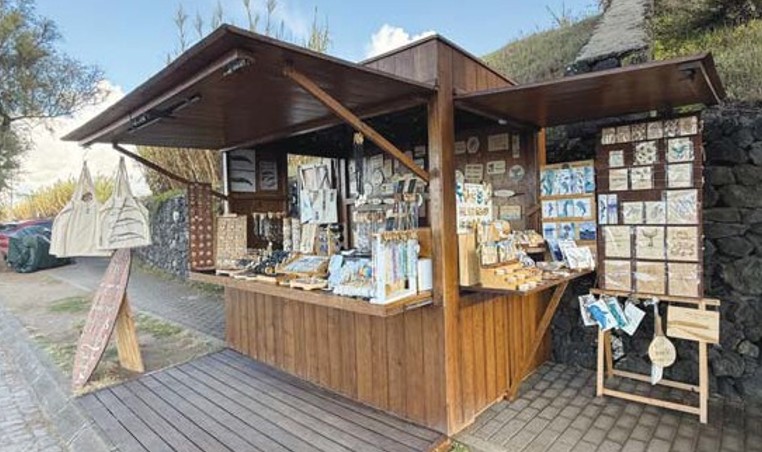
Through Facebook and Instagram, we sell to all kinds of customers, whether from the Azores or the mainland, with sales most prevalent during the Christmas season. We are also in high demand for personalizing birthday gifts, souvenirs, or decorations for baptisms and weddings. We currently have a kiosk in Areal de Santa Bárbara, in Ribeira Grande, where we mainly sell souvenirs to tourists visiting the island. This sales outlet is also very popular with the local population, who mostly come to us for our jewelry. At the kiosk, we also sell some products by other artists from the island.
What are the most requested customizations by customers?
In string art, we are most often asked to customize photos for silhouettes. In wood engraving, whether by pyrography or laser, we customize many products with people’s messages, mainly on key rings and bookmarks. Consumers always share their ideas with us, and we always try to work with what they show us. We do this so that we can present customers with several suggestions so they can choose the one they identify with most. We also modify the product as many times as necessary until the customer is satisfied.
In your opinion, has the community become more interested in this type of product in recent years?
Without a doubt. We are increasingly noticing people’s interest in offering unique, personalized gifts and in purchasing exactly what they have in mind. In Areal de Santa Bárbara, we also see that tourists praise our products immensely, not only because our materials are durable, but also because we sell authentic products that we produce ourselves. As for workshops, we have never considered creating them, but we have participated in several fairs, such as the Quinhentista Fair, the Ribeira Grande Christmas Village, and the Flower Festival.

What are the biggest challenges you currently face?
One of the biggest challenges we face is the fact that people often cannot afford to pay what handcrafted work deserves. We usually have to reduce the value of the hours we put in so that people can afford to buy many of our products.
What are Handy Dany’s future plans?
We currently have a physical space in Areal de Santa Bárbara, but because it is a kiosk and due to its location, it is more geared towards tourists. One of our plans for the future is to open a physical space to offer a wider variety of products to the community. For now, we can say we are going to take a step forward in our business and open a workshop in Ribeira Grande, where people can visit us by prior arrangement. In this space, visitors will be able to place orders in person or make purchases on the spot, as there will be a small exhibition space with some of our products.
If you could leave a message to the community, what would it be?
We would like to appeal to those who do not yet know us to visit us, both on social media and at our kiosk. We ask people to value craftsmanship, not only ours, but also that of many artists scattered across our island. We urge you to buy more at fairs and small businesses and to support and value what is ours.
In Atlântico Expresso-Natalino Viveiros, director.

Translated into English as a community outreach program by the Portuguese Beyond Borders Institute (PBBI) and the Modern and Classical Languages and Literatures Department (MCLL), in collaboration with Bruma Publication and ADMA (Azores-Diaspora Media Alliance) at California State University, Fresno. PBBI thanks Luso Financial for sponsoring NOVIDADES.

 Novidades - The Islands and the Diaspora