


A live online conversation on the Azores, international relations, and the living bridges of the diaspora
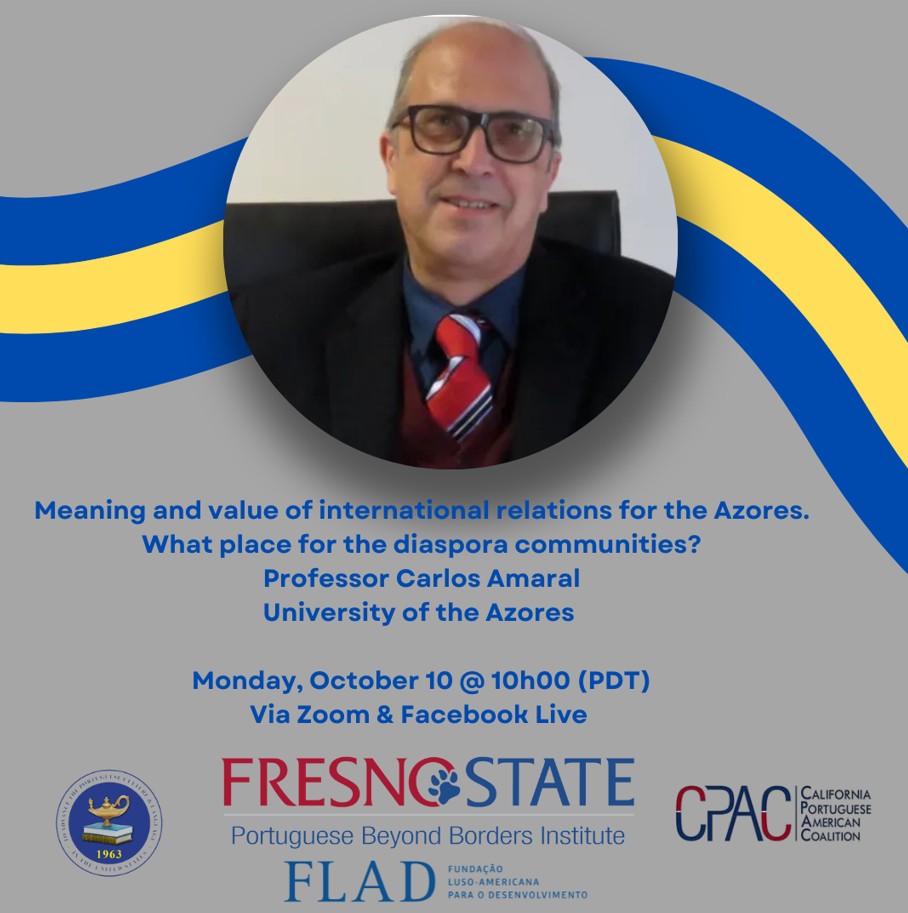
Across a constellation of nine islands and one immense ocean, the Azores have long stood where currents meet — geographies of wind and will, charted by sailors and sustained by communities who learned to make distance a bridge. This morning, at 10:00 a.m. Pacific Time, audiences around the world are invited to join a luminous conversation with Professor Carlos E. Pacheco Amaral (University of the Azores) — live on Zoom and Facebook — as he explores the evolving role of the Azores in international relations and the vital presence of its diaspora across continents.
In his distinctive blend of erudition and clarity, Professor Amaral offers a sweeping yet intimate portrait of the islands as a frontier of articulation. In this space, autonomy, geography, and diplomacy converge. The Azores emerge not merely as points on a map, but as voices within the global conversation, speaking of sustainability, cooperation, and identity in a rapidly changing world.
Without revealing all the revelations in store, Amaral will touch upon the ways regional autonomy reframed the Azores from periphery to platform, how strategic geography became cultural agency, and how the islands’ transatlantic vocation continues to resonate — from the European Union’s framework for the Outermost Regions to the vast human network of its diaspora.
“The Azores look simultaneously inward and outward,” notes Professor Amaral. “They are Europe’s Atlantic heart, Portugal’s western horizon, and the diaspora’s living compass.”
Event Details
- When: Today, Monday, November 10, 2025, at 10:00 a.m. (PT)
- Where: Zoom & Facebook Live https://us02web.zoom.us/j/84310503130
- Format: 40-50 minutes of presentation followed by Q&A
- Audience: Open to all — students, educators, civic leaders, and friends of the Azores and its diaspora
The presentation is both a reflection and an invitation to see how islands, once thought peripheral, illuminate the center of world affairs through education, cooperation, and cultural dialogue. This is not only a lecture; it is a call to listen to the sea’s own syntax — to hear how the Azores continue to teach the art of coexistence, memory, and forward-looking connection.
Because islands, like words, endure when they are spoken — and today, the Azores talks to the world.
 Novidades - The Islands and the Diaspora