

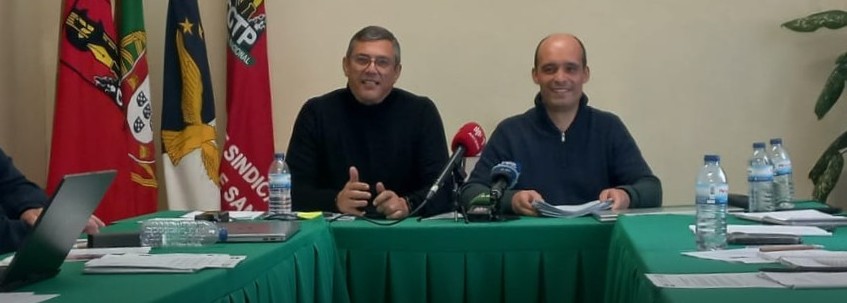
The General Confederation of Portuguese Workers – National Trade Union Confederation (CGTP-IN) in the Azores argues that “the future of the Azores requires the valorization of workers” and calls for a “break” with a regional economic model “based on low wages,” following a meeting of its Coordinating Committee held on Wednesday and formalized in a statement dated November 12, 2025, in Ponta Delgada. In the same document, the union announces the Azores’ participation in the general strike on December 11. The union considers that the social situation in the region is “worsening” and accuses the Government of the Republic of “insensitivity” in the face of the increase in the number of poor workers.
At issue is the package of labor law changes the Executive calls “Work XXI,” described by CGTP-IN/Azores as a “civilizational setback.” Among the criticisms listed are the imposition of a time bank with “two more hours of mandatory work per day,” the “perpetuation” of low wages close to the minimum, the possibility of “unfair dismissals,” “lifetime” fixed-term contracts, an “attack on parental rights,” the ‘weakening’ of collective bargaining, and “limitations” on the right to strike, a set of measures that the organization describes as contrary to workers’ interests. As an alternative, the CGTP-IN/Azores presented the “List of Demands of Azorean Workers for 2026,” focused on “significant and general” wage increases, a reduction to “35 hours of work per week for all,” the “revitalization” of collective bargaining, and combating precariousness, based on the principle that “a permanent job corresponds to a permanent contract.”
The union argues that these measures are crucial to “attract and retain workers in the Azores” and to tackle two structural deficits it identifies in the regional economy: “inequality in the distribution of wealth” and “low added value” in the production chain. At the legislative level, the union calls for the “complete withdrawal” of the government’s labor package, the restoration of the “principle of more favorable treatment for workers,” and the repeal of the expiration of collective bargaining, arguing that these mechanisms “stifle social dialogue” and favor “the stronger side in the labor relationship—the employer.” The regional structure also maintains that the participation of “tens of thousands of workers” in the protests organized by CGTP-IN and its unions demonstrates the demand for “better wages and decent working conditions,” ensuring that “the struggle will not slow down.”
The statement concludes with a call for a general strike on December 11, which “will also be a huge demonstration of unity, determination, and struggle” in the Azores against the labor package and “for a better future.”
in Diário dos Açores-Paulo Viveiros, director
Translated into English as a community outreach program by the Portuguese Beyond Borders Institute (PBBI) and the Modern and Classical Languages and Literatures Department (MCLL), in collaboration with Bruma Publication and ADMA (Azores-Diaspora Media Alliance) at California State University, Fresno. PBBI thanks Luso Financial for sponsoring NOVIDADES.

 Novidades - The Islands and the Diaspora