

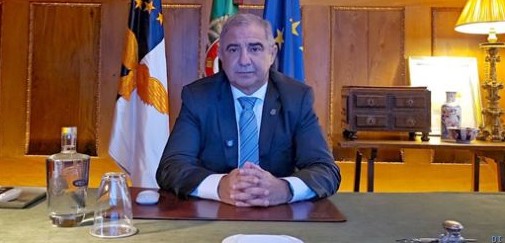
Yesterday, the president of the Regional Government of the Azores, José Manuel Bolieiro, advocated the creation of an “Ibero-American Atlantic Pact,” focused on the shared management of cultural and natural resources.
“One of the great challenges we face will undoubtedly be the implementation of a true ‘Ibero-American Atlantic Pact’, focused on the common governance of our cultural identity and natural resources,” he said.
The head of the Azorean executive was speaking at the opening session of the International Conference on Portuguese and Spanish Languages (CILPE2025 – IV), which this year is being held in Cape Verde and is digital.
At the meeting, which brings together more than 70 experts from 12 countries, José Manuel Bolieiro emphasized the Azores’ commitment to creating an “Ibero-American Atlantic Pact.”
“Due to our unique historical and geographical position as the European region closest to the Americas, the Azores not only have an interest in this process, but are also fully committed and determined to promote it and play an active role in affirming this goal, if that is the desire of all partners,” he stressed.
The head of the Azorean executive highlighted the role of Macaronesia, which includes the Azores, Cape Verde, the Canary Islands, and Madeira, as a “cultural, scientific, and economic bridge between continents.”
“The ocean we share does not separate us; it unites us. And in this network of islands that charts the routes of the Atlantic, the Azores archipelago occupies a truly unique geostrategic position,” he pointed out.
José Manuel Bolieiro emphasized that the Azores are “the European region closest to the Americas,” but noted that this proximity is not “just a geographical fact,” but “a historical, cultural, human, and economic reality that has shaped” the region’s identity.
The president of the Regional Government also argued that the fact that Portuguese and Spanish have 850 million speakers is “an extraordinary asset.”
“Their true value is not only demographic; it is a strategic potential for social cohesion, for the defense of democratic values, for the promotion of a global and inclusive citizenship, which recalls and cultivates the historical legacy of cosmopolitanism, inclusive universalism, and multiculturalism,” he stressed.

José Manuel Bolieiro considered that cooperation between Portuguese- and Spanish-speaking countries can help overcome challenges such as Artificial Intelligence, sustainable development, and civilizational setbacks, “full of unacceptable phobias.”
“The effective consolidation of our common space will transcend the ‘community of affections’ that we already are, reaching the level of a cohesive and strategic community in the general influences of the global scenario. The Atlantic Ocean is the geo-economic and geo-strategic axis that unites us. Its sustainable management, which we monitor, will make it safer and more sustainable. We must make this a mobilizing imperative for our cohesion,” he stressed.
Promoted by the Organization of Ibero-American States for Education, Science, and Culture (OEI), the IV International Conference on the Portuguese and Spanish Languages brings together more than 70 experts from 12 countries, who, over several days, will discuss the role of the Portuguese and Spanish languages in the contemporary world, as well as the valorization of indigenous languages and cultural diversity.
After three editions held in Latin American countries, the conference arrives on the African continent for the first time.
Among the personalities present at the program are figures such as Cardinal José Tolentino de Mendonça, academic Darío Villanueva, a member of the Royal Spanish Academy, and former President of the Republic of Cape Verde, Jorge Carlos Fonseca, along with researchers and policy makers from across the Ibero-American community.
In Diário Insular, José Lourenço-director
Translated into English as a community outreach program by the Portuguese Beyond Borders Institute (PBBI) and the Modern and Classical Languages and Literatures Department (MCLL), in collaboration with Bruma Publication and ADMA (Azores-Diaspora Media Alliance) at California State University, Fresno. PBBI thanks Luso Financial for sponsoring NOVIDADES.

 Novidades - The Islands and the Diaspora